Geostationary Orbits (Cambridge International A-Level Physics)
Exam board Cambridge International · A-LevelUpdated 2026-07-02
Geostationary orbits
-
Many communication satellites around Earth follow a geostationary orbit
-
This is a specific type of orbit in which the satellite:
- Remains directly above the equator, therefore, it always orbits at the same point above the Earth’s surface
- Moves from west to east (same direction as the Earth spins)
- Has an orbital time period equal to Earth’s rotational period of 24 hours
-
Geostationary satellites are used for telecommunication transmissions (e.g. radio) and television broadcast
-
A base station on Earth sends the TV signal up to the satellite where it is amplified and broadcast back to the ground to the desired locations
-
The satellite receiver dishes on the Earth's surface must point towards the same point in the sky
- Since the geostationary orbits of the satellites are fixed, the receiver dishes can be fixed too
Geostationary satellite in orbit
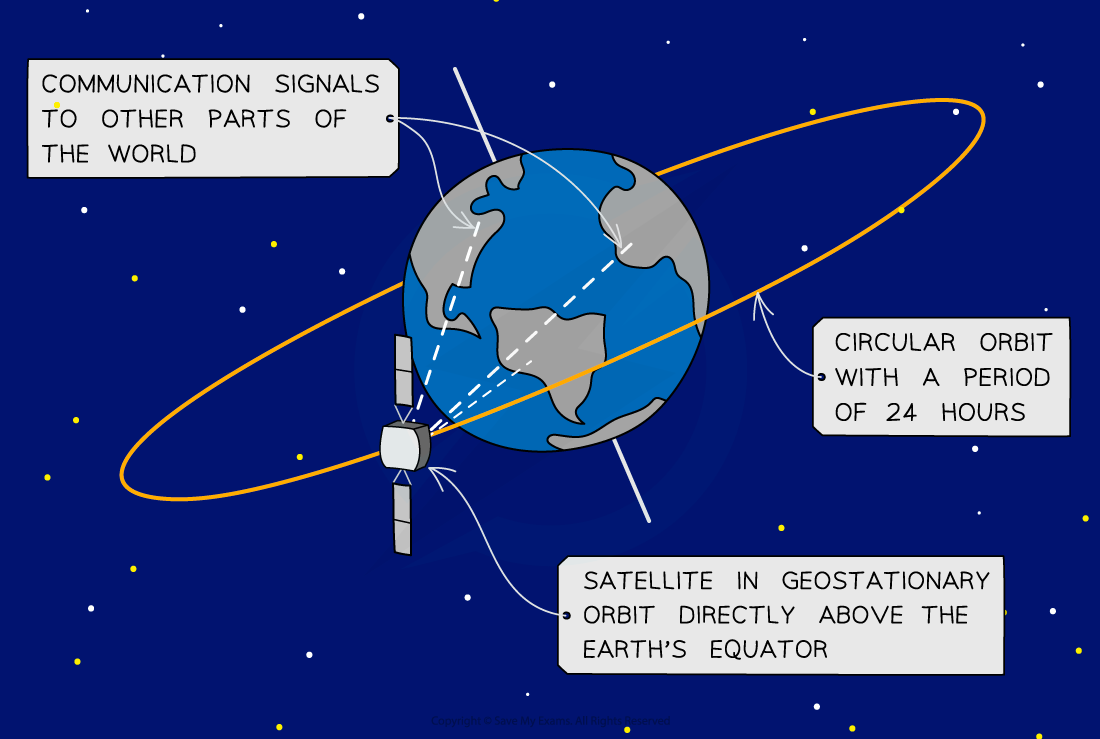
Satellite in geostationary orbit remain directly above the equator, and a circular orbit equal to that of the Earth
Was this revision note helpful?
Build on this topic