Capacitor Discharge Equations (Cambridge International A-Level Physics)
The Time Constant
Spec point —
19.3.2
- The time constant of a capacitor discharging through a resistor is a measure of how long it takes for the capacitor to discharge
- The time constant is defined as:
The time taken for the charge, current or voltage of a discharging capacitor to decrease to 37% of its original value
-
This is represented by the Greek letter tau () and measured in units of seconds(s)
- It is a useful way of comparing the rate of change of similar quantities e.g. charge, current or p.d.
-
The time constant is defined by the equation:
= RC
-
Where:
- = time constant (s)
- R = resistance of the resistor (Ω)
- C = capacitance of the capacitor (F)
-
For example, to find the time constant from a voltage-time graph, calculate 0.37V0 and determine the corresponding time for that value
Time constant on a capacitor discharge graph
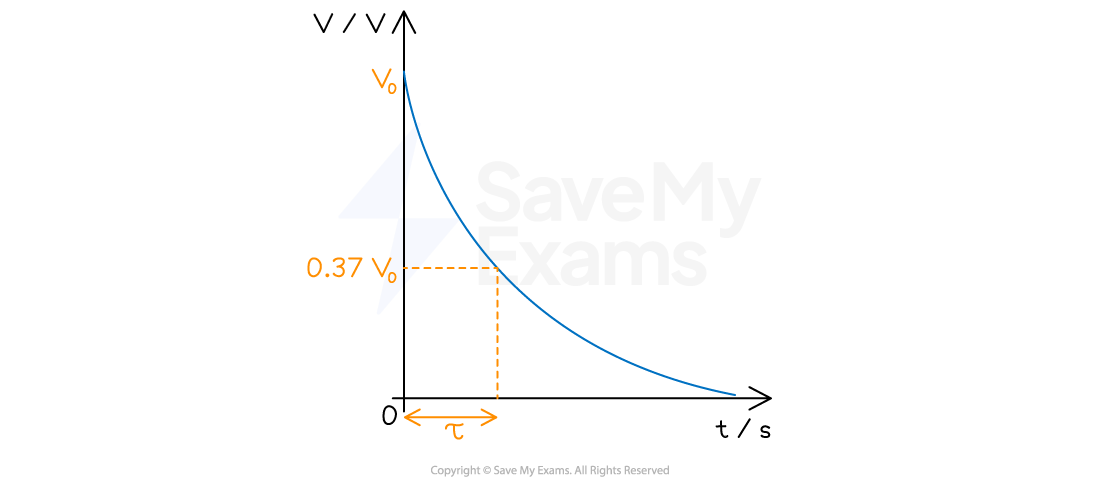
The time constant shown on a discharging capacitor for potential difference
Worked Example A capacitor of 7 nF is discharged through a resistor of resistance R. The time constant of the discharge is 5.6 × 10⁻³ s.
Calculate the value of R.
Answer:
Step 1: Write out the known quantities
- Capacitance, C = 7 nF = 7 × 10⁻⁹ F
- Time constant, = 5.6 × 10⁻³ s
Step 2: Write down the time constant equation
= RC
Step 3: Rearrange for resistance R
Step 4: Substitute in values and calculate R
Using the Capacitor Discharge Equation
-
The time constant is used in the exponential decay equations for the current, charge or potential difference (p.d.) for a capacitor discharging through a resistor
- These can be used to determine the amount of current, charge or p.d. left after a certain amount of time when a capacitor is discharging
-
All capacitor discharge equations are of the form:
-
Where:
- X = current, charge or potential difference
- X0 = initial current, charge or potential difference before discharge
- e = the exponential function
- t = time (s)
- RC = resistance (Ω) × capacitance (F) = the time constant (s)
-
This equation shows that
- the greater the time constant , the slower the current, charge or p.d. falls during discharge
- the greater the initial current, charge or p.d., the greater the initial rate of discharge, but the time taken to fall to a given fraction of X0 depends only on the time constant RC
-
The current at any time is directly proportional to the p.d across the capacitor and the charge across the parallel plates
-
The exponential decay of current on a discharging capacitor is defined by the equation:
-
Where:
- I = current (A)
- I0 = initial current before discharge (A)
-
The equation for the exponential decay of charge on a discharging capacitor is defined by the equation:
-
Where:
- Q = charge on the capacitor plates (C)
- Q0 = initial charge on the capacitor plates (C)
-
The equation for the exponential decay of p.d. on a discharging capacitor is defined by the equation:
-
Where:
- V = potential difference on the capacitor plates (V)
- V0 = initial potential difference on the capacitor plates (V)
The exponential function
-
The symbol e represents the exponential constant, a number which is approximately equal to e = 2.718...
- On a calculator, it is shown by the button ex
-
The inverse function of ex is ln(y), known as the natural logarithmic function
- This is because, if ex* *= y, then x = ln(y)
-
The 0.37 in the definition of the time constant arises as a result of the exponential constant, the true definition is:
The time taken for the charge of a capacitor to decrease toof its original value
- Where = 0.3679
Worked Example The initial current through a circuit with a capacitor of 620 μF is 0.6 A. The capacitor is connected across the terminals of a 450 Ω resistor.
Calculate the time taken for the current to fall to 0.4 A.
Answer:
Step 1: Write out the known quantities
- Initial current before discharge, I0 = 0.6 A
- Current, I = 0.4 A
- Resistance, R = 450 Ω
- Capacitance, C = 620 μF = 620 × 10-6 F
Step 2: Write down the equation for the exponential decay of current
Step 3: Calculate the time constant
= RC
= 450 × (620 × 10-6) = 0.279 s
Step 4: Substitute into the current equation
Step 5: Rearrange for the time t
- The exponential can be removed by taking the natural log of both sides:
Exam Hint Make sure you’re confident in rearranging equations with natural logs (ln) and the exponential function (e). To refresh your knowledge of this, have a look at the AS Maths revision notes on Exponentials & Logarithms
Was this revision note helpful?
Build on this topic