Cathode-Ray Oscilloscope (Cambridge International A-Level Physics)
Spec point —
7.1.3
Cathode-ray oscilloscope
-
A cathode-ray oscilloscope is a laboratory instrument used to display, measure and analyse waveforms of electrical circuits
-
An a.c. current on an oscilloscope is represented as a transverse wave
- The oscilloscope can be used to determine its frequency and amplitude
-
A d.c voltage on an oscilloscope is represented as a horizontal line at the relevant voltage
-
The x-axis is the time and the y-axis is the voltage (or y-gain)
Cathode-ray oscilloscope display
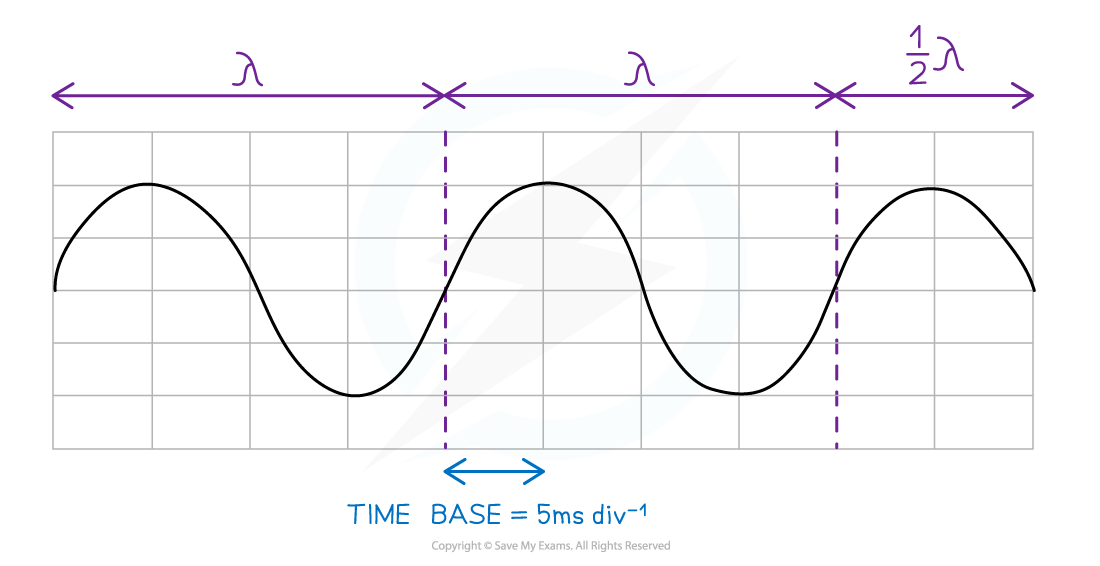
Diagram of cathode-ray oscilloscope display showing wavelength and time-base setting
-
The period of the wave can be determined from the time-base
- Time-base is how many seconds each division represents measured commonly in s div-1****or s cm-1
-
Count the number of wavelengths shown on the screen
-
Divide the total time by the number of wavelengths to obtain the time period T
-
Calculate the frequency of the wave using
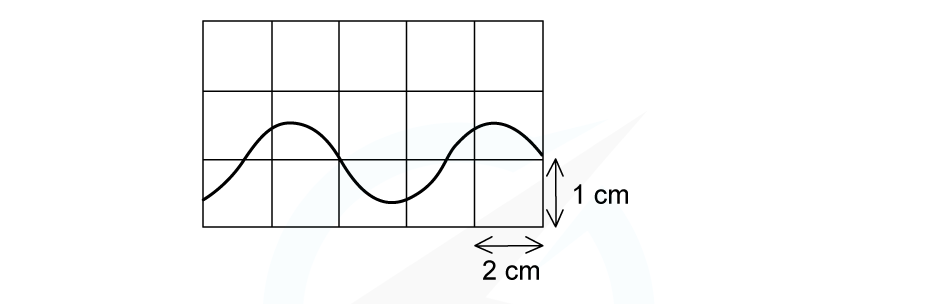
Worked Example A cathode-ray oscilloscope (c.r.o.) is used to display the trace from a sound wave. The time-base is set at 7 µs mm-1.
What is the frequency of the sound wave?
A. 2.4 Hz
B. 24 Hz
C. 2.4 kHz
D. 24 kHz
Answer: C
Step 1: Determine the period of the wave:
One full wave covers three horizontal squares, which is a distance of 6 cm
There are 60 mm in 6 cm
- Each mm represents a time of 7 μs
- Time period, T = 60 × (7 × 10−6) = 4.2 × 10⁻⁴ s
Step 2: Use the frequency equation to determine frequency:
- Recall the frequency equation
- Recall that 1000 Hz = 1 kHz and the answer must be given to 2 significant figures
Exam Hint The time-base setting varies with units for seconds (commonly ms) and the unit length (commonly mm). Unit conversions are very important for the calculation of the time period and frequency
Was this revision note helpful?
Build on this topic