11 markmedium
Which row shows what all physical quantities must have?
| magnitude | direction | unit | |
|---|---|---|---|
| A | ✗ | ✗ | ✓ |
| B | ✓ | ✗ | ✓ |
| C | ✓ | ✓ | ✗ |
| D | ✓ | ✓ | ✓ |
Choose your answer
36 questions · 89 marks · ≈ 1 hour · spans 36 of 108 topics
Assembled from the topic question banks — not an official Cambridge International paperWhich row shows what all physical quantities must have?
| magnitude | direction | unit | |
|---|---|---|---|
| A | ✗ | ✗ | ✓ |
| B | ✓ | ✗ | ✓ |
| C | ✓ | ✓ | ✗ |
| D | ✓ | ✓ | ✓ |
Choose your answer
When a constant braking force is applied to a vehicle moving at speed v, the distance d moved by the vehicle as it comes to rest is given by the expression
where* k* is a constant.
When d is measured in metres and v is measured in metres per second, the constant has a value of k1.
What is the value of the constant k when the distance is measured in metres, and the speed is measured in kilometres per hour?
Choose your answer
A metre rule is used to measure the length of a piece of wire. It is found to be 70 cm long to the nearest millimetre.
How should this result be recorded in a table of results?
Choose your answer
0.7 m
0.70 m
0.700 m
0.7000 m
A ball is thrown upwards with an initial vertical velocity of 2.2 m s–1.
What is the maximum height reached by the ball?
Choose your answer
10 cm
25 cm
50 cm
75 cm
A car is travelling at constant velocity on a straight road.
Which row gives the correct Newton's third law force pair?
| Force A | Force B | |
|---|---|---|
| A. | Driving force from engine | Air resistance on the car |
| B. | Weight of the car | Normal reaction from the road |
| C. | Driving force from wheels on road | Friction force from air on car |
| D. | Weight of the car | Gravitational force of the car on the Earth |
Choose your answer
A skydiver falls vertically from a stationary balloon.
She leaves the balloon at time . At time , she reaches terminal velocity. Beyond the time shown in the graphs, she opens her parachute
Which graph shows the variation with time of the force due to air resistance?
Choose your answer
Two train carriages each of mass 7500 kg roll toward one another on a level track. One is travelling at 3.00 m s−1 and the other at 1.50 m s−1 as shown.
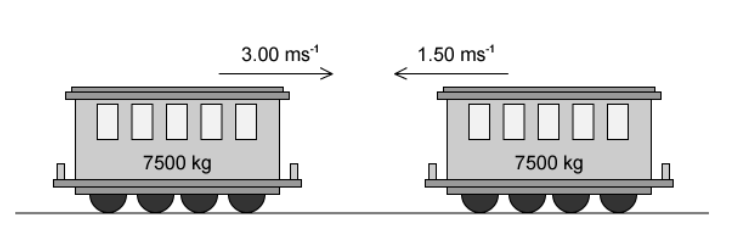
They collide and join together.
What is the kinetic energy lost during the collision?
Choose your answer
4200 J
7500 J
11 250 J
38 000 J
A car wheel nut can be loosened by applying a force of 310 N to the end of a bar of length 0.7 m, as in X. A car mechanic is capable of applying forces of 650 N simultaneously in opposite directions on the ends of a wheel wrench, as in Y.
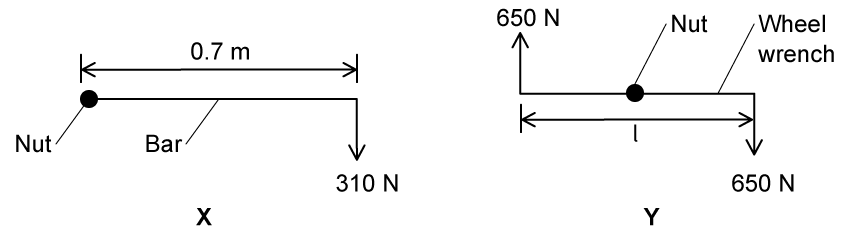
What is the minimum length of the wrench needed for the mechanic to loosen the nut?
Choose your answer
1.5 m3 of water is mixed with 0.50 m3 of alcohol. The density of water is 1000 kg m–3 and the density of alcohol is 800 kg m–3
What is the density of the mixture with volume 2.0 m3 ?
Choose your answer
850 kg m–3
900 kg m–3
940 kg m–3
950 kg m–3
Two blocks, P and Q, are initially stationary and connected by a taut string passing over a smooth pulley, as shown. The system is released from rest. Block Q moves vertically downwards from position A to B. Block P moves up the rough surface of the slope, as shown.
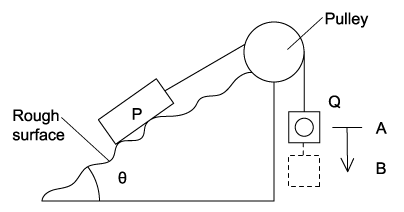
Which equation correctly describes the energy changes for the system?
Choose your answer
Loss in potential energy of Q = Gain in kinetic energy of Q + Work done against friction
Loss in potential energy of system = Gain in kinetic energy of system + Work done against friction
Loss in potential energy of system = Gain in kinetic energy of system
Loss in potential energy of Q = Gain in potential energy of P + Gain in kinetic energy of system
The diagram shows two identical vessels X and Y connected by a short pipe with a tap.
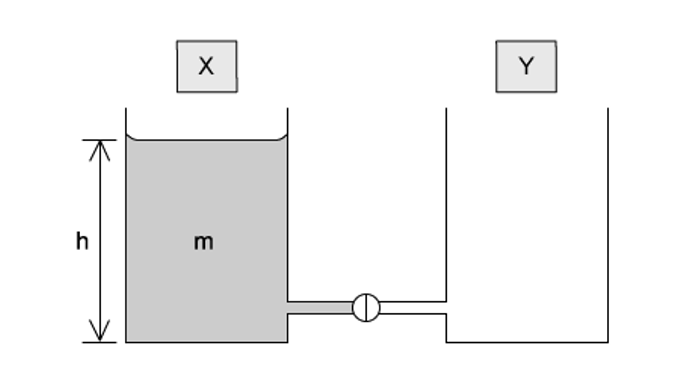
Initially, X is filled with water of mass m to a depth h, and Y is empty.
When the tap is opened, water flows from X to Y until the depths of water in both vessels are equal.
How much potential energy is lost by the water during this process? (g = acceleration of free fall)
Choose your answer
0
A steel bar, shown in the diagram, has a circular cross-section that is under tension T.
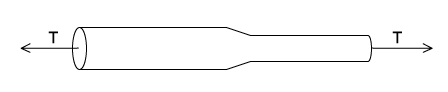
The diameter of the thinner portion is half the wider portion.
What is the value of ?
Choose your answer
4.0
2.0
0.50
0.25
The graphs below are force-extension graphs, which one is a rubber band this is stretched almost to its breaking point ?
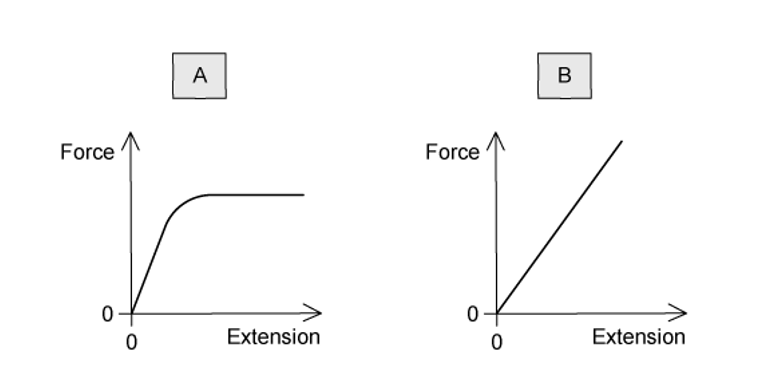
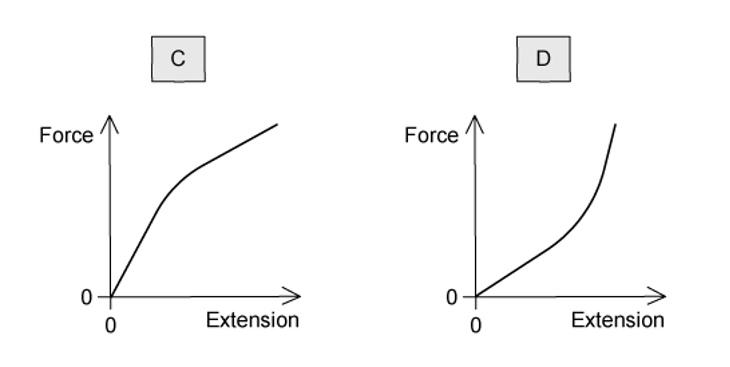
Choose your answer
The vertical cross-section diagram shows a water wave moving from left to right.
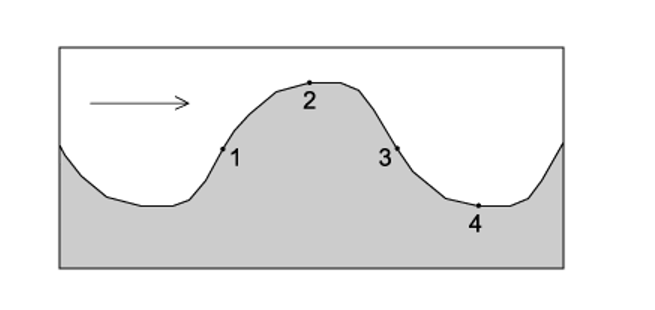
Which points on the diagram show the water moving upwards with maximum speed?
Choose your answer
1 and 3
3 only
1 and 4
4 only
The graph shows two waves P and Q.
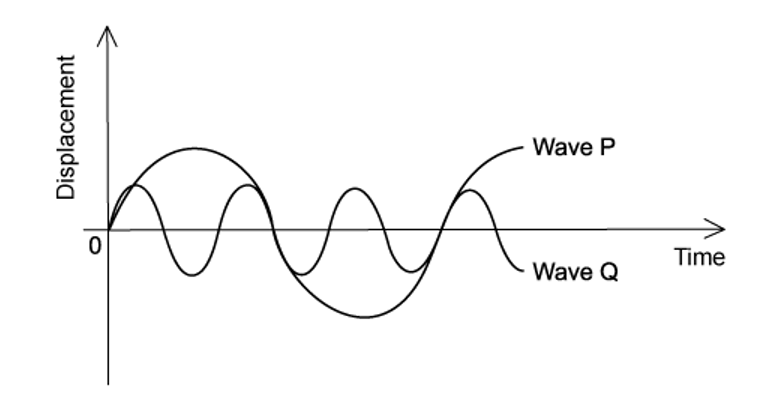
Wave P has an amplitude of 8 cm and a frequency 100 Hz.
What is the amplitude and the frequency of wave Q?
| Amplitude / cm | Frequency / Hz | |
|---|---|---|
| A B C D | 4 4 2 2 | 300 33 300 33 |
Choose your answer
A source moves directly in line with an observer at a constant velocity vs and emits a sound wave with a wavelength of λs. The observed wavelength of the source is λ0 and the ratio is equal to .
What is the value of vs?
Speed of sound, v = 340 m s-1
Choose your answer
68.0 m s-1
85.0 m s-1
612 m s-1
765 m s-1
Two lasers are set up to pass through a vacuum. One laser emits red light; the other emits green light.
Which property of the two lasers are different?
Choose your answer
speed
plane of polarisation
frequency
amplitude
Unpolarised light of intensity I0 is incident on a polariser with a vertical transmission axis. The transmitted light is incident on a sheet of material X. After transmission through X the intensity of light is .
It is suggested that X could be
| 1 | a polariser with a vertical transmission axis |
|---|---|
| 2 | a polariser with a horizontal transmission axis |
| 3 | non-polarising glass |
Choose your answer
1 & 2
2 & 3
1 & 3
3 only
A standing wave is formed in a closed pipe. The distance between the first node and the ninth node is 18.0 cm.
What is the wavelength of the wave?
Choose your answer
4.5 cm
9.0 cm
12.0 cm
24.0 cm
A 5 cm cube casts a shadow when a torch is shone from behind it. When a speaker is placed behind it emitting sound of a frequency 4000 Hz, the sound can still be detected behind the cube.
Which of the following statements explain this observation?
Choose your answer
Light travels faster than sound
Light is a transverse wave and sound is longitudinal
Light waves have shorter wavelengths than sound waves
Light waves are electromagnetic and sound waves are compression waves
A student investigates the interference of light using two identical green LEDs.
Which statement would explain why the investigation will not work?
Choose your answer
the light waves from the sources have a range of wavelengths
the light waves from the sources are not monochromatic
the light waves from the sources are not coherent
the light waves from the sources do not have the same amplitude
A student set up an experiment with a diffraction grating. They put a narrow beam of monochromatic light incident along the normal. They found that the third-order diffracted beams are formed at angles of 45° to the original direction.
Which of the following gives the highest order of diffracted beam produced by this grating ?
Choose your answer
6th
5th
4th
3rd
A milliammeter shows a reading of 20 mA.
How many electrons flow through the milliammeter in 10 seconds?
Choose your answer
0.20
3.2 × 10²⁰
200
1.3 × 10¹⁸
A power cable X has resistance R and carries current .
A second cable Y has resistance 2R and carries current
What is the ratio ?
Choose your answer
2
4
Two heating coils X and Y, of resistance RX and RY respectively, deliver the same power when 12 V is applied across X and 6 V is applied across Y.
What is the ratio ?
Choose your answer
2
4
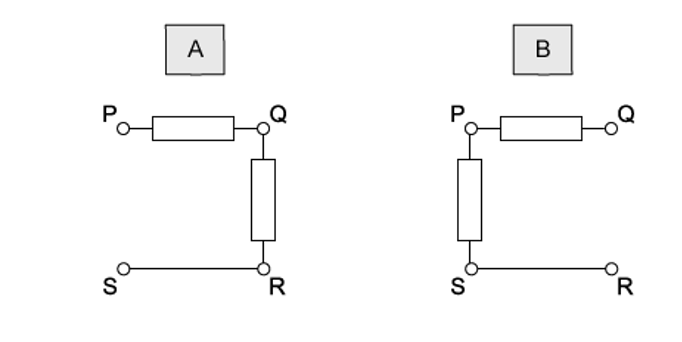
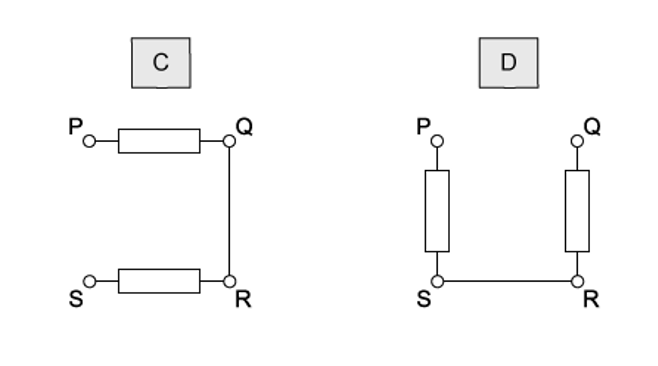
A box with four terminals P, Q, R and S contains two identical resistors.
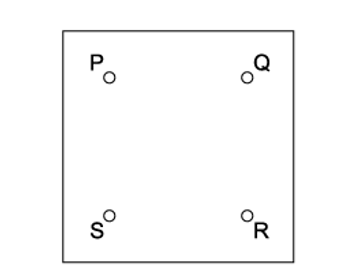
When a battery of electromotive force (e .m. f.) E and negligible internal resistance is connected across PS, a high-resistance voltmeter connected across QR reads
Which diagram shows the correct arrangement of the two resistors inside the box ?
Choose your answer
A cell, two resistors of equal resistance and an ammeter are used to construct four circuits. The resistors are the only parts of the circuits that have resistance.
In which circuit will the ammeter show the greatest reading ?
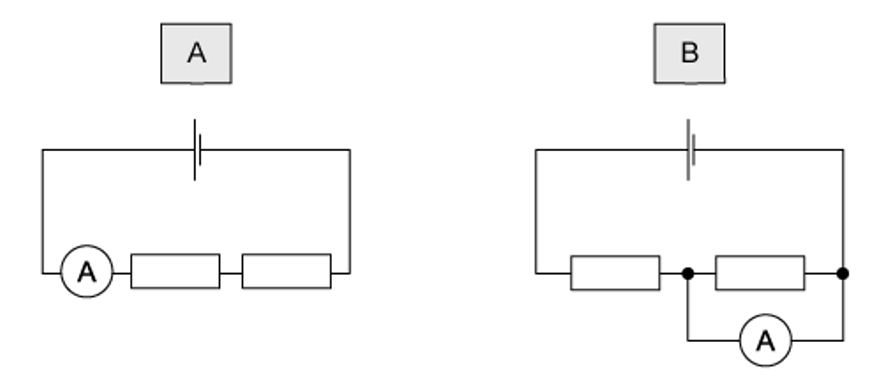
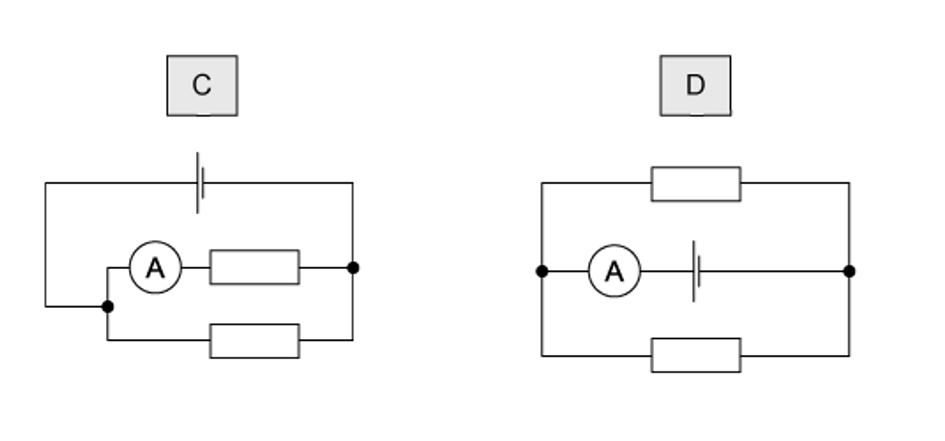
Choose your answer
A potential divider consists of a fixed resistor R and a light-dependent resistor (LDR)
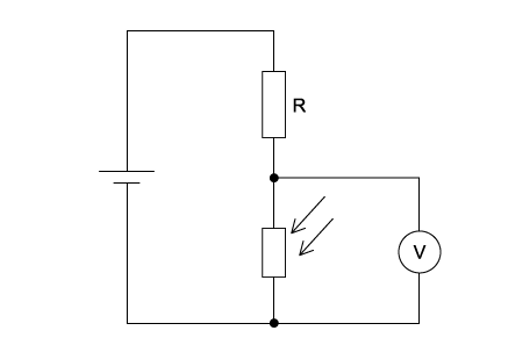
What happens to the voltmeter reading, and why does it happen, when the intensity of light on the LDR increases?
Choose your answer
The voltmeter reading decreases because the LDR resistance decreases
The voltmeter reading decreases because the LDR resistance increases
The voltmeter reading increases because the LDR resistance decreases
the voltmeter reading increases because the LDR resistance increases
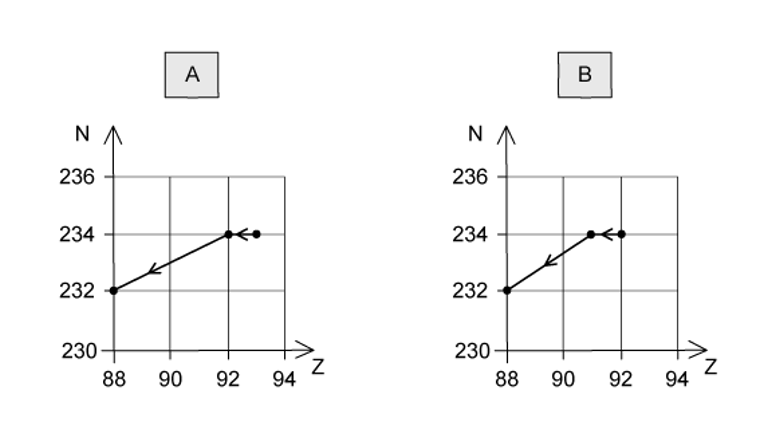
A radioactive nucleus is formed by β-decay. This nucleus then decays by α-emission.
The graphs below show the nucleon number N plotted against proton number Z. Which one shows the β-decay followed by the α-emission?
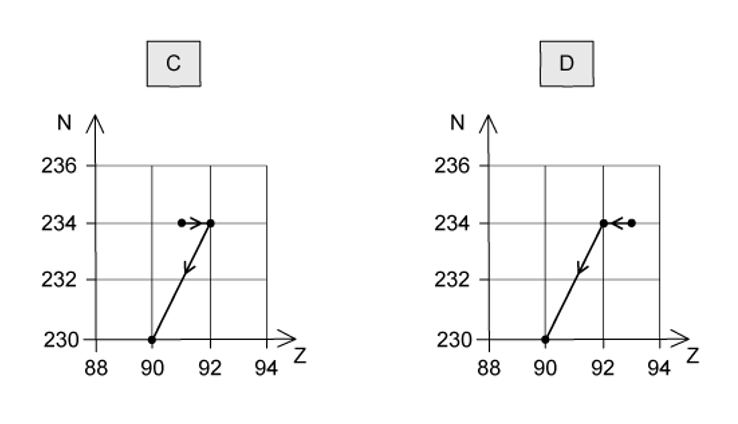
Choose your answer
Which of the following sentences about antimatter is incorrect?
Choose your answer
antimatter is normal matter with an opposite charge
antimatter is only produced in particle accelerators
antimatter destroys matter
equal amounts of antimatter and matter were created during the Big Bang
Explain why one complete revolution is equivalent to an angular displacement of 2π rad.
A particle following a circular path is observed to have an angular displacement of 0.22 rad.
Express this angle in degrees (°). Show your working and give your answer to an appropriate number of significant figures.
Extract:
A particle following a circular path is observed to have an angular displacement of 0.22 rad. Express this angle in degrees (°). θ(degrees) = θ(rad) × (180/π); θ° = 0.22 × (180/π) = 12.605°
Calculate the percentage error that is made when the angle 0.22 rad, as measured in degrees (θ°), is assumed to be equal to tan(θ°) to four significant figures. Give your final answer to two significant figures.
Extract:
A particle following a circular path is observed to have an angular displacement of 0.22 rad.
The particle travels the angle in part (b) in 60 ms.
Calculate the frequency of the particle.
A satellite orbits the Earth, as shown in Fig. 1.1. It remains in orbit due to the gravitational field of the Earth.
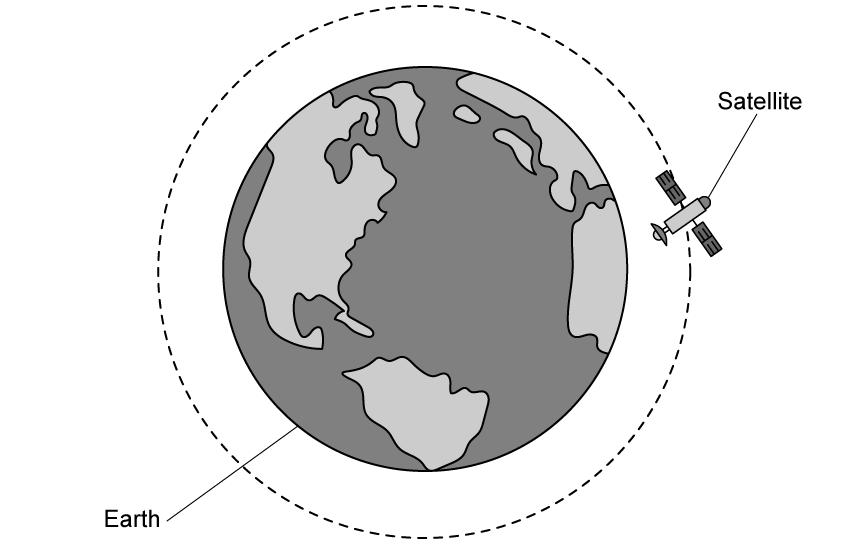
Fig. 1.1
It takes the satellite 200 minutes to complete one full revolution around the Earth. The mass of the Earth is 6.0 × 1024 kg and the radius of the Earth is 6400 km.
Show that the distance of the satellite from the surface of the Earth is approximately 5000 km.
Extract:
A satellite orbits the Earth, as shown in Fig. 1.1. It remains in orbit due to the gravitational field of the Earth. It takes the satellite 200 minutes to complete one full revolution around the Earth. The mass of the Earth is 6.0 × 10^24 kg and the radius of the Earth is 6400 km. Show that the distance of the satellite from the surface of the Earth is approximately 5000 km. From the mark scheme: r = 11 343 836 m = 11.343 × 10^6 m; Period T = 200 minutes = 12 000 s.
Calculate the acceleration due to the Earth's gravity of the satellite at its orbiting altitude from part a).
Extract:
Calculate the angular speed of the satellite, ω: ω = 2π/T = 2π/12 000 = 5.24 × 10^−4^ rad s^−1^
The satellite crashes into the surface of the Earth and becomes embedded in the ground.
Determine a ratio for the angular speed of the satellite on the surface of the Earth and the angular speed of the satellite when it was in orbit in part a). Explain your answer.
Scientists want to put a satellite in orbit around planet Venus.
Justify how Newton's law of gravitation can be applied to a satellite orbiting Venus, when neither the satellite, nor the planet are point masses.
The satellite's orbital time, T, and its orbital radius, R, are linked by the equation:
T2 = kR3
Venus has a mass of 4.9 × 1024 kg.
Determine the value of the constant k, and give the units in SI base units.
Extract:
Scientists want to put a satellite in orbit around planet Venus.
The satellite's orbital time, T, and its orbital radius, R, are linked by the equation: T^2 = kR^3
Venus has a mass of 4.9 × 10^24 kg.
k = 1.21 × 10^−13 (with units s^2 m^−3)
One day on Venus is equal to 116 Earth days and 18 Earth hours.
Determine the orbital speed of the satellite in m s−1.
Extract:
R = 9.44 × 10^8^ m
The gravitational potential energy between the satellite and Venus is −2.08 × 10⁸ J.
Calculate the magnitude of the gravitational force keeping the satellite in orbit. Explain your answer.
The gravitational field strength on the surface of a particular moon is 3.2 N kg–1. The moon orbits a planet of similar density, but the diameter of the planet is 2.6 times greater than the moon.
Calculate the gravitational field strength at the surface of the planet when the effect of each body on the other is negligible.
Extract:
The gravitational field strength on the surface of a particular moon is 3.2 N kg^–1^. The moon orbits a planet of similar density, but the diameter of the planet is 2.6 times greater than the moon.
Fig. 1.1 shows a graph with a horizontal axis representing the distance from the centre of a celestial body in terms of the moon's radius rm.
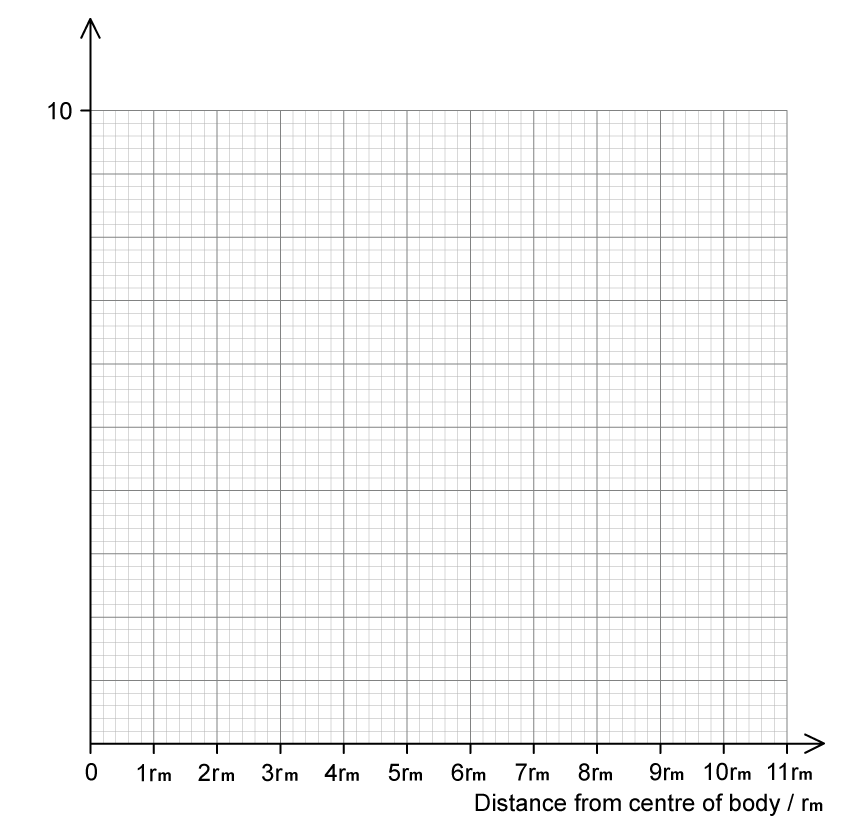
Fig. 1.1
Complete and label the vertical axis values and sketch the graph to show gravitational field strength against distance from the centre for the moon in part a) in Fig. 1.1.
Extract:
The gravitational field strength on the surface of a particular moon is 3.2 N kg^–1. The moon orbits a planet of similar density, but the diameter of the planet is 2.6 times greater than the moon. Calculate the gravitational field strength at the surface of the planet... g_p = 2.6 × 3.2 = 8.32 N kg^–1
Fig. 1.1 shows a graph with a horizontal axis representing the distance from the centre of a celestial body in terms of the moon's radius r_m. Fig. 1.1. Complete and label the vertical axis values and sketch the graph to show gravitational field strength against distance from the centre for the moon in part a) in Fig. 1.1.
Sketch the graph of gravitational field strength against distance from the centre of the planet on Fig. 1.1.
Extract:
The gravitational field strength on the surface of a particular moon is 3.2 N kg^–1^. The moon orbits a planet of similar density, but the diameter of the planet is 2.6 times greater than the moon.
Fig. 1.2 shows the relative positions of the planet P and the moon m.

Fig. 1.2
Find a ratio of the distance from the neutral point to the planet's centre and the distance from the neutral point to the moon's centre.
A space shuttle of mass 3 × 10⁶ kg is travelling from the moon back to Earth. It accelerates uniformly from launch at 2.3 m s−2. It has enough propellant to provide thrust for the first 155 seconds.
The mass of the moon is 7.35 × 10²² kg and the mean radius is 1740 km.
Calculate the work done by the rocket during the first 155 seconds after launch. State any assumptions you have made.
Extract:
The mass of the moon is 7.35 × 10^22 kg and the mean radius is 1740 km. Gravitational constant, G = 6.67 × 10^−11 N m^2 kg^−2
The Moon has a radius of approximately 27% that of the Earth, and a mass of 1.3% that of the Earth.
Show that the gravitational potential at the surface of the Earth is about 21 times greater than the gravitational potential at the surface of the moon.
Explain, using thermal energy transfer, why blowing on a hot coffee cools it down faster.
Fig 1.1 shows the cooling curve for a hot cup of coffee left standing in a room.
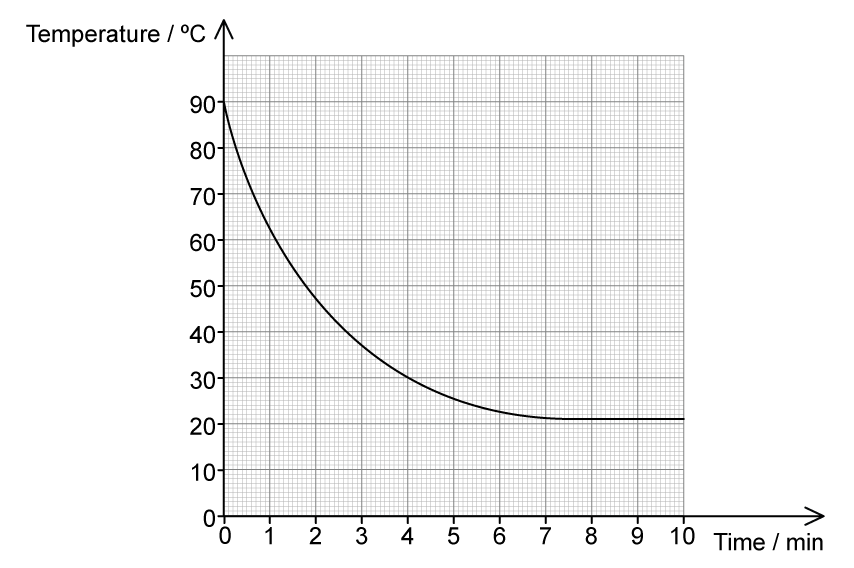
Fig 1.1
(i) Determine the temperature of the room.
(1 mark)
(ii) Sketch on Fig 1.1 the curve for when the coffee is blown on.
(2 marks)
A student states that the temperature of the coffee measures the amount of thermal energy, or heat, in it.
Suggest whether this statement is correct. Explain your reasoning using two observations.