11 markeasy
What is a reasonable estimate of the number of seconds in a year?
Choose your answer
5 × 10⁵ s
1 × 10⁶ s
3 × 10⁷ s
7 × 10⁸ s
36 questions · 72 marks · ≈ 72 min · spans 36 of 108 topics
Assembled from the topic question banks — not an official Cambridge International paperWhat is a reasonable estimate of the number of seconds in a year?
Choose your answer
5 × 10⁵ s
1 × 10⁶ s
3 × 10⁷ s
7 × 10⁸ s
The current through a semiconductor diode is given by:
where is the initial current, is the charge of an electron, is the applied potential difference, is the temperature, and is a constant.
What is the unit of * *when expressed in SI base units?
Choose your answer
kg m2 s−2 K−1
kg m2 s−4 K−1
kg−1 m−2 s2 K
kg−1 m−2 s4 K
A steel wire is stretched in an experiment to determine the Young modulus for steel.
The uncertainties in the measurements are given below.
| Measurement | Uncertainty |
|---|---|
| load on wire length of wire diameter of wire extension | ±2% ±0.2% ±1.5% ±1% |
What is the percentage uncertainty in the Young modulus?
Choose your answer
1.3%
1.8%
4.7%
6.2%
A glider is descending at a constant speed at an angle of 15° to the horizontal. The diagram shows the directions of the lift L, air resistance R and weight W acting on the glider.
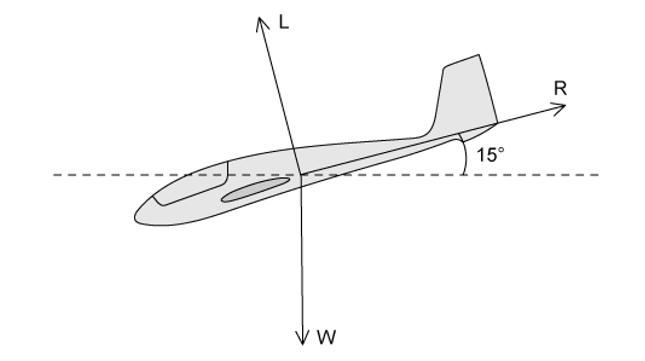
Which vector triangle could represent the forces acting on the glider?
Choose your answer
A sprinter runs a 200m race in a straight line. He accelerates from the starting block at a constant acceleration of 2.5 m s–2 to reach his maximum speed of 10 m s–1. He maintains this speed until he crosses the finish line.
Which time does it take the sprinter to run the race?
Choose your answer
8 s
20 s
22 s
40 s
Two blocks X and Y, of masses m and 4 m respectively, are accelerated along a smooth horizontal surface by a force F applied to block X as shown
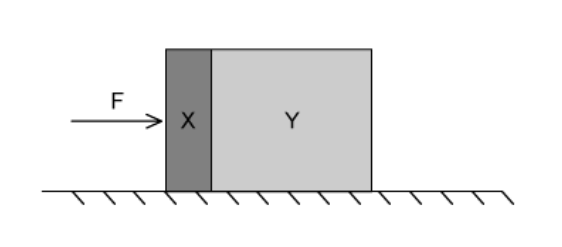
What is the magnitude of the force exerted on block Y by block X during this acceleration?
Choose your answer
A skydiver has a weight of 800 N, and experiences a drag force of 450 N.
What is the magnitude and direction of the resultant force of the skydiver?
| Magnitude / N | Direction | |
|---|---|---|
| A | 1250 | Downwards |
| B | 350 | Upwards |
| C | 1250 | Upwards |
| D | 350 | Downwards |
Choose your answer
A molecule of mass m travelling at speed v hits a wall in a direction perpendicular to the wall. The collision is elastic.
What are the changes in the momentum and in the kinetic energy of the molecule caused by the collision?
| Change in momentum | Change in kinetic energy | |
|---|---|---|
| A B C D | 0 mv mv2 2mv | 0 mv2 0 0 |
Choose your answer
Two parallel forces, each of magnitude F, act on a body as shown
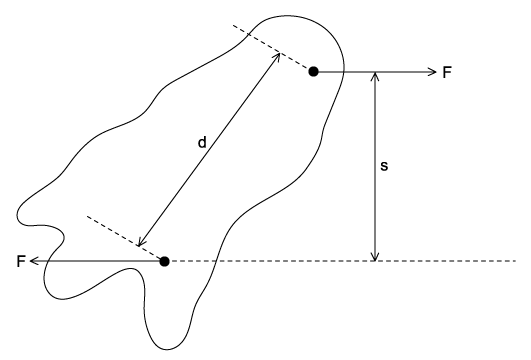
What is the magnitude of the torque on the body produced by this couple?
Choose your answer
Fd
Fs
2 Fd
2Fs
The diagram shows two fixed pins, Y and Z. A length of elastic is stretched between Y and Z and around pin X, which is attached to a trolley.
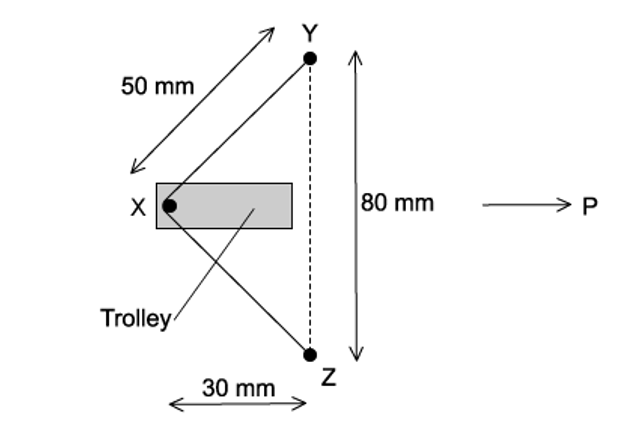
X is at the centre of the elastic and the trolley is to be propelled in the direction P at right angles to YZ. The tension in the elastic is 4 N.
What is the force accelerating the trolley in the direction P when the trolley is released?
Choose your answer
2.4 N
3.2 N
4.8 N
6.4 N
A beam of α-particles collides with a lead sheet. Each α-particle in the beam has a mass of 6.6 × 10⁻²⁷ kg and a speed of 1.5 × 10⁷ m s–1
5.0 × 10⁴ α-particles per second collide with an area of 1.0 cm2 of lead. Almost all of the α-particles are absorbed by the lead so that they have zero speed after collision.
What is an estimate of the average pressure exerted on the lead by the α-particles?
Choose your answer
5.0 × 10⁻¹⁵ Pa
5.0 × 10⁻¹³ Pa
5.0 × 10⁻¹¹ Pa
5.0 × 10⁻⁹ Pa
The diagram shows the design of a water wheel which drives a generator to produce electrical energy. The flow rate of the water is 200 kg s–1. The generator supplies a current of 32 A at a voltage of 230 V.
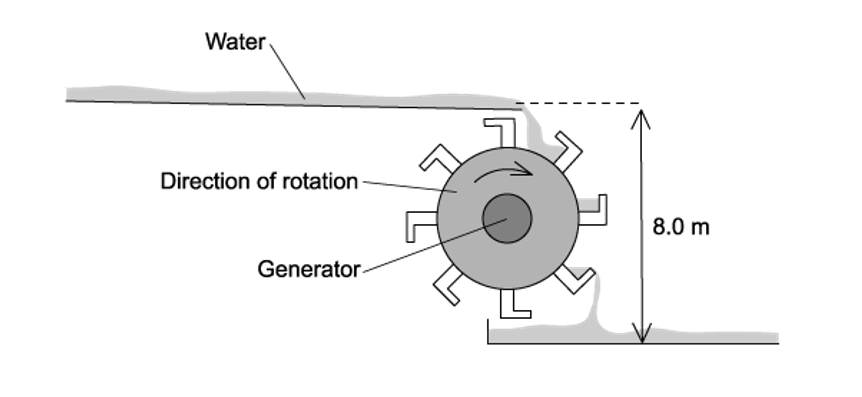
Ignoring any changes in kinetic energy of the water, what is the efficiency of the system?
Choose your answer
14 %
16 %
22 %
47 %
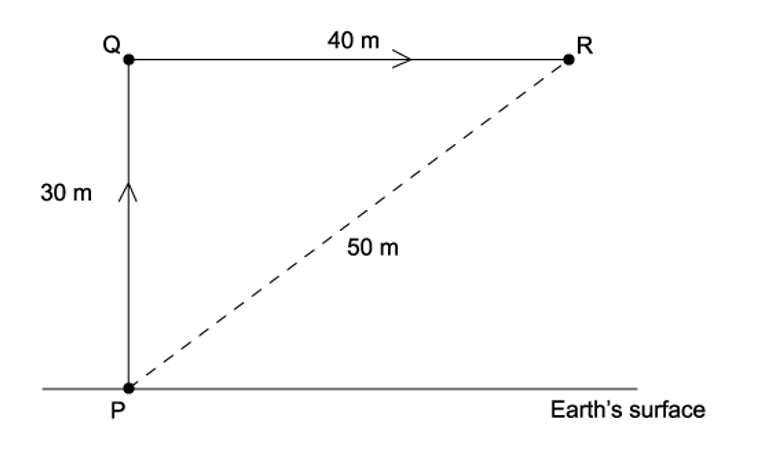
A stone of weight 4.0 N in the Earth’s gravitational field is moved from P to Q and then to R along the path shown.
How much potential energy does the stone gain?
Choose your answer
120 J
200 J
280 J
1200 J
The stress-strain graph for bone is shown below.
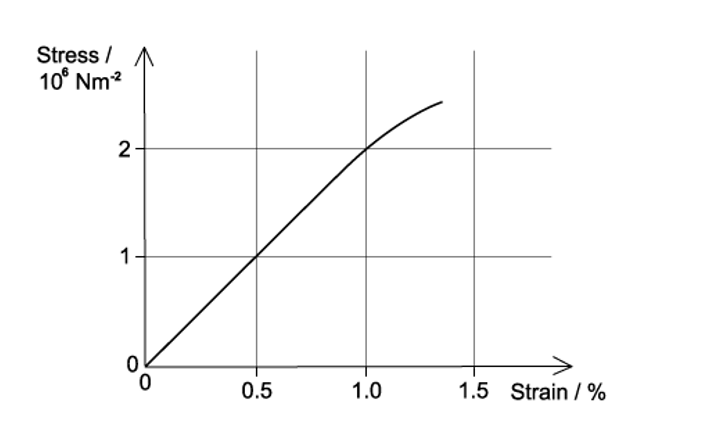
What is the Young modulus of bone?
Choose your answer
2 × 10⁶ N m−2
2 × 10⁸ N m−2
1 × 10⁶ N m−2
1 × 10⁸ N m−2
A spring is extended with varying forces; the graph below shows the results.
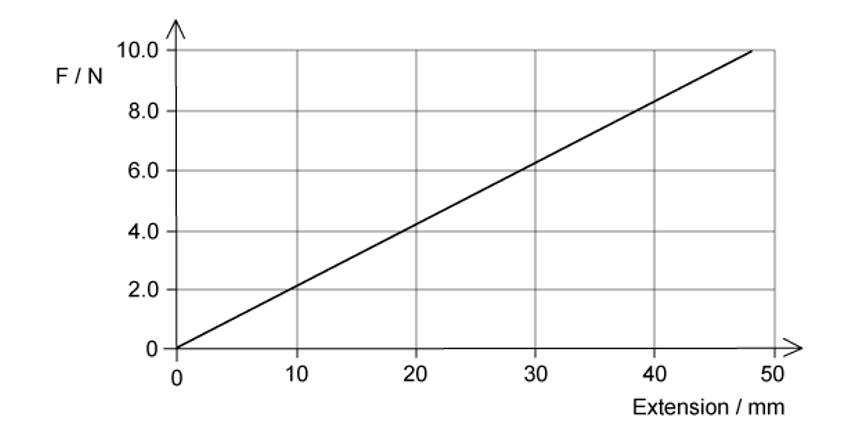
What is the energy stored in the spring when the extension is 30 mm?
Choose your answer
0.25 J
0.95 J
0.095 J
0.19 J
A sound wave has a frequency of 50 Hz and a speed of 330 m s–1
If two waves have a phase difference of 60˚, what is the possible distance between two points on the wave?
Choose your answer
6.6 m
2.2 m
1.1 m
0.03 m
Fig 1.1 shows two longitudinal waves, wave A and wave B, over time t. Wave A has an intensity of IA.
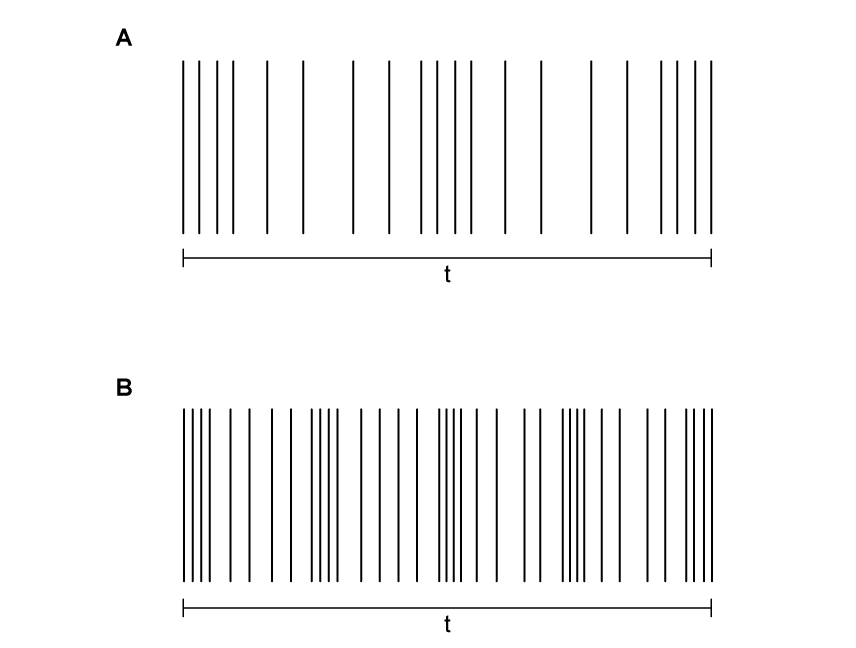
Fig. 1.1
Assuming both waves have equal amplitude, what is the intensity of wave B?
Choose your answer
Fig. 1.1 is a graph of the observed wavelength against time of a sound wave emitted from a single source. The emitted sound wave has a frequency . The sound travels at a constant velocity directly towards an observer and a frequency of is observed. It then travels directly away from the observer and a frequency of is observed.
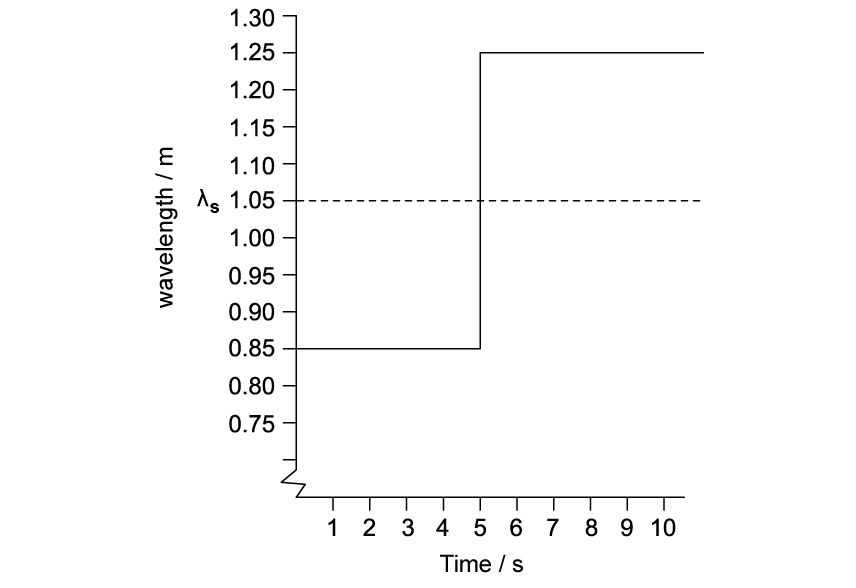
Fig. 1.1
What is the value of the ratio?
Choose your answer
Which of the following is the approximate range of frequencies of infrared radiation?
Choose your answer
1 × 10¹⁴ – 1 × 10¹⁶ Hz
1 × 10¹² – 1 × 10¹⁴ Hz
1 × 10⁹ – 1 × 10¹¹ Hz
1 × 10³ – 1 × 10⁹ Hz
Unpolarised light of intensity I0 is incident on a polariser that has a vertical transmission axis, as shown in the diagram below.
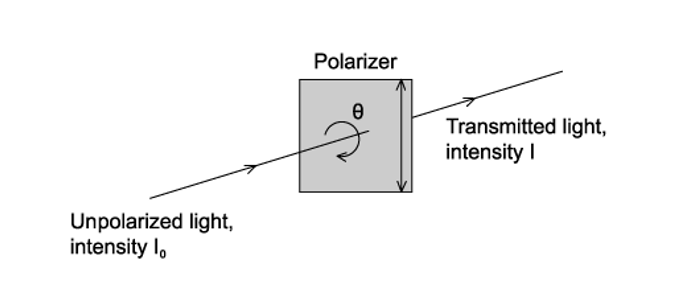
Which graph shows the intensity of the transmitted light ?
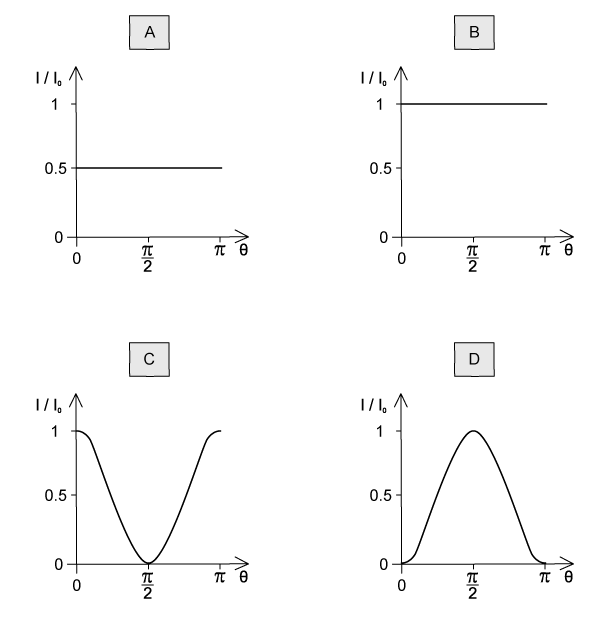
Choose your answer
An investigation to sound waves reflected by a wall was carried out. The frequency f of the wave was adjusted until a stationary wave is formed with an antinode with a distance x closest to the wall.
Which expression gives f in terms of x and the speed of sound *c *?
Choose your answer
Sound diffracts around a loudspeaker aperture of diameter 15 cm.
The speed of sound is 340 m s−1, and the frequency of the sound is 3 kHz.
What effect would be observed?
Choose your answer
No diffraction
Slight diffraction
Significant diffraction
Not enough information to tell
A beam of monochromatic light with wavelength λ is shone through a double slit at distance D away from a screen. An interference pattern is produced where the distance between the fringes is .
What would the distance between the double slit and the screen need to be for the fringe distance to remain when a light beam of wavelength is used instead?
Choose your answer
The diagram shows a diffraction grating with a slit distance (d) and a monochromatic source of light incident on the grating.
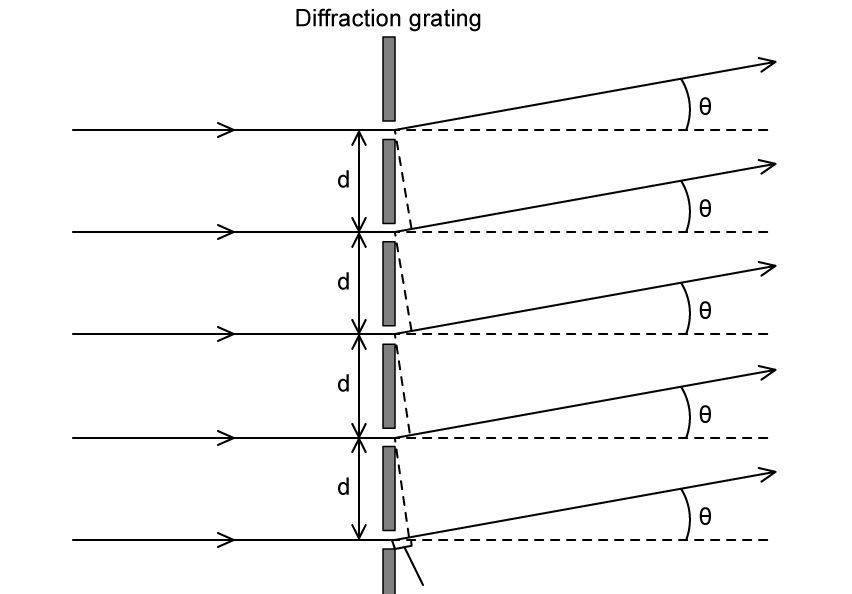
What happens to the angle of diffraction when the distance between the slits on the grating is reduced?
Choose your answer
The angle of diffraction remains the same
The angle of diffraction is decreased
The angle of diffraction is increased
There is not enough information to know what will happen
An electron beam of current 50 μA flows in a cathode-ray oscilloscope. The time-base causes the beam to sweep horizontally across the screen at 1.0 × 104 cm s–1
What is the number of electrons arriving at the screen in one centimetre length of the horizontal trace?
Choose your answer
3.1 × 10¹⁰
3.1 × 10¹³
1.3 × 10¹³
8.0 × 10¹⁴
What is the correct definition for potential difference?
Choose your answer
Energy transferred per unit charge
Energy transferred per unit current
Power transfer per unit charge
Work done per unit current
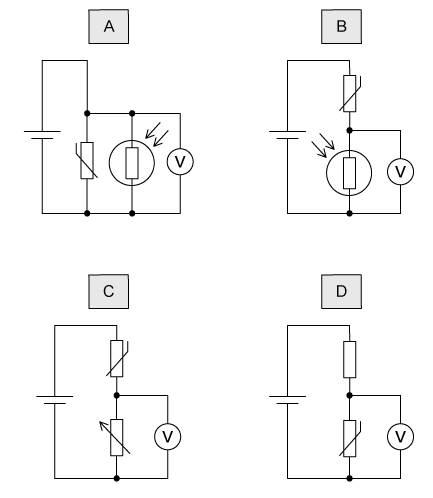
A thermistor and another component are connected to a constant voltage supply. A voltmeter is connected across one of the components. The temperature of the thermistor is then reduced, but no other changes are made.
In which circuit will the voltmeter reading increase ?
Choose your answer
In the circuit below, a voltmeter of resistance RV and an ammeter of resistance RA are used to measure the resistance R of the fixed resistor.
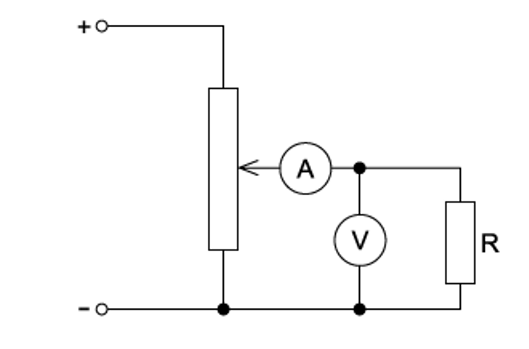
Which condition is necessary for an accurate value to be obtained for *R *?
Choose your answer
R is much smaller than RV
R is much smaller than RA
R is much greater than RV
R is much greater than RA
Six resistors, each of resistance 5 Ω, are connected to a 2 V cell of negligible internal resistance.
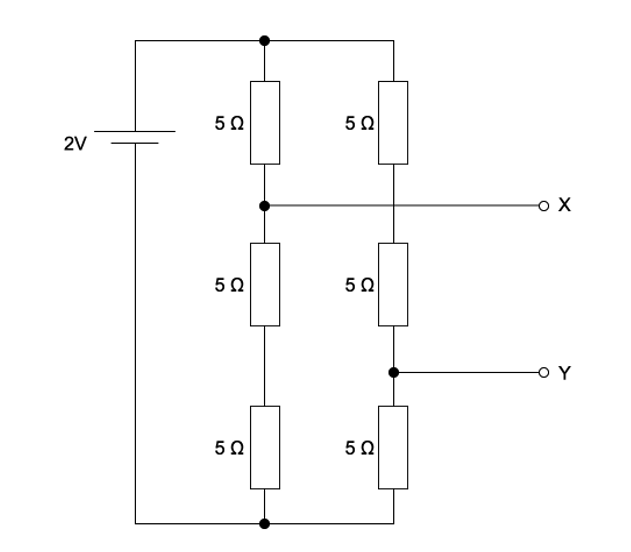
What is the potential difference between terminals X and Y ?
Choose your answer
In the circuit shown, the 6.0 V battery has negligible internal resistance. Resistors R1 and R2 and the voltmeter have resistance 100 kΩ.
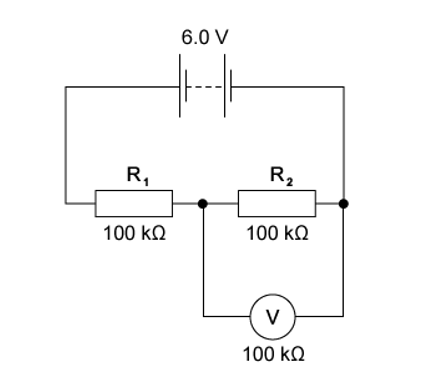
What is the current in the resistor R2?
Choose your answer
20 µA
30 µA
40 µA
60 µA
Which of the following equations correctly shows an α-particle causing a nuclear reaction ?
Choose your answer
O _ 8 ^ 17 + e _ - 1 ^ 0 -> B _ 5 ^ 13 + H _ 2 ^ 4 e
What is a particle that is not made of any smaller particles?
Choose your answer
elementary particle
minimum particle
original particle
atomic particle
State the difference between angular velocity and linear velocity.
A moon is in a circular orbit r about a planet. The angular speed of the moon in its orbit is ω. The planet and its moon may be considered to be point masses that are isolated in space.
r and *ω *are related by the expression
r*<sup>3</sup>*ω*<sup>2</sup> = constant
Io and Europa are moons that are in circular orbits around the planet Jupiter.
Data for Io and Europa are shown in Fig 1.1.
| moon | radius of orbit / km | period of rotation around Jupiter / hours |
|---|---|---|
| Io | 422 000 | 42.5 |
| Europa | 670 900 |
Fig 1.1
Use the data from Fig 1.1. to determine the angular speed of Europa in its orbit around Jupiter.
Extract:
Use the data from Fig 1.1. to determine the angular speed of Europa in its orbit around Jupiter. The angular speed of Europa, ω = 2.0 × 10^–5 rad s^–1.
Calculate the time period of Europa.
T = ................................ years
Extract:
Io and Europa are moons that are in circular orbits around the planet Jupiter. Data for Io and Europa are shown in Fig 1.1.
moon | radius of orbit / km | period of rotation around Jupiter / hours Io | 422 000 | 42.5 Europa | 670 900 | (blank)
Fig 1.1
Determine the radius of the orbit of a moon that had double the linear speed of Io but a third of its time period.
A bowl-shaped skating ramp can be modelled as a hollow sphere.
A skateboarder with a horizontal speed follows a circular path inside the bowl of radius 2.3 m, as shown in Fig 1.1.
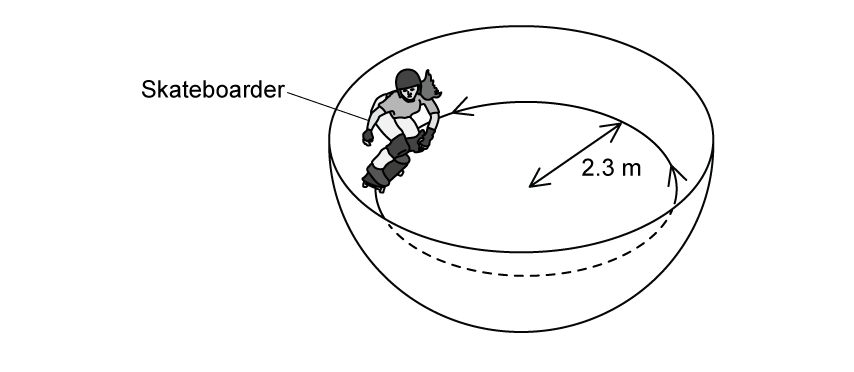
Fig 1.1
The forces acting on the skateboarder are their weight W and the normal reaction force R of the ramp on the skateboarder. R is at an angle *θ *to the horizontal.
Sketch W, R and *θ *on Fig 1.2.
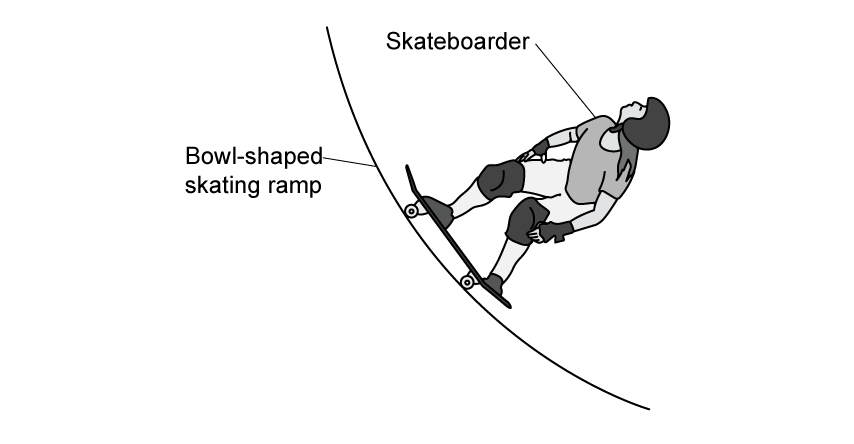
Fig 1.2
Extract:
A bowl-shaped skating ramp can be modelled as a hollow sphere. A skateboarder with a horizontal speed follows a circular path inside the bowl of radius 2.3 m. The forces acting on the skateboarder are their weight W and the normal reaction force R of the ramp on the skateboarder. R is at an angle θ to the horizontal.
Determine an equation for *W *in terms of *θ *and the resultant force, *F *on the skateboarder.
Extract:
A bowl-shaped skating ramp can be modelled as a hollow sphere. A skateboarder with a horizontal speed follows a circular path inside the bowl of radius 2.3 m. The forces acting on the skateboarder are their weight W and the normal reaction force R of the ramp on the skateboarder. R is at an angle θ to the horizontal. Determine an equation for W in terms of θ and the resultant force, F on the skateboarder. F = R cosθ; W = R sinθ. The horizontal component R cosθ is in the same direction as the resultant force, F (towards the centre of the circle).
Explain why force F is significant to the motion of the skateboarder.
Extract:
A skateboarder with a horizontal speed follows a circular path inside the bowl of radius 2.3 m, as shown in Fig 1.1. The forces acting on the skateboarder are their weight W and the normal reaction force R of the ramp on the skateboarder. R is at an angle θ to the horizontal. Determine an equation for W in terms of θ and the resultant force, F on the skateboarder. W = F tanθ
For the radius of the ramp in Fig 1.1, the skateboarder travels at a speed of 6.0 m s–1.
Show that the angle *θ *is 32°.
An equation to describe field strength is:
Define X and Y in the equation above.
Extract:
An equation to describe field strength is: gravitational field strength = X/Y. Define X and Y in the equation above. X is: Force acting on an object with mass; Y is: Mass of object;
Based on your answer to part (a), define the terms in the following equation:
The following text is about gravitational fields.
Complete the following sentences by crossing out the incorrect words:
A gravitational field is a region of space in which objects with mass / charge will experience a force.
The direction of the gravitational field is always directed away from / towards the centre of the mass.
Gravitational forces are always / never attractive.
Gravitational fields around a point mass are uniform / radial.
Explain
(i) What is meant by a geostationary orbit.
(3 marks)
(ii) Why it is preferable to have a satellite in this orbit for TV and telephone signals.
(2 marks)
A satellite of mass m is in orbit around a planet.
The mass *M *of the planet may be considered to be concentrated at its centre.
Show that the time period T of the orbit of the satellite is given by the expression
where R is the radius of the orbit of the satellite and G is the gravitational constant.
Explain your working.
Extract:
Show that the time period T of the orbit of the satellite is given by the expression T^2 = (4 π^2 R^3)/(G M) where R is the radius of the orbit of the satellite and G is the gravitational constant.
The radius of a geostationary orbit from the centre of the Earth is 4.2 × 10⁷ m.
Calculate the mass of the Earth.
Extract:
The radius of a geostationary orbit from the centre of the Earth is 4.2 × 10^7 m.
The radius of the Earth is 6400 km.
Determine the ratio