A small child does work on a large suitcase by pushing it along a smooth floor, as shown in Fig. 1.1.
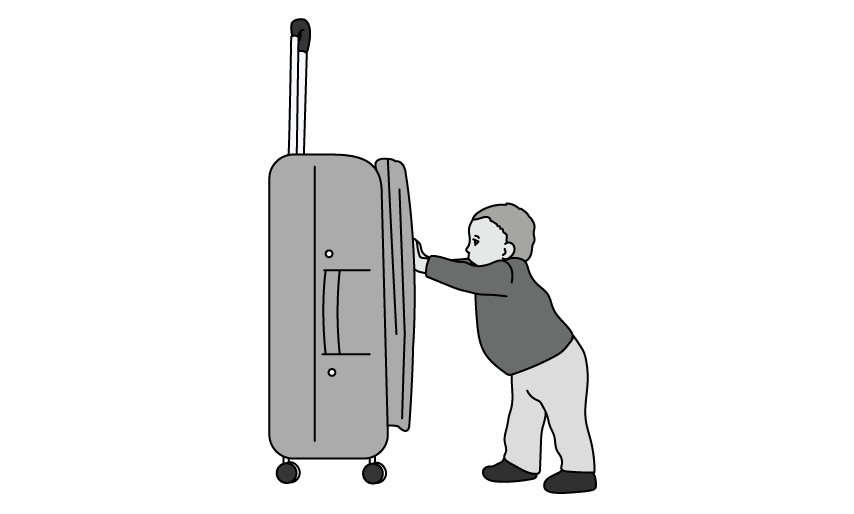
Fig. 1.1.
State the definition of work done and write the equation.
The suitcase is moved back to its original position by an adult who pulls it at an angle of 70° to the floor, as shown in Fig. 1.2.
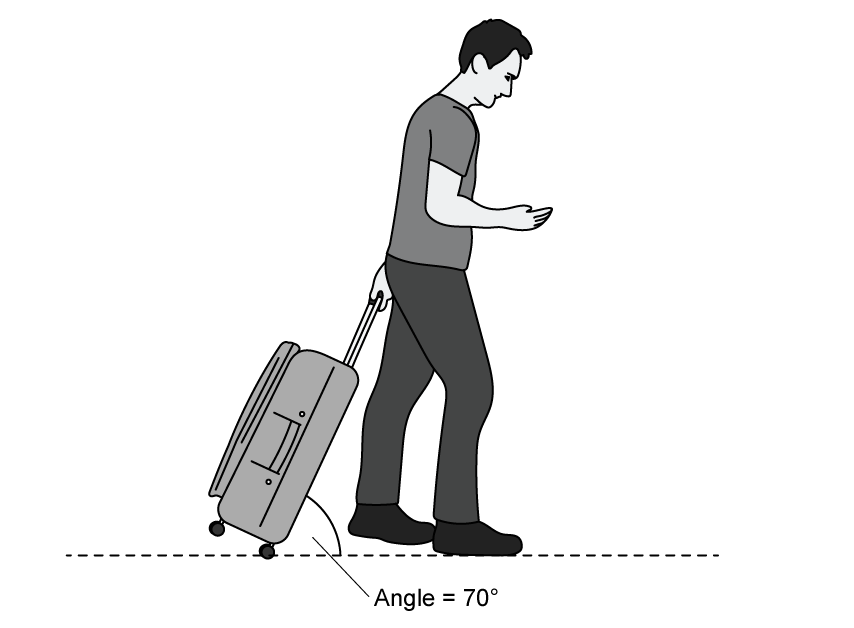
Fig. 1.2.
Write an expression for the work done on the suitcase by the adult in terms of force , distance and the angle 70°.
Extract:
State the definition of work done and write the equation: The energy needed to displace an object by an external force applied in the direction of its displacement; W = F s
The suitcase is moved back to its original position by an adult who pulls it at an angle of 70° to the floor. Write an expression for the work done on the suitcase by the adult in terms of force F, distance s and the angle 70°. Work done on an incline: W = F s cos θ. W = F s cos 70
In moving the suitcase the child and adult both exerted equal forces of 20 N. They each move the suitcase a distance of 2.5 m.
Calculate the work done by
(i) the child
(2 marks)
(ii) the adult.
(2 marks)
Extract:
A small child does work on a large suitcase by pushing it along a smooth floor, as shown in Fig. 1.1. The suitcase is moved back to its original position by an adult who pulls it at an angle of 70° to the floor, as shown in Fig. 1.2. In moving the suitcase the child and adult both exerted equal forces of 20 N. They each move the suitcase a distance of 2.5 m. Work done by the child: W = 20 × 2.5 = 50 J Work done by the adult: W = (20 × cos 70) × 2.5 = 17 J
State whether the child or the adult is more efficient at moving the suitcase, explaining your reasoning.