Reverse Chain Rule (Cambridge International A-Level Mathematics)
Exam board Cambridge International · A-LevelUpdated 2026-07-02
Reverse Chain Rule
How do you integrate (ax + b)n?
-
The reverse chain rule can be used for integrating functions in the form y = (ax + b)n
- Make sure you are confident using the chain rule to differentiate functions in the form y = (ax + b)n
- The reverse chain rule works backwards
-
For n = 2 you will most likely expand the brackets and integrate each term separately
-
If n > 2 this becomes time-consuming and if n is not a positive integer we need a different method completely
-
To use the reverse chain rule (provided n is not -1)
-
Raise the power of n by 1
-
Divide by this new power
-
Divide this whole function by the coefficient of x
- \int ( a x + b )^{n \mathrm{d} x = \frac{( a x + b )^{n} + 1} }{n + 1} \times \frac{1}{a} + c
-
-
You can check your answer by differentiating it
- You should get the original function when you differentiate your answer
-
Note that this method only works when the function in the brackets is linear (ax + b)
Worked Example
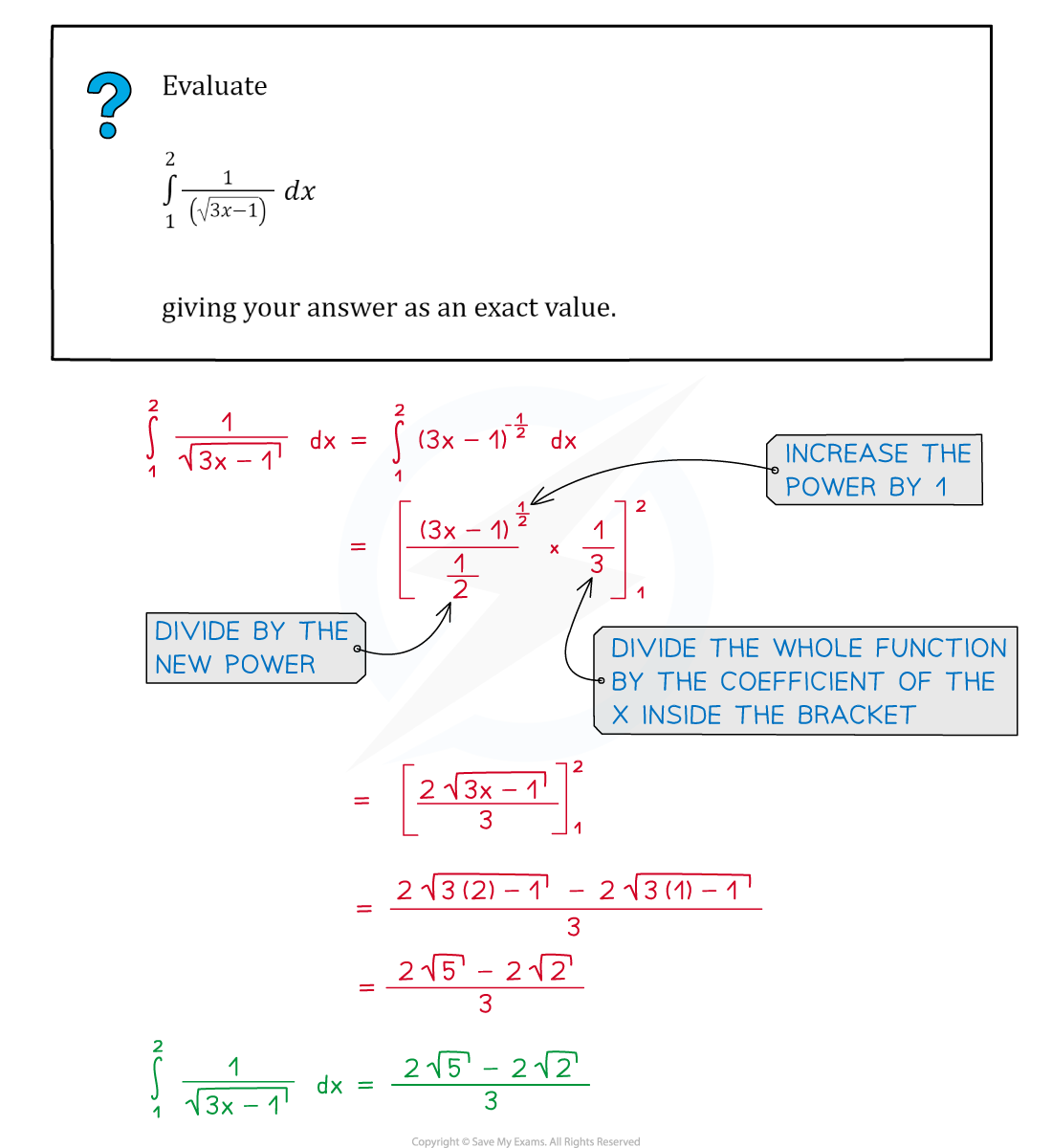
Exam Hint Make sure you can recognise when a question needs to use the reverse chain rule, it may not always be obvious.
Was this revision note helpful?
Build on this topic