Definite Integration (Cambridge International A-Level Mathematics)
Definite integration
What is definite integration?
- Definite Integration occurs in an alternative version of the Fundamental Theorem of Calculus
- This version of the Theorem is the one referred to by most AS/A level textbooks/websites
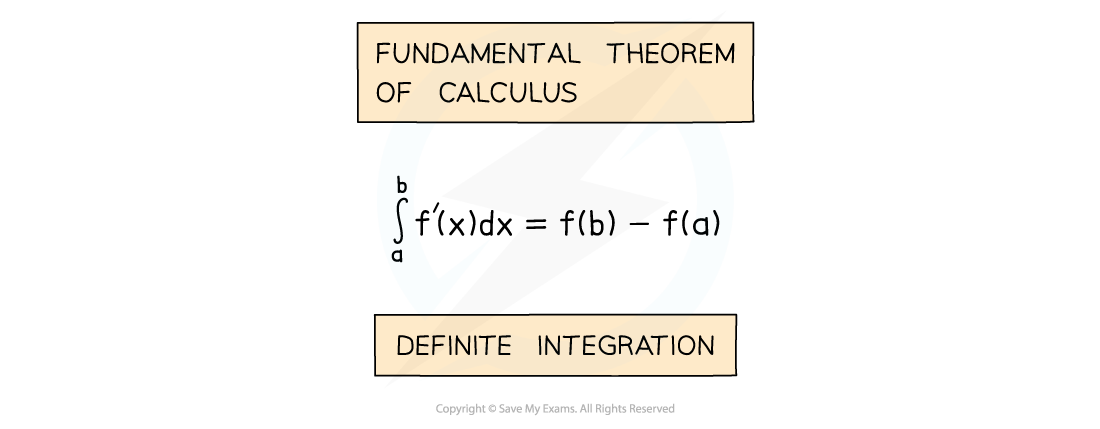
-
a and b are called limits
- a is the lower limit
- b is the upper limit
-
f’(x) is the derivative of f(x)
Why is there no constant of integration in definite integration?
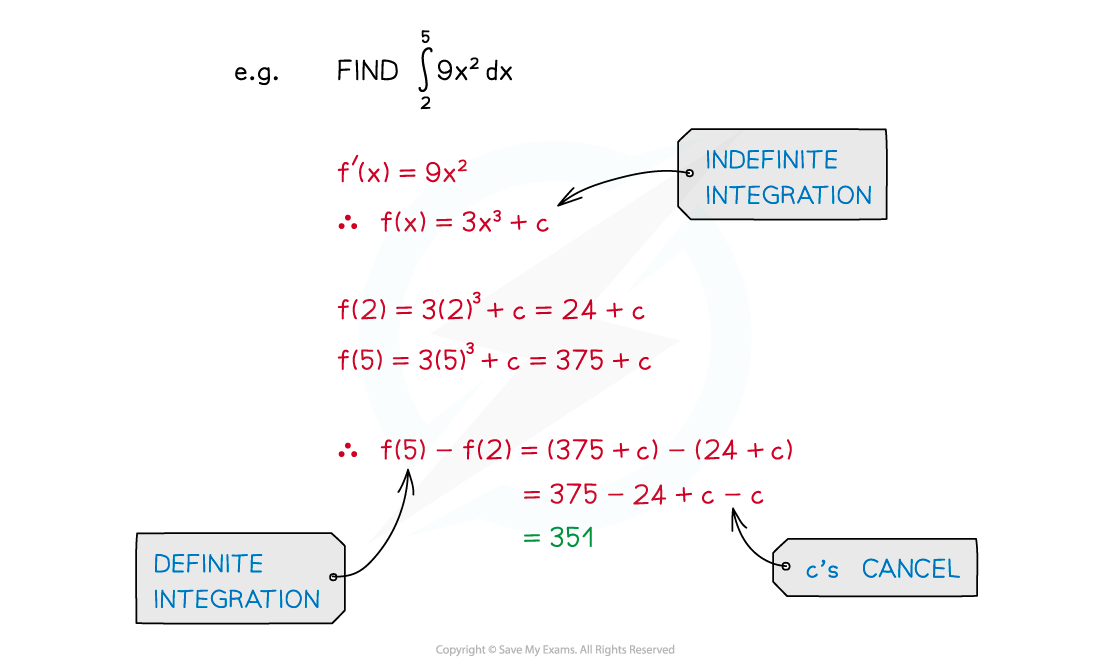
-
“+c” would appear in both f(a) and f(b)
- Since we then calculate f(b) – f(a) they cancel each other out
- There would be a “+c” from f(b) and a –“+c” from f(a)
-
So “+c” is not included with definite integration
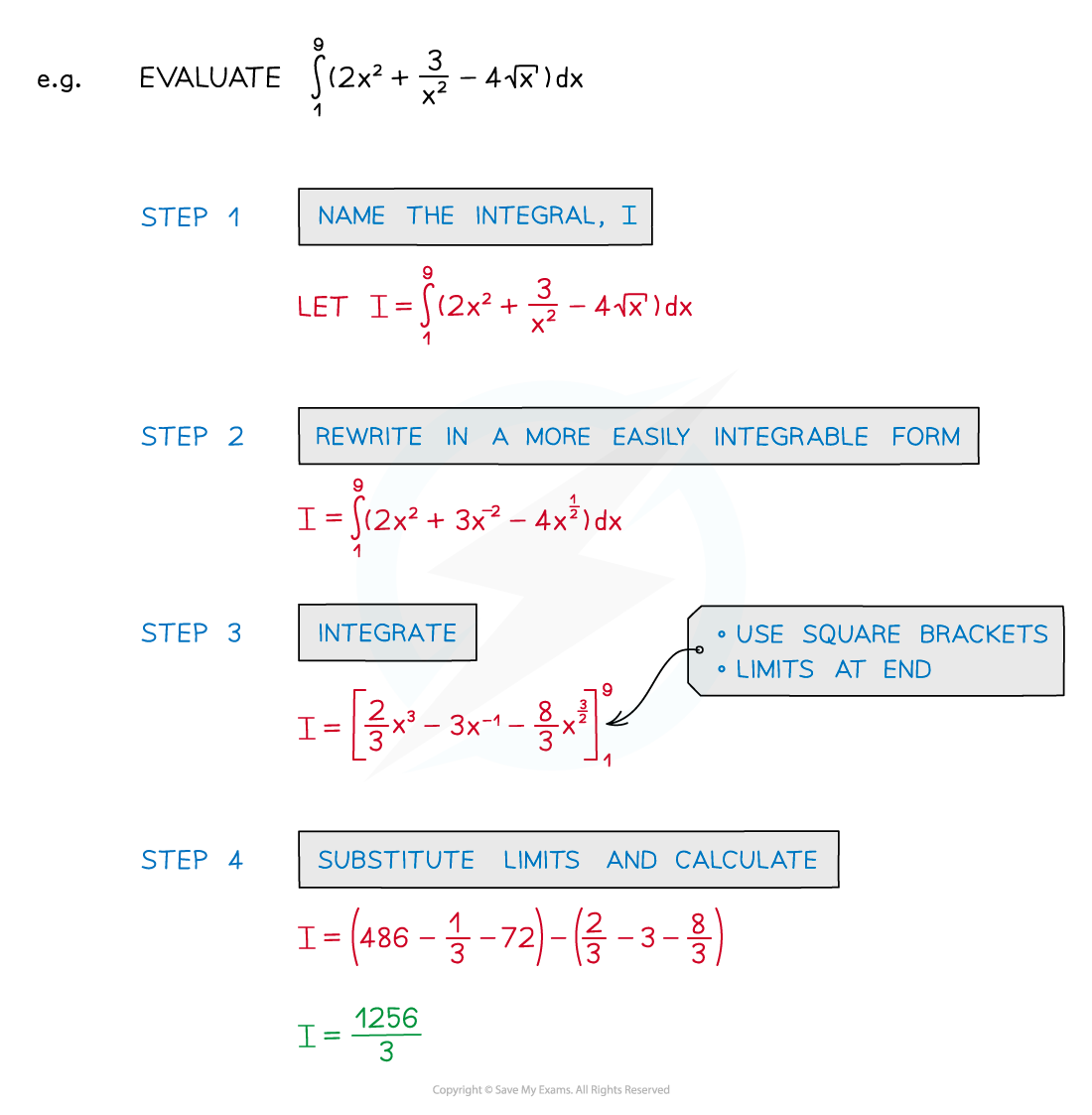
How do I find the value of a definite integral?
-
STEP 1: If not given a name, call the integral
- This saves you having to rewrite the whole integral every time!
-
STEP 2: If necessary rewrite the integral into a more easily integrable form
- Not all functions can be integrated directly
-
STEP 3: Integrate without applying the limits
- Notation: use square brackets [ ] with limits placed after the end bracket
-
STEP 4: Substitute the limits into the function and calculate the answer
How do I find a definite integral on my calculator?
- Advanced scientific calculators can work out the values of definite integrals
- The button will look similar to:


- (Note how the calculator did not return the exact value of the integral)
Exam Hint
- Look out for questions that ask you to find an indefinite integral in one part (so “+c” needed), then in a later part use the same integral as a definite integral (where “+c” is not needed).
Worked Example Find the value of
Start by expanding the brackets inside the integral
Integrate as usual (here it's a 'powers of ' integration)
Write the answer in square brackets with the integration limits outside
Now substitute 4 into that function And subtract from it the function with 2 substituted in
Error converting from MathML to accessible text.
Was this revision note helpful?
Build on this topic