Composite Economic Indicators (Cambridge International A-Level Economics)
The Human Development Index (HDI)
- The HDI is defined as a composite index published annually by the United Nations Development Programme (UNDP), measuring average achievement across three dimensions of human development
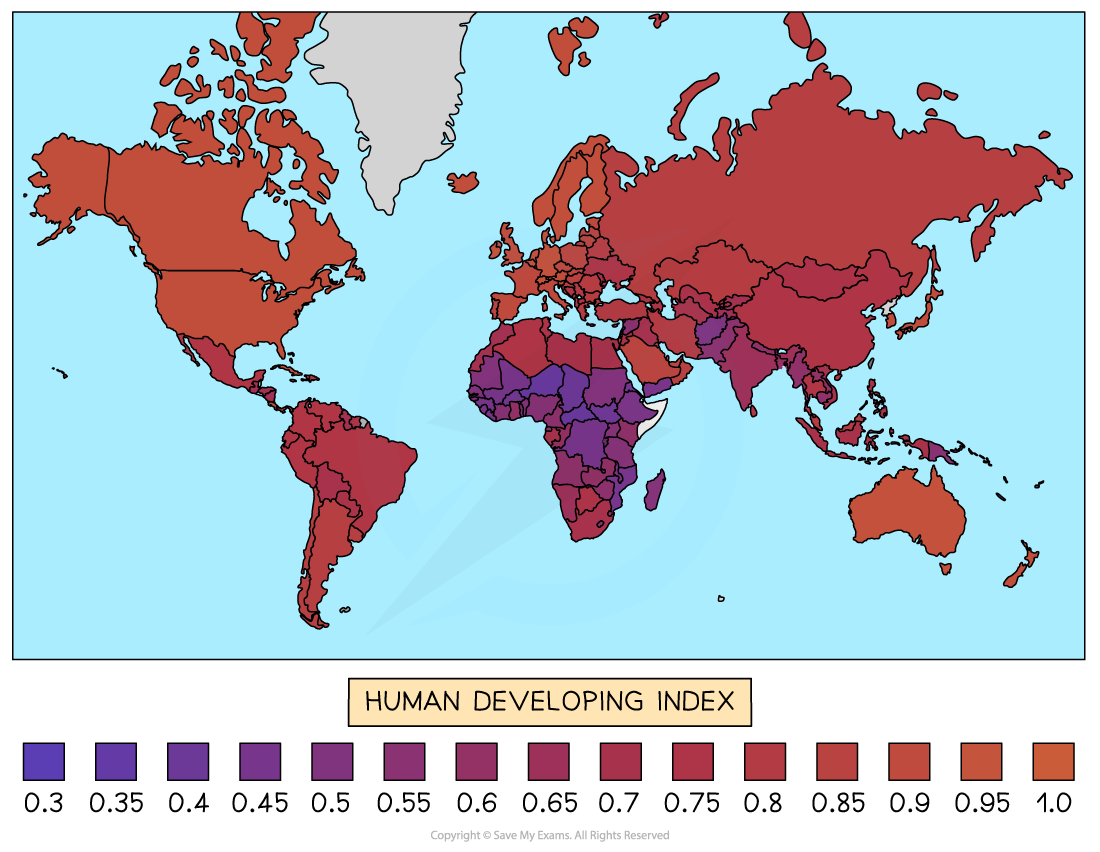
World HDI values
The three dimensions and their indicators
| Dimension | Indicator |
|---|---|
| Health | - Life expectancy at birth |
| Education | - Mean years of schooling + expected years of schooling |
| Standard of living | - GNI per capita (PPP-adjusted) |
-
Each dimension is scored between 0 and 1; the HDI is the geometric mean of the three dimension scores
-
Countries are classified as very high, high, medium or low human development based on their HDI score
-
A value of < 0.550 is considered low development
- E.g. Senegal was at 0.514 in 2021
-
A value of 0.550-0.699 is considered medium development
- E.g.Bangladesh was at 0.667 in 2021
-
A value of 0.700-0.799 is considered high development
- E.g Thailand was at 0.777 in 2021
-
A value ≥ 0.800 is considered very high development
- E.g. Austria was at 0.918 in 2021
-
Evaluating the HDI
-
Advantage over GNI alone
- Two countries with identical GNI per capita can have very different HDI scores depending on how income is translated into health and education outcomes
- Cuba and Qatar are classic examples of this divergence
-
Limitations
-
Does not capture inequality within countries
- A high HDI can coexist with extreme income concentration
-
Does not include political freedom, environmental sustainability or gender equality
-
Education and health indicators measure quantity, not quality
-
Measure of economic welfare (MEW)
- The MEW is defined as an adjusted measure of GDP developed by economists Nordhaus and Tobin in 1972, which attempts to correct GDP to better reflect actual economic welfare
- MEW adjusts GDP in two directions:
| Adjustment | Direction | Examples |
|---|---|---|
| Add welfare-enhancing activities excluded from GDP | - Upward | - Value of leisure time, unpaid domestic work, subsistence output |
| Deduct welfare-reducing activities included in GDP | - Downward | - Costs of pollution, urban congestion, crime, military spending |
- The rationale is that GDP counts all output equally regardless of whether it improves welfare - MEW attempts to strip out the output that does not, and add back the welfare that GDP misses
Limitations
- Extremely difficult to measure in practice — assigning monetary values to leisure time and environmental damage is inherently subjective
- Not produced regularly for most countries, limiting its use for international or time-series comparisons
- Methodological choices about what to add and deduct are contested
Multidimensional poverty index (MPI)
- The MPI is defined as a composite index developed by the Oxford Poverty and Human Development Initiative (OPHI) and the UNDP, measuring acute poverty across three dimensions using ten indicators
The three dimensions and their indicators
| Dimension | Indicators |
|---|---|
| Health | - Nutrition - Child mortality |
| Education | - Years of schooling - School attendance |
| Living standards | - Cooking fuel - Sanitation - Drinking water - Electricity - Housing - Assets |
- A household is classified as multidimensionally poor if it is deprived in at least one third of the weighted indicators
- The MPI score = headcount ratio (proportion of population that is poor) × intensity (average share of deprivations experienced by poor households)
Evaluating the MPI
-
Advantage over income poverty measures
- The MPI identifies which specific deprivations people experience simultaneously, allowing more targeted policy responses than a simple income threshold
-
Limitations:
- Does not include income as an indicator - due to data constraints rather than conceptual exclusion
- Data relies on household surveys, which are infrequent in many low-income countries, reducing timeliness
- Thresholds and weights are partly arbitrary - small changes can alter a country's classification
Comparison of composite indicators
| HDI | MEW | MPI | |
|---|---|---|---|
| Published by | - UNDP | - Not regularly published | - UNDP / OPHI |
| Focus | - Human development broadly | - Welfare-adjusted GDP | - Acute poverty |
| Best suited to | - Comparing development levels across countries | - Critiquing GDP as a welfare measure | - Identifying and targeting poverty |
| Key limitation | - Ignores inequality and environment | - Hard to measure consistently | - Excludes income; data gaps |
Worked Example What is not included as a weighted indicator of poverty in the Multidimensional Poverty Index (MPI)?
A cooking fuel B electricity C medication D water Final answer: Answer: C
The MPI measures acute poverty across three dimensions - health, education and living standards - using ten weighted indicators
- Under living standards, the MPI includes: cooking fuel, electricity, drinking water, sanitation, housing quality and assets - so options A, B and D are all genuine MPI indicators
- Medication is not one of the ten MPI indicators - the health dimension covers nutrition and child mortality, not access to medication specifically
Worked solution
- Options A, B and D are distractors that test whether students know the actual composition of the MPI rather than guessing what "sounds like" a poverty indicator
- The key distinction: the MPI health dimension measures outcomes (mortality, nutrition) not inputs (medication, healthcare access) — this is precisely why medication is excluded despite seeming intuitively relevant
Exam Hint The key distinction examiners test is why composite indicators are superior to single indicators - always argue that they capture multiple dimensions simultaneously, meaning a country cannot mask poor health or education behind high income.
The strongest evaluation point across all three is that even composite indicators have blind spots: HDI ignores inequality, MEW cannot be measured consistently, and MPI excludes income entirely.
In essays, naming the specific limitation of the indicator in question will always score higher than generic criticism.
Was this revision note helpful?
Build on this topic