Absolute & Comparative Advantage (Cambridge International A-Level Economics)
What is absolute and comparative advantage?
- International trade occurs when countries exchange goods and services across national borders
- Countries trade because they differ in their ability to produce goods efficiently - these differences create the basis for specialisation and mutual gain
Absolute advantage
-
A country has an absolute advantage in the production of a good if it can produce more of it than another country using the same quantity of resources
- Example: if Country X produces 100 units of wheat per worker and Country Y produces 60 units per worker, Country X has absolute advantage in wheat
Comparative advantage
-
A country has a comparative advantage in the production of a good if it can produce it at a lower opportunity cost than another country
- Opportunity cost is the key concept — not the absolute quantity produced
- A country can have comparative advantage in a good even if it has absolute advantage in nothing
- Comparative advantage, not absolute advantage, determines the basis for beneficial trade
The distinction between absolute and comparative advantage
| Absolute advantage | Comparative advantage | |
|---|---|---|
| Based on | - Quantity of output per unit of resource | - Opportunity cost of production |
| Determines | - Which country is more productive | - Which country should specialise in what |
| Basis for trade? | - Not sufficient alone | - The true basis for international trade |
The sources of comparative advantage
- The sources of comparative advantage can vary from country to country, but some common factors include
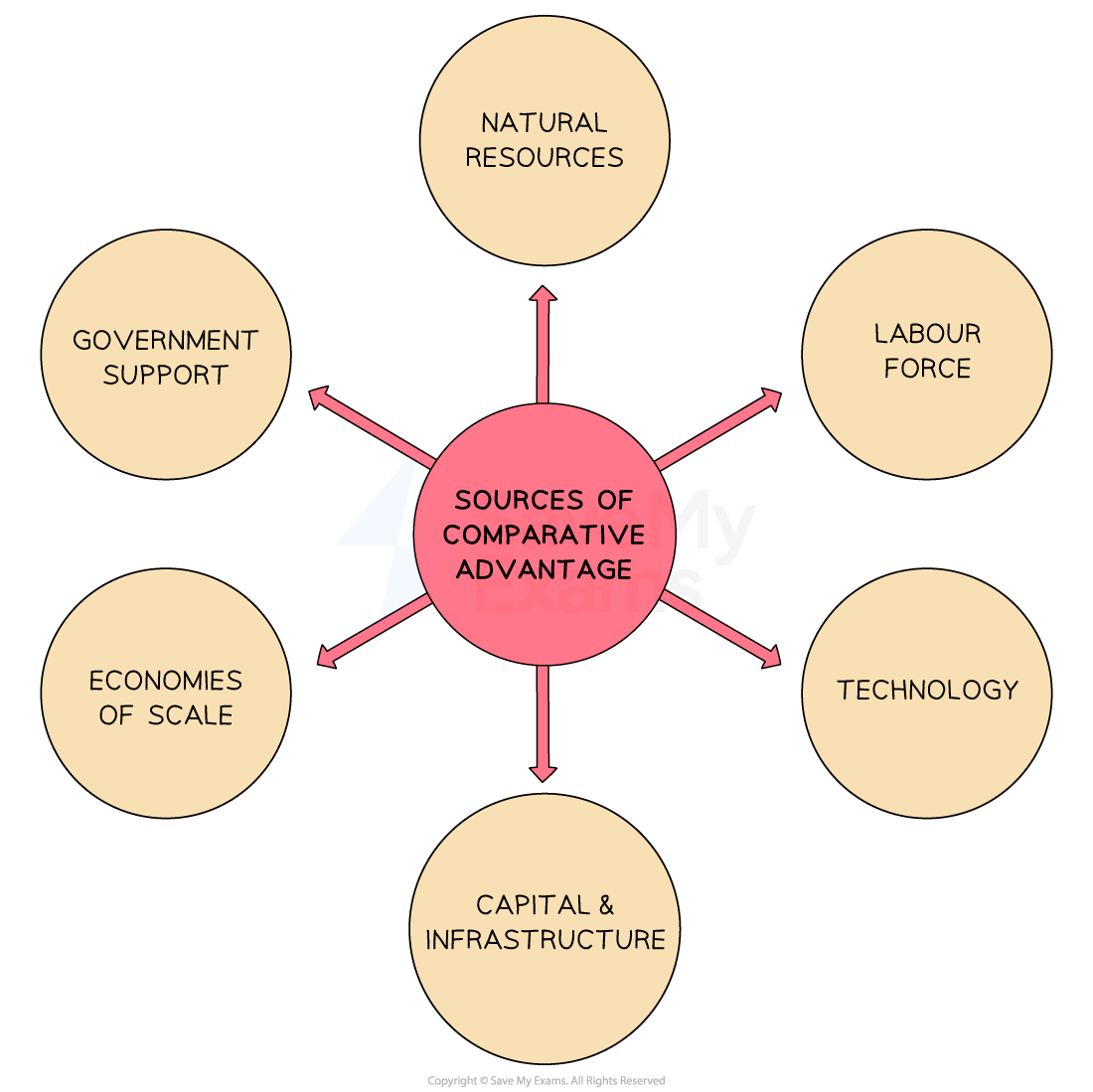
*Common sources of comparative advantage *
Natural resources
-
Countries with abundant natural resources, such as minerals, energy sources, fertile land or water bodies, may have a comparative advantage in industries that utilise these resources
- E.g. Ukraine has very fertile farmland and a climate conducive to growing grain
Labor force
-
The quality, skills and cost of labor can be a significant source of comparative advantage
- Countries with a skilled workforce in specific industries, such as technology, engineering or manufacturing, may have a competitive edge in those sectors
- Countries with lower labour costs may have a comparative advantage in labour-intensive industries
Technology
- Access to advanced technology, innovation and research capabilities can create a comparative advantage
Capital and infrastructure
-
The availability and quality of capital and infrastructure, such as transportation networks, communication systems and reliable utilities, can contribute to a comparative advantage
- Well-developed infrastructure facilitates efficient production, distribution and connectivity, giving countries an edge in international trade
Economies of scale
-
Companies or countries that can achieve economies of scale in production have a comparative advantage
- Spreading fixed costs over a larger output, reduces unit costs and allows firms to offer competitive prices in the global market
Government policies and support
-
Government policies, such as trade agreements, subsidies, tax incentives, and intellectual property protections, can influence a country's comparative advantage
- Strategic government support can help industries develop and compete in the global market
Calculating comparative advantage
-
Comparative advantage is identified by calculating and comparing the opportunity cost of producing each good in each country
- The country with the lower opportunity cost in a good has the comparative advantage in that good and should specialise in its production
-
Each worker can only produce one good at a time
- The opportunity cost of producing one unit of a good is the quantity of the other good that same worker could have produced instead
The table shows the output per worker per week in two countries
| Wheat (tonnes) | Cars | |
|---|---|---|
| Country X | 4 | 2 |
| Country Y | 8 | 6 |
Country X opportunity costs:
- 1 tonne of wheat - the worker could have made 2/4 = 0.5 cars
- 1 car - the worker could have produced 4/2 = 2 tonnes of wheat
Country Y opportunity costs:
- 1 tonne of wheat - the worker could have made 6/8 = 0.75 cars
- 1 car - the worker could have produced 8/6 = 1.33 tonnes of wheat
Comparing opportunity costs:
| Opportunity cost of 1 tonne of wheat | Opportunity cost of 1 car | |
|---|---|---|
| Country X | 0.5 cars | 2 tonnes of wheat |
| Country Y | 0.75 cars | 1.33 tonnes of wheat |
- Country X has comparative advantage in wheat - it gives up only 0.5 cars per tonne vs 0.75 in Y
- Country Y has comparative advantage in cars - it gives up only 1.33 tonnes of wheat per car vs 2 in X
- Country X has absolute advantage in both goods - its workers produce more of both per week - yet both countries still gain from specialisation and trade because their opportunity costs differ
Worked Example The table shows the factor inputs required to produce one tonne of wheat and one car in countries X and Y:
Factor inputs per tonne of wheat Factor inputs per car Country X 4 2 Country Y 8 6 What makes it possible for both countries to benefit from trade?
A. Country X has an absolute advantage in wheat and car production
B. Country Y has an absolute advantage in wheat and car production
C. Country Y has a comparative advantage in wheat production
D. Opportunity cost of wheat and car production is the same between countries
Final answer: Answer: C
Worked solution:
This question uses a factor inputs table rather than an output table - fewer inputs per unit means greater efficiency
The method is the same: calculate opportunity cost ratios and compare
- Country X: opportunity cost of 1 tonne of wheat = 4/2 = 2 cars forgone
- Country Y: opportunity cost of 1 tonne of wheat = 8/6 = 1.33 cars forgone
- Country X: opportunity cost of 1 car = 2/4 = 0.5 tonnes of wheat forgone
- Country Y: opportunity cost of 1 car = 6/8 = 0.75 tonnes of wheat forgone
Now eliminate each option:
- Option A - X requires fewer inputs for both goods so does have absolute advantage in both. True, but absolute advantage alone does not create the basis for mutually beneficial trade. Eliminated
- Option B - Y requires more inputs for both goods so has absolute advantage in neither. Factually incorrect. Eliminated
- Option C - Y's opportunity cost of wheat is 1.33 cars; X's is 2 cars. Y gives up fewer cars to produce wheat, so Y has comparative advantage in wheat. Correct
- Option D - Opportunity costs differ between countries (2 cars vs 1.33 cars for wheat). If they were identical, there would be no basis for trade at all. Eliminated
The trap is option A - students who identify that X has absolute advantage in both goods may assume this explains the gains from trade. It does not. Mutually beneficial trade requires only that opportunity costs differ between countries, not that one country is more productive overall.
Exam Hint Always show your opportunity cost calculations explicitly - do not just state which country has comparative advantage.
In MCQs the calculation takes seconds and eliminates wrong answers with certainty; in data response questions the working must be shown to access marks.
The most common error is confusing absolute and comparative advantage. A country can have absolute advantage in every good and still benefit from specialising where its opportunity cost is lowest. The key test is always: which country gives up less of the other good to produce one unit of this good?
If opportunity costs are identical between countries there is no basis for trade.
Limitations to the theory of comparative advantage
-
The theory assumes complete specialisation
- In practice countries rarely specialise entirely in one good as this creates vulnerability to demand shocks and supply disruptions
-
The theory assumes constant opportunity costs
- In reality opportunity costs rise as resources are reallocated, meaning gains from specialisation diminish as production expands
-
The theory assumes no transport costs
- In practice trade costs can eliminate the price advantage gained from specialisation
-
The theory assumes perfect factor mobility
- In reality labour and capital cannot move freely between industries, meaning reallocation is slow, costly and politically difficult
-
The theory is static
-
It describes comparative advantage at a point in time but ignores how productivity changes through investment and innovation over time
- A country may have comparative advantage in a low-value primary good today but could develop advantage in higher-value industries over time
- This is the basis for the infant industry argument covered in 6.2
-
-
The theory ignores economies of scale
- Countries may benefit from producing goods in which they do not currently have comparative advantage if large-scale production would eventually reduce unit costs sufficiently
-
The theory assumes free trade
- In practice tariffs, quotas and subsidies distort relative prices and prevent countries from trading at their comparative advantage
Was this revision note helpful?
Build on this topic