Aggregate Demand (Cambridge International A-Level Economics)
An introduction to aggregate demand (AD)
-
Aggregate demand (AD) is the total demand for all goods and services in an economy at any given average price level
-
Its value is often calculated using the expenditure approach
- AD = Consumption (C) + Investment (I) + Government spending (G) + (Exports-Imports) (X-M)
- AD = C + I + G + (X-M)
-
Consumption is the total spending on goods and services by consumers (households) in an economy
-
Investment is the total spending on capital goods in an economy
- This includes spending by firms on machinery, equipment and buildings
- It also includes household spending on new housing
- It includes changes in inventories (stocks of goods held by firms)
-
Government spending is the total spending by the government in the economy
- Includes public sector salaries, payments for provision of merit and public goods etc.
- It does not include transfer payments
-
Net exports are the difference between the revenue gained from selling goods or services abroad and the expenditure on goods or services from abroad
- Individuals, firms and governments export and import
-
The relationship between the average price level and the total output in an economy is shown with an aggregate demand (AD) curve
Aggregate demand (AD) curve for an economy
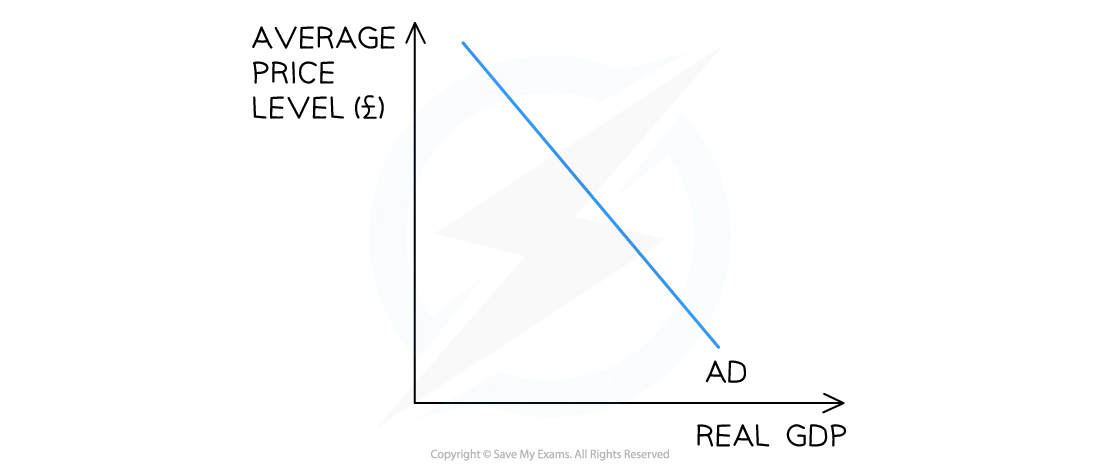
* Average Price Level on the Y axis and Real GDP or Real National Output on the X axis*
Movements along the aggregate demand curve
- Whenever there is a change in the average price level (AP) in an economy, there is a movement along the aggregate demand (AD) curve
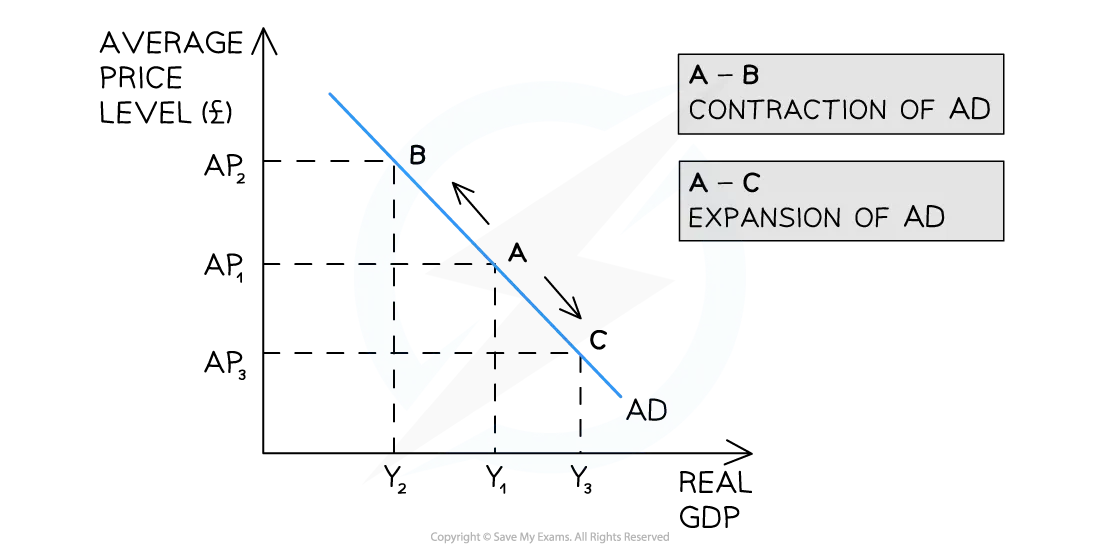
A change in AP causes a movement along the aggregate demand (AD) curve, leading to a contraction or expansion of AD
Diagram analysis
-
An increase in the AP (ceteris paribus) from AP1 → AP2 leads to a movement along the AD curve from A → B
- There is a contraction of real GDP from Y1 → Y2
-
A decrease in the AP (ceteris paribus) from AP1 → AP3 leads to a movement along the AD curve from A → C
- There is an expansion of real GDP (output) from Y1 → Y3
Exam Hint Always distinguish between a movement along the AD curve and a shift of the AD curve. A change in the average price level causes a movement along - a change in any determinant (interest rates, confidence, exchange rates, fiscal policy) causes the whole curve to shift. Mixing these up is one of the most common errors in AD/AS questions.
Factors that cause the entire AD curve to shift
- Whenever there is a change in any of the determinants of aggregate demand (AD) in an economy, there is a shift of the entire AD curve
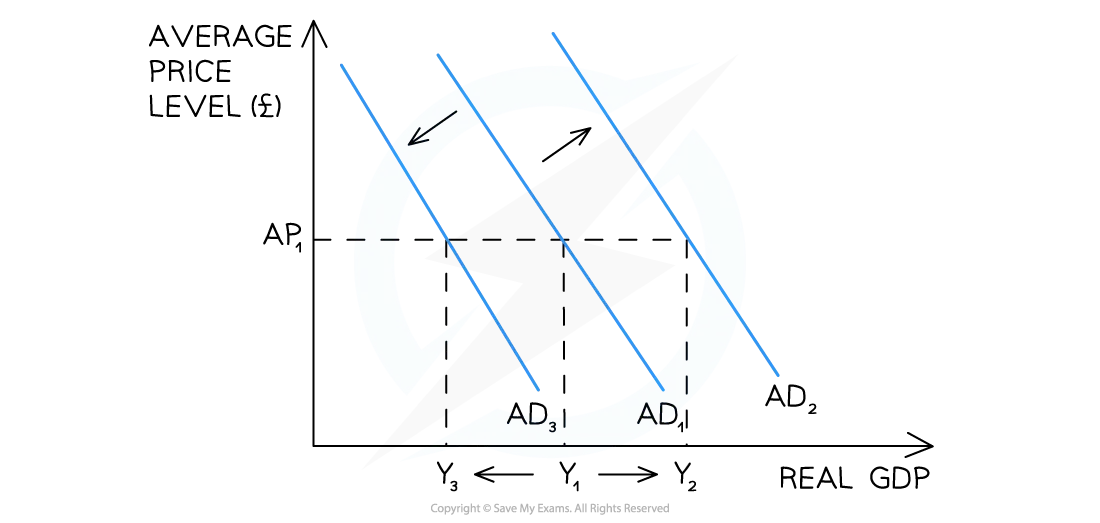
An increase in any of the determinants of AD will cause the AD curve to shift right - and vice versa
Diagram analysis
-
An increase in any one of the determinants of aggregate demand (AD) results in a shift right of the entire curve from AD1 → AD2
- At every price level, real GDP has increased from Y1 → Y2
-
A decrease in any one of the determinants of AD results in a shift left of the entire curve from AD1 → AD3
- At every price level, real GDP has decreased from Y1 → Y3
The determinants of aggregate demand
- AD = Consumption (C) + investment(I) + Government Spending(G) + (Exports (X) - Imports (M))
- Each of these components are influenced by a range of factors and any change to one of them has the potential to shift the aggregate demand curve
- If numerous factors change at the same time, the net effect will determine which way- and how far- the aggregate demand shifts
Factors that affect each determinant
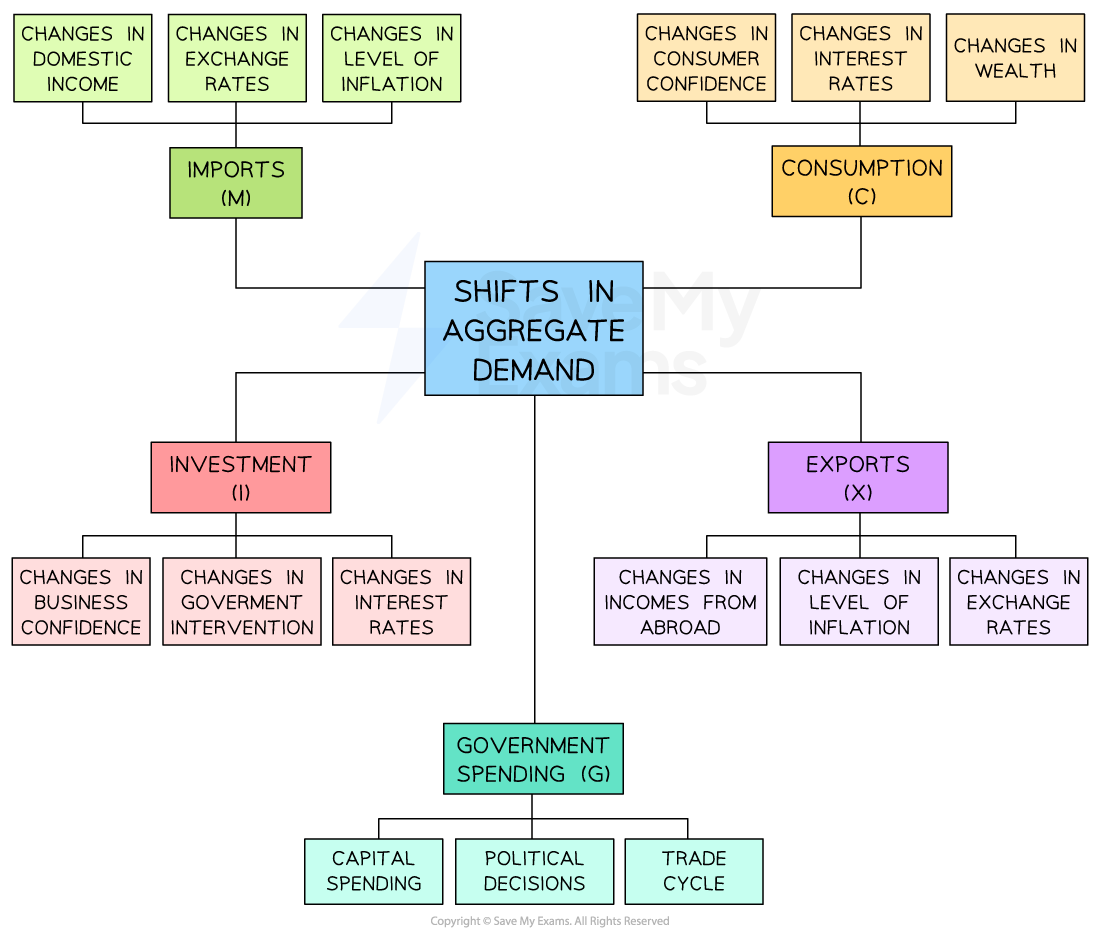
When multiple factors change at the same time, the net effect will determine which way the AD curve shifts—and how far. It is easier to analyse the impact of a single change
The key determinants and their transmission mechanisms
Interest rates
- A rise in interest rates increases the cost of borrowing and raises the return on saving, reducing consumption (C) and reducing firm investment (I); AD shifts left - falling interest rates have the reverse effect
Consumer confidence
- A fall in confidence leads households to reduce spending and increase precautionary saving, reducing consumption (C) and shifting AD left - rising confidence has the reverse effect
Business confidence
- A fall in confidence reduces firms' willingness to invest in new capital, reducing investment (I) and shifting AD left - rising confidence has the reverse effect
Exchange rates
- An appreciation of the exchange rate makes exports more expensive abroad and imports cheaper domestically, reducing exports (X) and increasing imports (M); net exports fall and AD shifts left - depreciation has the reverse effect
Government fiscal policy
- An increase in government spending (G) or a cut in taxation raises household disposable income and consumption (C), shifting AD right - a cut in spending or rise in taxation shifts AD left
Was this revision note helpful?