Actual Growth, Potential Growth & Output Gaps (Cambridge International A-Level Economics)
Actual growth, potential growth and output gaps
Actual growth versus potential growth
-
The two concepts capture different things and can move independently of one another
- Actual growth is the observed change in real GDP from one period to the next - the year-on-year rate of growth reported in official statistics
- Potential growth is the change in the economy's productive capacity - the rate at which the economy could grow if all its resources were fully and efficiently employed
1. Actual growth
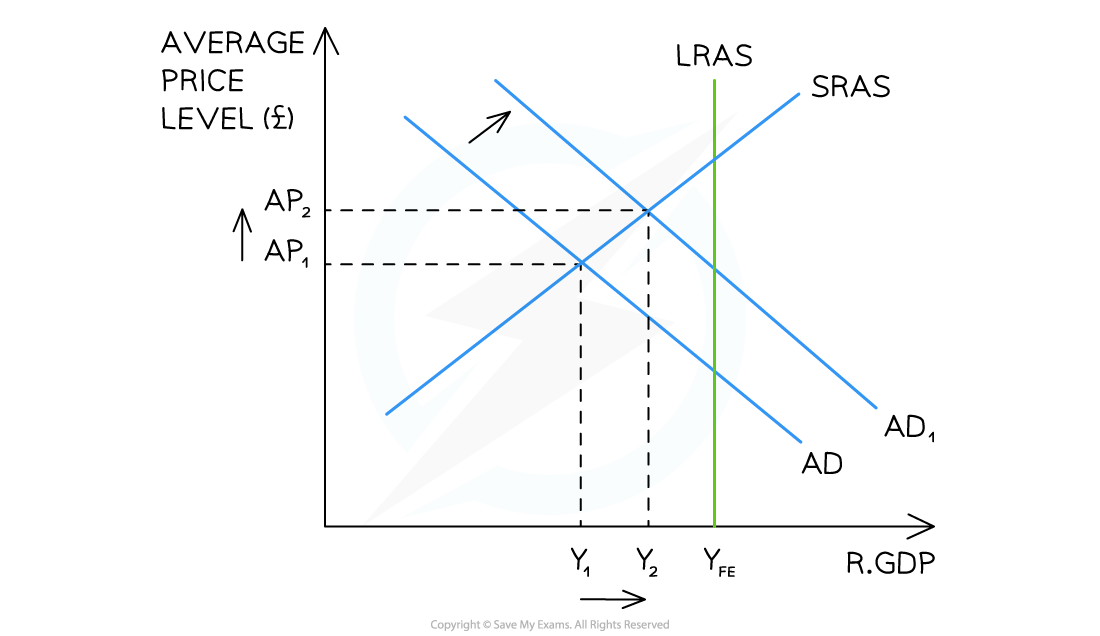
Actual growth
Diagram analysis
-
Actual growth is driven primarily by changes in AD in the short run - firms raise output in response to higher demand.
-
An increase in consumption, investment, government spending or net exports has caused a shift in AD from AD→AD1
-
The current real output has increased from Y1→Y2, which represents an increase in real GDP
- An increase in real GDP = economic growth
-
-
This short-run growth has led to an increase in average prices from AP1→AP2
Determinants of actual growth (in the short run)
- Changes in consumer spending, investment, government spending and net exports
- Monetary and fiscal policy decisions
- Exchange rate movements
- Consumer and business confidence
2. Potential growth
- Potential growth is shown by a rightward shift of LRAS - the economy's capacity expands from Y_FE to Y_FE'
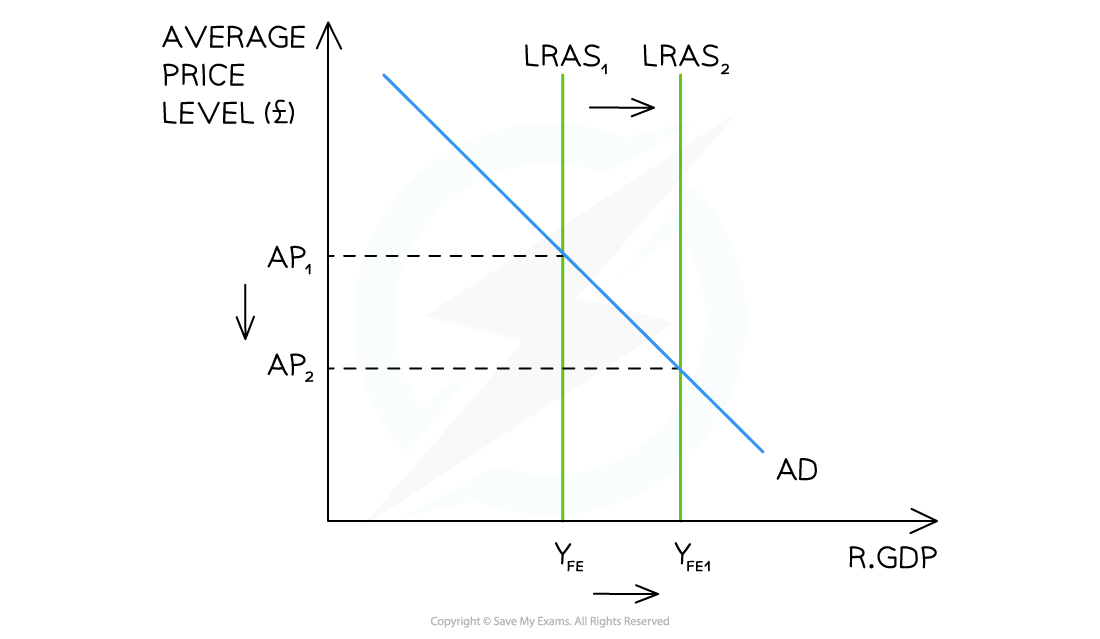
Potential growth
Diagram analysis
-
A change to the quantity/quality of the factors of production has increased potential output of the economy from YFE→YFE1
-
E.g. More rigorous competition policy creates a higher number of firms in each industry, leading to greater aggregate supply in the economy
- This shifts the long-run aggregate supply curve to the right LRAS1→LRAS2, resulting in economic growth
-
-
The final impact on price levels depends on the shape of the long-run aggregate supply curve (Keynesian or Classical)
Determinants of potential growth (in the long run)
- Quantity of factors - net investment, labour force growth, discovery of new resources
- Quality of factors - education and training raising human capital, R&D improving technology
- Efficiency - reforms that improve productivity and reduce frictions
- Institutional environment - stable rules, secure property rights, effective competition policy
Positive and negative output gaps
Spec point —
9.2.2
-
The output gap is the difference between actual real GDP and the economy's potential real GDP at a given point in time
-
It is the direct expression of divergence between actual and potential growth
- Positive output gap - actual real GDP is above potential real GDP. The economy is producing more than its sustainable capacity in the short run
- Negative output gap - actual real GDP is below potential real GDP. The economy has spare capacity and unemployed resources
-
-
A positive output gap is not "good news" in a simple sense
- It reflects overheating and typically generates inflationary pressure
-
A negative output gap is not purely "bad news" either
- It reflects spare capacity that can be brought back into use without inflationary consequences.
-
For the AD/AS diagrammatic treatment of positive and negative output gaps, including the equivalence with inflationary and deflationary gaps on the Keynesian 45° model, see the notes on 9.1.3
Indicators of output gaps in practice
-
The output gap cannot be measured directly because potential real GDP cannot be observed
- Policymakers infer the gap from multiple indicators:
| Indicator of a positive output gap | Indicator of a negative output gap |
|---|---|
| - Rising inflation, particularly demand-pull | - Falling inflation or deflationary pressure |
| - Unemployment below the natural rate | - Unemployment above the natural rate |
| - High capacity utilisation in firms | - Low capacity utilisation and idle capital |
| - Falling vacancies filled quickly | - Rising vacancies, slow hiring |
| - Wage growth accelerating | - Wage growth stagnating |
| - Strong import growth relative to exports | - Weak import growth |
-
No single indicator is decisive - rising inflation, for example, may reflect either demand-side overheating or a supply-side shock
- Policymakers typically rely on a basket of measures to form a judgement
Difficulties in measurement
-
The measurement problem has real policy consequences:
- Potential output is not directly observable - it must be estimated, and those estimates are revised regularly
- Revisions can be large - what looked like a positive output gap at the time may be revised away months later as data are updated
- Structural changes (technological shifts, labour force participation changes, long recessions) can alter the path of potential growth itself, making historical comparisons unreliable
- Getting the diagnosis wrong is costly: tightening policy into a negative output gap deepens recession; loosening into a positive output gap fuels inflation
Link to the business cycle
- Output gaps open and close in a repeating pattern over time
- The phases of that pattern, its causes, and the automatic stabilisers that dampen it are covered in 9.2.3.
Exam Hint Be precise about what is driving growth. A rise in real GDP does not automatically mean potential output has increased - it may simply reflect a rise in AD along existing LRAS, which is actual growth without potential growth. Strong answers identify which type of growth is being discussed and recognise that the two can move independently.
For top-band responses, avoid treating positive output gaps as unambiguously good and negative output gaps as unambiguously bad. A positive output gap signals overheating and inflationary pressure; a negative output gap signals spare capacity and scope for non-inflationary expansion. The evaluative point is that both types of gap require policy attention, just in opposite directions.
Use the measurement uncertainty explicitly as an evaluation point. When a question asks whether a government should respond to an apparent output gap, a strong answer notes that the estimate may be wrong, that revisions are common, and that the cost of responding to the wrong diagnosis can be severe - this is Level 4 critical thinking.
Was this revision note helpful?