Supply-Side Policy & International Trade Policy (Cambridge International A-Level Economics)
The link between supply-side and international trade
The link between supply-side policy and international trade
-
Supply-side policy raises the productive capacity of the economy by improving efficiency, productivity, and the quantity and quality of factors of production
-
International trade policy uses tariffs, quotas, subsidies, and trade agreements to shape an economy's external environment in pursuit of macroeconomic objectives
-
Both work primarily through the supply side
- Supply-side policy expands LRAS directly
- Trade policy alters the supply environment by changing the cost and availability of imports, exports and inputs
Recap from AS
-
The AS syllabus covers the basic tools and effects of both policies
- Supply-side tools (training, infrastructure, R&D, deregulation, privatisation, tax cuts) and their basic effects on LRAS
- Trade policy tools (tariffs, quotas, subsidies, embargoes) plus the arguments for free trade and protectionism
-
This page builds on that foundation and adds the classification of supply-side tools into market-based and interventionist approaches, and the integrated effectiveness analysis of both policies across multiple macroeconomic objectives
Supply-side policy
- Supply-side policy is government action that raises the productive capacity of the economy, shifting LRAS rightwards and allowing higher output without inflationary pressure
- Policies can be separated into market-based and interventionist
Market-based supply-side policy
- Market-based supply-side policy reduces government intervention in markets, allowing market forces to determine prices, employment and resource allocation more freely
- The main tools are
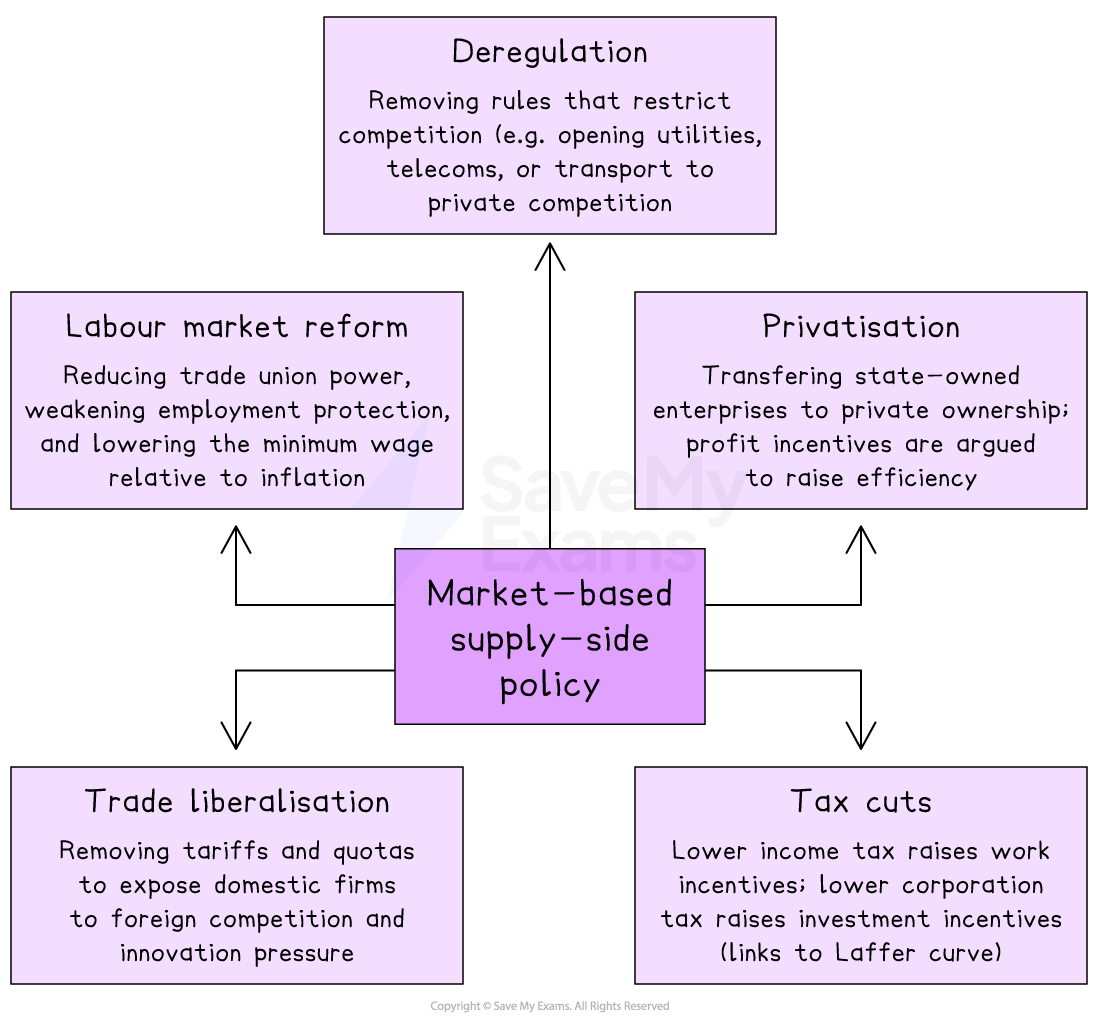
The main tools of market based supply-side policy
Interventionist supply-side policy
-
Interventionist supply-side policy involves direct government investment in the productive capacity of the economy, addressing market failures that prevent the private sector from achieving efficient outcomes alone
-
The main tools are
- Education and training — government-funded schools, universities, vocational training, apprenticeships
- Infrastructure investment — transport networks, broadband, energy grids, ports
- R&D subsidies — direct funding or tax credits for private research and innovation
- Industrial policy — strategic support for sectors deemed critical for long-run growth (e.g. green technology, semiconductors)
- Healthcare investment — improving the productivity of the labour force through better health outcomes
Effectiveness across objectives
| Objective | Mechanism | Effectiveness |
|---|---|---|
| Economic growth | - Both approaches raise LRAS - Long-run growth becomes non-inflationary | - Highly effective in the long run - Slow to materialise |
| Low inflation | - LRAS shift rightwards reduces price pressure at any output level; addresses cost-push inflation by reducing input costs | - The only category of policy that addresses cost-push inflation without raising unemployment |
| Low unemployment | - Reduces structural unemployment (training, mobility) - Reduces NAIRU | - Effective for structural and frictional unemployment - Not for cyclical |
| Balance of payments | - Productivity gains improve export competitiveness - Lower costs reduce import prices indirectly | - Effective in the long run - Depends on the export structure of the economy |
| Equitable income distribution | - Market-based widens inequality - Interventionist (education, training) reduces it | - Mixed, as it depends entirely on which approach is chosen |
Exam Hint When evaluating in essays, choose the approach based on the objective:
- Interventionist policies (education, training, infrastructure) for inequality and structural unemployment
- Market-based policies (tax cuts, deregulation) for raising business investment and short-term efficiency.
International trade policy
- International trade policy is the use of tariffs, quotas, subsidies and trade agreements to shape an economy's external trade environment in pursuit of macroeconomic objectives
- The arguments for free trade (comparative advantage, lower consumer prices, productivity through competition) and for protectionism (infant industries, anti-dumping, strategic protection) are covered earlier at AS Level starting here
- The focus now is on how trade policy serves macroeconomic objectives
Three policy stances that can be taken
-
Protectionist
- Tariffs and quotas to protect domestic industries
- Subsidies to support exporters
- Capital controls to manage currency flows
-
Free trade
- Minimal restrictions on imports and exports
- Participation in trade agreements (FTAs, customs unions)
- Commitment to WTO rules
-
Strategic
- Selective protection of strategic industries (semiconductors, food security, defence) combined with free trade in other sectors
Effectiveness across objectives
| Objective | Mechanism | Effectiveness |
|---|---|---|
| Economic growth | - Free trade raises efficiency through comparative advantage - Protectionism can support infant industries to grow into competitive sectors | - Free trade more effective in the long run - Protectionism only effective for industries with genuine comparative advantage and time-limited support |
| Low inflation | - Free trade lowers import prices and reduces cost-push pressure - Protectionism raises import prices | - Free trade reduces inflation - Protectionism risks raising it |
| Low unemployment | - Protectionism preserves jobs in protected industries - Free trade may cost jobs in some sectors but creates them in others | - Politically powerful argument for protectionism - Economically uncertain |
| Balance of payments | - Tariffs and quotas reduce imports - Subsidies raise exports - Both improve trade balance | - Effective in the short run, but risks retaliation - Long-run effects depend on income elasticities |
| Equitable income distribution | - Free trade benefits consumers but harms workers in import-competing industries - Protectionism does the reverse | - Distributional effects are central to the political economy of trade policy |
Strengths and limitations
| Strengths | Limitations | |
|---|---|---|
| Supply-side policy | - The only category of policy that addresses cost-push inflation - Can reduce inflation and unemployment simultaneously - Permanently improves performance - Complements demand-side policies - Reduces NAIRU | - Long time horizons (years) - Uncertain outcomes - Interventionist policies are expensive - Market-based policies can widen inequality - Cannot respond to short-term shocks |
| Trade policy | - Direct effect on competitiveness and trade balance - Supports strategic industries - Useful for developing economies pursuing industrialisation - FTAs lock in market access | - Retaliation from partner countries - Raises consumer prices through higher import costs - Reduces incentives for domestic innovation - WTO commitments constrain flexibility |
Worked Example With the help of a diagram, assess the effectiveness of government policies which might be used to reduce cost-push inflation.
[20 marks]
Indicative answer structure
AO1 Knowledge: Define cost-push inflation; identify possible policy responses (supply-side policy, exchange rate appreciation, trade liberalisation)
AO2 Analysis: Use AD/AS diagram to show how supply-side policy shifts LRAS rightwards, reducing the price level. Explain that
- Market-based supply-side policy (deregulation, tax cuts, trade liberalisation) reduces costs by raising efficiency
- Interventionist supply-side policy (training, infrastructure, R&D) reduces costs over time by raising productivity
- Free trade reduces import prices directly, easing cost-push pressure
- Demand-side policy (contractionary monetary or fiscal) is largely ineffective because it raises unemployment without addressing the supply-side cause
AO3 Evaluation: Supply-side policy is the theoretically appropriate response to cost-push inflation, but it has limitations
- Time lags — effects take years; cost-push shocks may persist in the short run
- Uncertain outcomes — productivity gains are not guaranteed
- Cost — interventionist policies raise government debt
- Distributional effects — market-based policies may widen inequality
Conclude that supply-side and trade policy are the most effective long-run responses to cost-push inflation, while demand-side policy may need to manage short-run pressures despite its limitations
Exam Hint In essays, distinguish market-based from interventionist policies explicitly and evaluate them separately.
The strongest answers identify which approach is more appropriate for the specific objective in the question:
- Interventionist for reducing inequality and structural unemployment
- Market-based for raising business investment and short-term efficiency
Treating supply-side policy as a single category limits evaluation marks.
For trade policy questions, the key insight is that free trade vs protectionism is rarely a binary choice - most countries use a strategic mix. The strongest answers evaluate both stances against the country's stage of development, industrial structure, and external position.
Use the post-2021 inflation episode as an evaluative anchor for supply-side questions. The episode was driven by supply-side shocks (energy, supply chains) - supply-side policy is the theoretically appropriate response, yet most central banks responded with contractionary monetary policy because it acts faster. This contrast illustrates the time-lag limitation of supply-side policy in real-world settings.
Was this revision note helpful?
Build on this topic