Demerit & Merit Goods (Cambridge International A-Level Economics)
Under consumption of merit goods
Under-consumption of merit goods
- Merit goods are products that are beneficial for society but the free market does not provide enough of them
- Demerit goods are products which have harmful impacts on consumers or society
- Value judgements play a role in determining whether goods are classified as merit or demerit goods
- Some goods are clearly defined as being a merit or demerit good, such as education (merit good) and illegal drugs (demerit good)
- The classification of some goods can be unclear, as it is based on a value judgement
Classification of goods based on value judgements
| Good | Merit good | Demerit good |
|---|---|---|
| Cannabis | - Can help with physical pain - May allow some to enjoy life more | - Can contribute to poor health and psychological conditions |
| Contraception | - Supporters of family planning argue contraception can help reduce costs of an unwanted pregnancy | - Some religions argue that contraception is a sin and encourages sexual promiscuity, undermining family values |
Merit goods
-
Consumers under-consume merit goods, as they do not fully recognise the private or external benefits
-
Merit goods are often under-consumed in a free-market and are a cause of partial market failure
- Common examples include vaccinations, education and electric cars
- Governments often have to subsidise these goods in order to lower the price and/or increase the quantity demanded
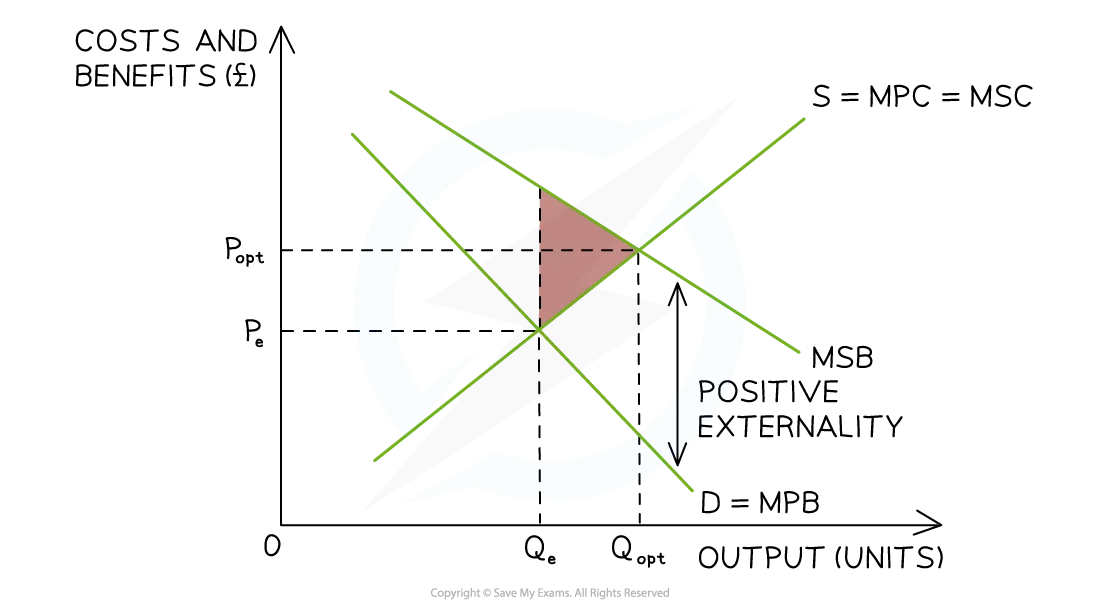
Positive externalities from the consumption of merit goods
Diagram analysis
-
The marginal social costs (MSC) are assumed to be equal to the marginal private cost (MPC) as the focus is on the consumer **(demand side) **of the market
-
The optimal allocation of resources for** society** would generate an equilibrium where marginal social benefit (MSB) = MSC
- At PeQe where there is no market failure
-
The free-market equilibrium for merit goods is underconsumed as consumers fail to consider the external benefits from consumption
- This is shown at PeQe where the MPB=MSC
-
The quantity consumed at Qe is below the socially optimal level resulting in an under-consumption and a partial market failure
- There is a deadweight loss to society **(pink triangle)
-
To be socially efficient, more factors of production should be** allocated to producing this good/service
Worked Example Which one of the following applies to merit goods?
- They are always overconsumed by individuals
- They are likely to be provided by the market
- They can only be supplied by the government
- They are always free
Answer
They are likely to be provided by the market
Merit goods (education and healthcare) can often be provided by the market. They are beneficial to society, and usually not enough are provided
Over-consumption of demerit goods
-
Consumers over-consume demerit goods to a greater extent than is considered desirable by society
-
Consumers are unlikely to consider all of the consequences when making consumption decisions
- The social costs of consumption outweigh the private costs
-
Demerit goods are often over-consumed in a free-market and are a cause of partial market failure
- These goods are usually addictive and harmful for consumers, e.g. gambling, alcohol, drugs, sugary foods/drinks
- Governments often have to regulate these goods in such a way that they raise the prices and/or limit the quantity demanded
-
The activities of producers can generate significant external costs, e.g. pollution caused by coal-burning power stations during the production of electricity
- However, electricity is considered to be a merit good
- The smoke is a by-product and not a good or service
-
For this reason, economists usually consider demerit goods to be goods used in consumption
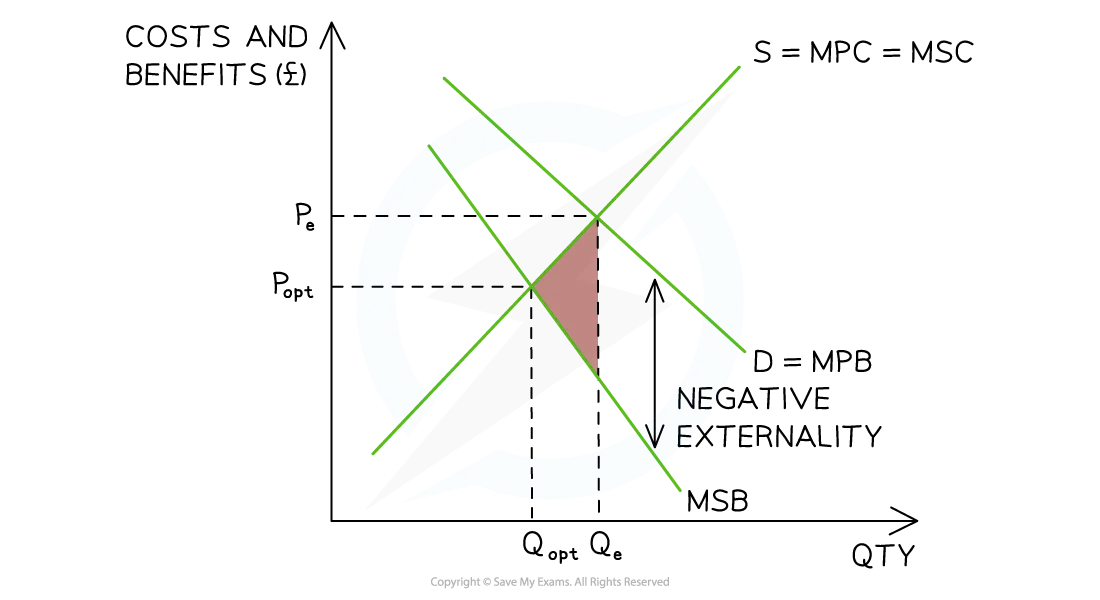
Negative externalities from the consumption of demerit goods
Diagram analysis
-
**The MSC **is assumed to be equal to the MPC as the focus is on the consumer (demand) side of the market
-
The optimal allocation of resources for** society** would generate an equilibrium where MSB = MSC
- At PeQe where there is no market failure
-
The free-market equilibrium for demerit goods is overconsumed as consumers fail to consider the external costs from consumption
- This is shown at PeQe where the MPB=MSC
-
The quantity consumed at Qe is above the socially optimal level, resulting in overconsumption and a partial market failure. There is a deadweight loss to society **(pink triangle)
-
To be socially efficient, fewer factors of production should be** allocated to producing this good/service
Exam Hint Not all products with positive or negative externalities in consumption are merit or demerit goods
You should be able to illustrate the misallocation of resources resulting from the consumption of merit and demerit goods using diagrams showing marginal private and social cost and benefit curves
Worked Example Which of the following applies to demerit goods?
- Their marginal private benefit is greater than their marginal social benefit
- They are always underprovided by the market
- Their marginal social benefit is greater than their marginal private benefit
- They have the characteristics of non-excludability and non-rivalry
**Answer **
Their marginal private benefit is greater than their marginal social benefit
Individuals may derive some private benefit from consuming demerit goods, but the overall social benefit is** less** due to the negative consequences on society. The MPB(the benefit to the individual consumer) tends to exceed the MSB(the benefit to society as a whole)
The other options are incorrect:
- Demerit goods may tend to be over-provided and over-consumed by the free market
- Demerit goods are associated with negative externalities, implying that the social benefit is less than the private benefit
- Demerit goods can often be characterised by excludability and rivalry, meaning they can be restricted to to those willing and able to pay and their consumption by one person reduces its availability to others
Was this revision note helpful?