From Utility To Demand (Cambridge International A-Level Economics)
Deriving a demand curve
Utility and deriving a demand curve
The law of diminishing marginal utility helps to explain why the demand curve is downward sloping
The Demand Curve
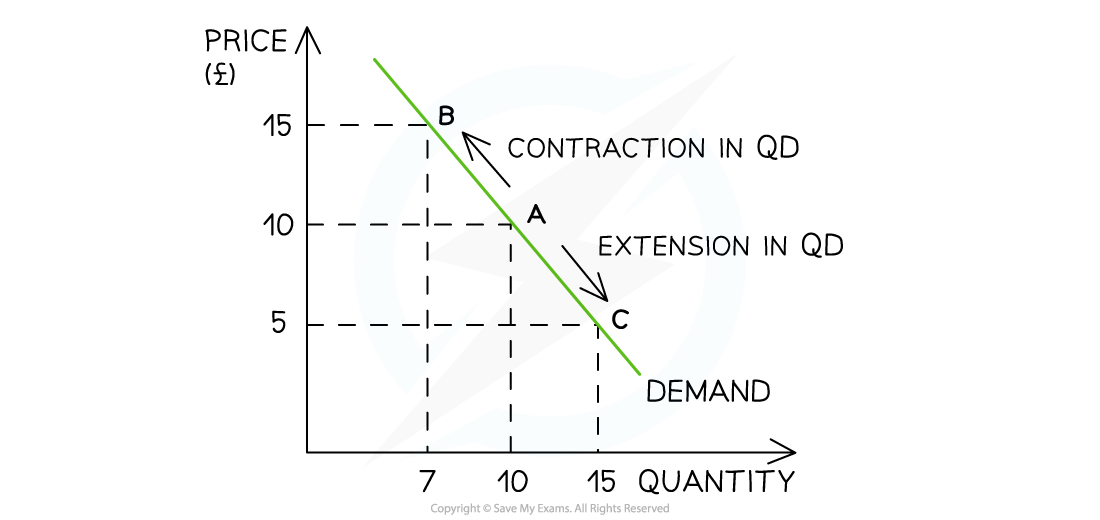
A demand curve shows a contraction in quantity demanded (QD) as prices increase and an extension in quantity demanded (QD) as prices decrease
Diagram analysis
- When the first units are purchased, the utility is high and consumers are willing to pay a high price at £15
- When subsequent units are purchased, each one offers less utility and the willingness of the consumer to pay the initial price decreases to £5
- Lowering the price makes it a more attractive proposition for the consumer to keep consuming additional units
- This is why firms offer discounts such as '50% off the second item'
Assumptions and limitations of utility theory
1. Rational decision-making
-
When analysing markets, a range of assumptions are made about the rationality of economic agents involved in the transactions
-
In classical economic theory, the word 'rational' means that economic agents are able to consider the outcome of their choices and recognise the net benefits of each one. Rational agents will select the choice which presents the highest benefits
- Consumers are assumed to act rationally. They do this by maximising their utility
- Producers are assumed to act rationally. They do this by selling goods/services in a way that maximises their profits
- Workers are assumed to act rationally. They do this by balancing welfare at work with consideration of both pay and benefits
- Governments are assumed to act rationally. They do this by placing the interests of the people they serve first in order to maximise their welfare
Exam Hint One way in which you can demonstrate critical thinking is to challenge the underlying assumptions of economic theory
Irrationality distorts markets and produces fundamentally different outcomes than what would be achieved if all economic agents acted rationally
-
In many ways, the assumption of rational decision-making is flawed. Consumers are often more influenced by the following than a rational computation of net benefits
- The influence of other people's behaviour
- The importance of habitual behaviour
- Consumer weakness in computation
2. The influence of other people's behaviour
-
Peer pressure often prompts consumers to make purchasing decisions that may go against a computation of net benefits. Consumers tend to exhibit herding behaviour
-
Producers influence consumers' choices through various forms of promotion, such as advertising, celebrity endorsements and influencer culture
- This results in emotional decisions and not necessarily rational decisions, e.g., consumers purchasing the branded Nurofen when they could purchase the much cheaper (and essentially identical) Ibuprofen
-
Producers use advanced behavioural psychology techniques to influence consumer choices, e.g. Neuro branding
3. The importance of habitual behaviour
-
Consumers make so many purchasing decisions so they often rely on habits to speed up the process
- Using rule of thumb refers to a shortcut that makes a quick estimation of benefits without gathering too much information
- Consumers use information from the past, which may be outdated, as they habitually purchase the same products, e.g., visiting the same sections in a supermarket for several years
-
Consumer inertia often develops as convenience is prioritised
-
Consumers make purchasing decisions that directly harm them and are usually addictive, e.g., alcohol.
-
Sellers recognise habitual patterns and exploit them. For example, products placed at the checkout till to benefit from impulse purchasing (chewing gum)
Consumer weakness at computation
-
The wider the range of choice, the harder it is for a consumer to gather information and compute which one offers the highest net benefits
-
Consumers often lack the time or ability to consider the relative prices of different products and sellers will frequently make it difficult for them to do so
- Products the seller wants to sell are often placed at eye level where computation is easy
- Many products that would deliver higher benefits are placed below knee level or high on the shelf where computation is harder
Was this revision note helpful?
Build on this topic