Standard Electrode & Cell Potentials (Cambridge International A-Level Chemistry)
Standard Electrode & Standard Cell Potentials
Spec point —
24.2.1
Electrode potential
-
The electrode (reduction) potential(E) is a value which shows how easily a substance is reduced
-
These are demonstrated using reversible half equations
- This is because there is a redox equilibrium between two related species that are in different oxidation states
- For example, if you dipped a zinc metal rod into a solution which contained zinc ions, there would be zinc atoms losing electrons to form zinc ions and at the same time, zinc ions gaining electrons to become zinc atoms
- This would cause a redox equilibrium
Half equations
-
When writing half equations for this topic, the electrons will always be written on the left-hand side (demonstrating reduction)
-
The position of equilibrium is different for different species, which is why different species will have electrode (reduction) potentials
-
The more positive (or less negative) an electrode potential, the more likely it is for that species to undergo reduction
- The equilibrium position lies more to the right
-
For example, the positive electrode potential of bromine below, suggests that it is likely to get reduced and form bromide (Br-) ions
Br2(l) + 2e- ⇌ 2Br- (aq) voltage = +1.09 V
-
The more negative (or less positive) the electrode potential, the less likely it is that reduction of that species will occur
- The equilibrium position lies more to the left
-
For example, the negative electrode potential of sodium suggests that it is unlikely that the sodium (Na+) ions will be reduced to sodium (Na) atoms
Na+(aq) + e- ⇌ Na (s) voltage = -2.71 V
Standard electrode potential
-
The position of equilibrium and therefore the electrode potential depends on factors such as:
- Temperature
- Pressure of gases
- Concentration of reagents
-
So, to be able to compare the electrode potentials of different species, they all have to be measured against a common reference or standard
Standard conditions
-
Standard conditions also have to be used when comparing electrode potentials
-
These standard conditions are:
- An ion concentration of 1.00 mol dm-3
- A temperature of 298 K
- A pressure of 1 atm
-
The electrode potentials are measured relative to something called a standard hydrogen electrode
-
The standard hydrogen electrode is given a value of 0.00 V, and all other electrode potentials are compared to this standard
-
This means that the electrode potentials are always referred to as a standard electrode potential (Eꝋ)**
-
The standard electrode potential (Eꝋ)** is the voltage produced when a standard half-cell is connected to a standard hydrogen cell under standard conditions
-
For example, the standard electrode potential of bromine suggests that relative to the hydrogen half-cell it is more likely to get reduced, as it has a more positive Eꝋ value
Br2(l) + 2e- ⇌ 2Br-(aq) Eꝋ = +1.09 V
2H+(aq) + 2e- ⇌ H2(g) Eꝋ = 0.00 V
- The standard electrode potential of sodium, on the other hand, suggests that relative to the hydrogen half-cell it is less likely to get reduced as it has a more negative Eꝋ value
Na+(aq) + e- ⇌ Na (s) Eꝋ = -2.71 V
2H+ (aq) + 2e- ⇌ H2(g) Eꝋ = 0.00 V
Standard cell potential
-
Once the Eꝋ of a half-cell is known, the voltage of an electrochemical cell made up of two half-cells can be calculated
- These could be any half-cells and neither have to be a standard hydrogen electrode
-
This is also known as the standard cell potential (Ecellꝋ)
-
The standard cell potential can be determined by two methods:
- Using the equation Ecellꝋ****= Ereductionꝋ– Eoxidationꝋ
- Use of this equation does require knowledge of which reaction is reduction and which is oxidation
- The reduction reaction has the higher / more positive Eꝋ* *value
- Ecellꝋ****is the difference in Eꝋ between two half-cells
-
For example, an electrochemical cell consisting of bromine and sodium half-cells has an Ecellꝋ**** of:
- Ecellꝋ****= (+1.09) - (-2.71)
- Ecellꝋ****= +3.80 V
Standard Hydrogen Electrode
Spec point —
24.2.2
-
When a metal rod is placed in an aqueous solution, a redox equilibrium is established between the metal ions and atoms
- For example, the copper atoms get oxidised and enter the solution as copper ions
Cu (s) → Cu2+(aq) + 2e-
Oxidation of copper ions
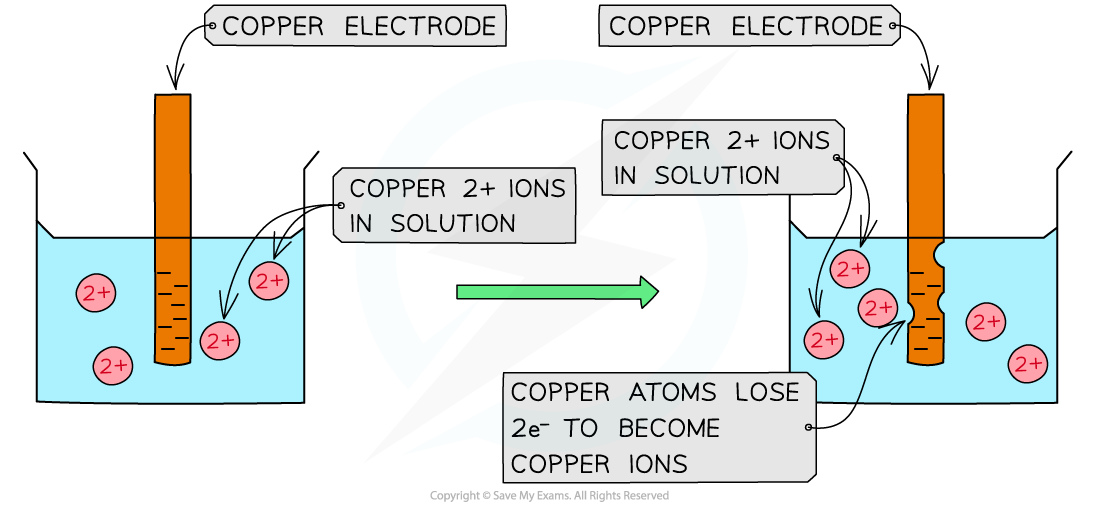
During oxidation, copper atoms lose 2 electrons to form copper ions
- The copper ions gain electrons from the metal rod and deposit as metal atoms on the rod
Cu2+(aq) + 2e- → Cu (s)
Reduction of copper ions
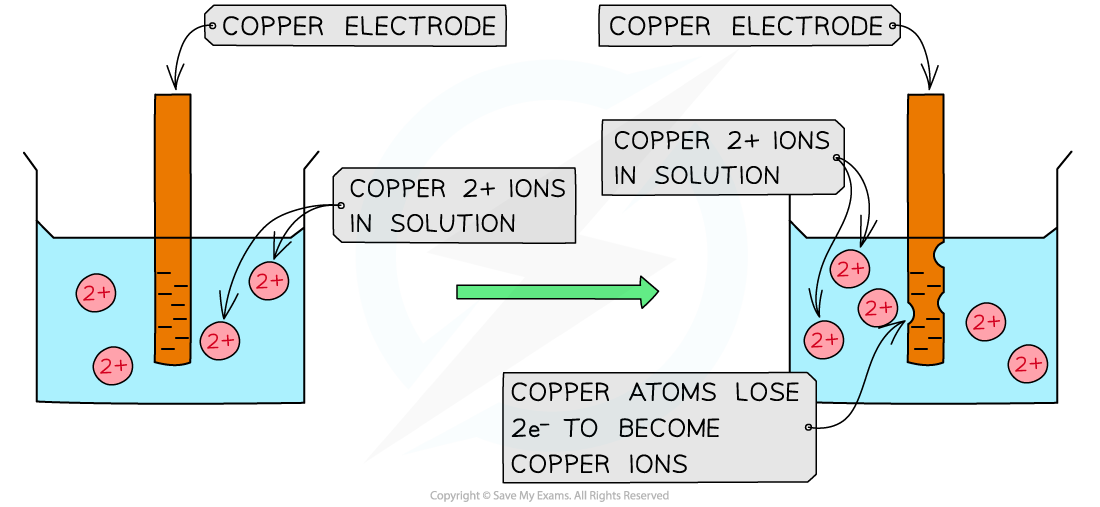
During reduction, copper ions gain 2 electrons to form copper atoms
-
When equilibrium is established, the rate of oxidation and reduction of copper is equal
-
The position of the redox equilibrium is different for different metals
- Copper is more easily reduced, thus the equilibrium lies further over to the right
Cu2+(aq) + 2e- ⇌ Cu (s)
- Vanadium is more easily oxidised, thus the equilibrium lies further over to the left
V2+(aq) + 2e- ⇌ V(s)
-
The metal atoms and ions in solution cause an electric potential(voltage)
-
This potential cannot be measured directly however the potential between the metal/metal ion system and another system can be measured
-
This value is called the electrode potential (E) and is measured in volts
- The electrode potential is the voltage measured for a half-cell compared to another half-cell
- Often, the half-cell used for comparison is the standard hydrogen electrode
Standard hydrogen electrode
-
The standard hydrogen electrode is a half-cell used as a reference electrode and consists of:
- Hydrogen gas in equilibrium with H+ ions of concentration 1.00 mol dm-3 (at 1 atm)
2H+(aq) + 2e-⇌ H2 (g)
- An inert platinum electrode that is in contact with the hydrogen gas and H+ ions
- When the standard hydrogen electrode is connected to another half-cell, the standard electrode potential of that half-cell can be read off a voltmeter
The standard hydrogen electrode (SHE)
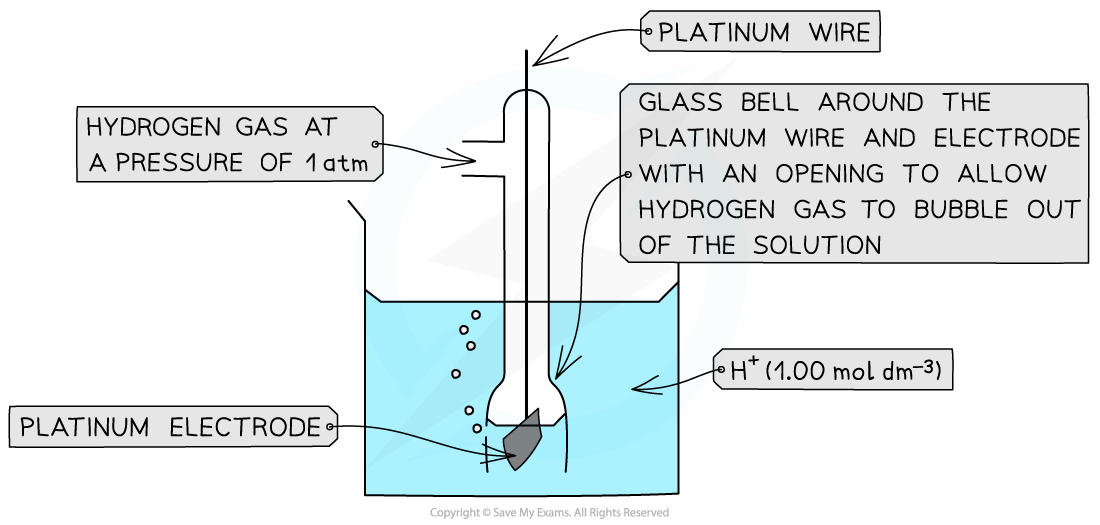
The standard electrode potential of a half-cell can be determined by connecting it to a standard hydrogen electrode
Was this revision note helpful?