Acyl Chlorides (Cambridge International A-Level Chemistry)
Production of Acyl Chlorides
Spec point —
33.3.1
-
Due to the increased reactivity of acyl chlorides compared to carboxylic acids, they are often used as starting compounds in organic reactions
-
Acyl chlorides are compounds that contain an -COCl functional group and can be prepared from the reaction of carboxylic acids with:
- Solid phosphorus(V) chloride (PCl5)
- Liquid phosphorus(III) chloride (PCl3) and heat
- Liquid sulfur dichloride oxide (SOCl2)
-
Propanoyl chloride can this way be prepared from propanoic acid using the reactions above
Using propanoic acid to form propanoyl chloride
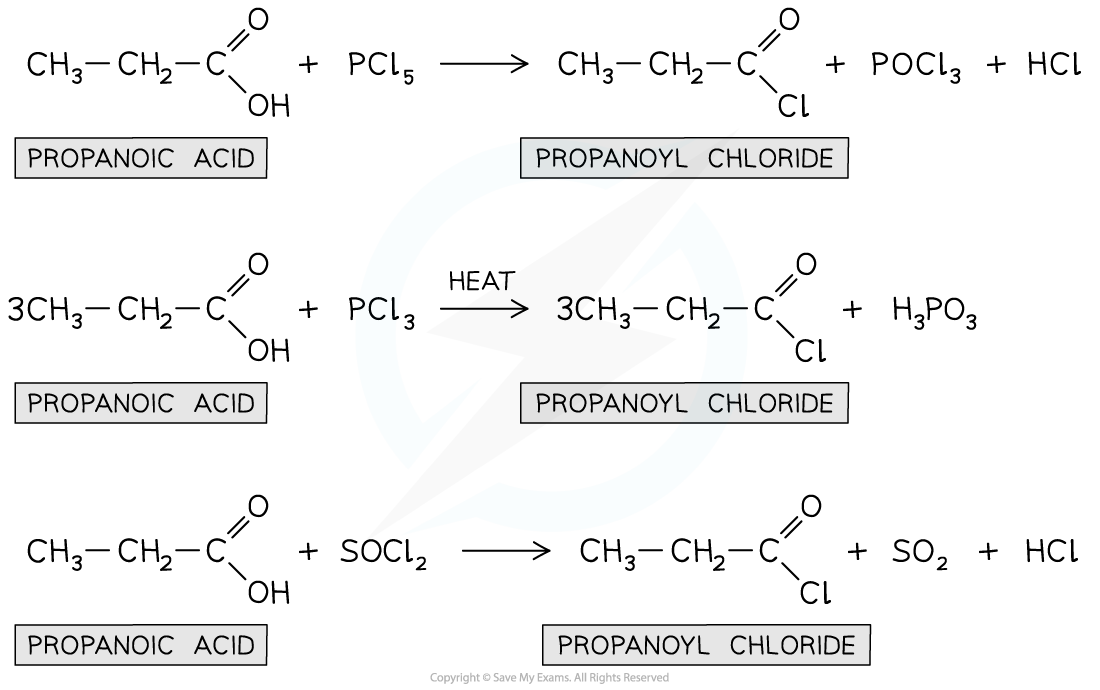
Propanoic acid can be used to produce propanoyl chloride with different by-products depending on the reagent used
Reactions of Acyl Chlorides
Spec point —
33.3.2
-
Acyl chlorides are reactive organic compounds that undergo many reactions such as addition-elimination reactions
-
In addition-elimination reactions, the addition of a small molecule across the C=O bond takes place followed by elimination of a small molecule
-
Examples of these addition-elimination reactions include:
- Hydrolysis
- Reaction with alcohols and phenols to form esters
- Reaction with ammonia and amines to form amides
Hydrolysis
-
The hydrolysis of acyl chlorides results in the formation of a carboxylic acid and HCl molecule
-
This is an addition-elimination reaction
- A water molecule adds across the C=O bond
- A hydrochloric acid (HCl) molecule is eliminated
-
An example is the hydrolysis of propanoyl chloride to form propanoic acid and HCl
Hydrolysis of acyl chlorides
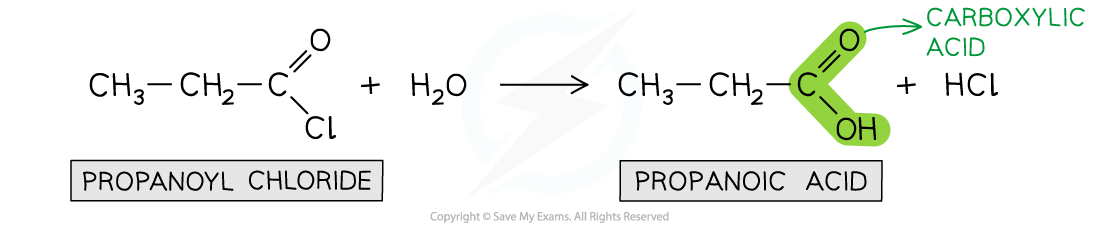
Acyl chlorides are hydrolysed to carboxylic acids
Formation of esters
-
Acyl chlorides can react with alcohols and phenols to form esters
- The reaction with phenols requires heat and a base
-
Esters can also be formed from the reaction of carboxylic acids with phenol and alcohols however, this is a slower reaction as carboxylic acids are less reactive and the reaction does not go to completion(so less product is formed)
-
Acyl chlorides are therefore more useful in the synthesis of esters
-
The esterification of acyl chlorides is also an addition-elimination reaction
- The alcohol or phenol adds across the C=O bond
- A HCl molecule is eliminated
Esterification reactions using acyl chlorides
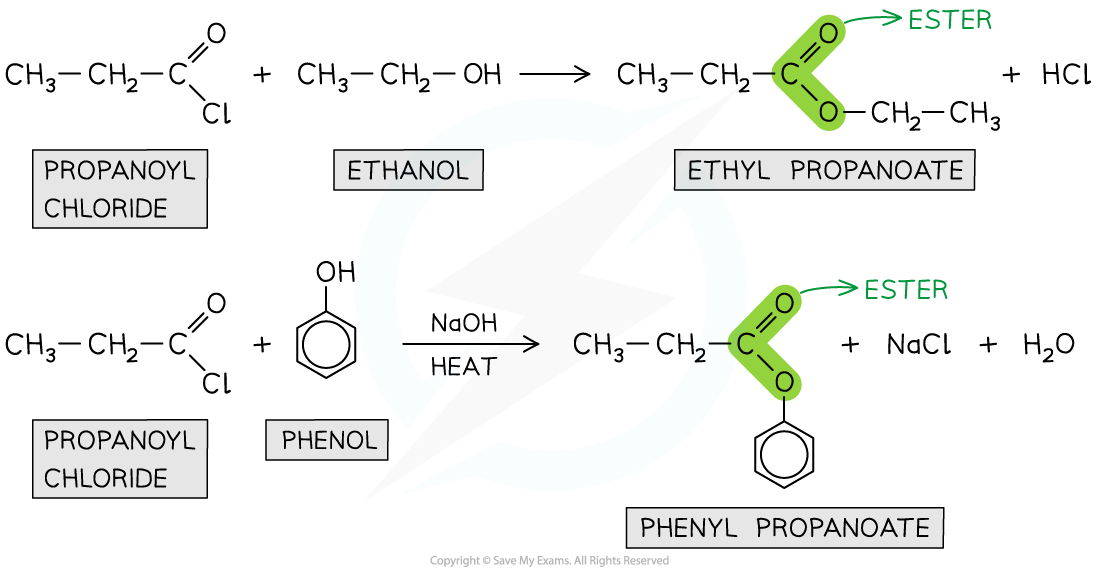
Acyl chlorides undergo esterification with alcohols and phenols to form esters
Formation of amides
-
Acyl chlorides react with ammonia or primary amines to form amides in a condensation reaction.
-
A lone pair on the nitrogen atom attacks the carbonyl carbon in the acyl chloride.
-
The reaction proceeds via a nucleophilic addition–elimination mechanism:
- The nucleophile adds to the C=O bond
- A chloride ion (Cl⁻) is eliminated
- Hydrogen chloride (HCl) is formed
What happens to the HCl?
- The HCl formed does not remain unreacted.
- It is immediately neutralised by a second molecule of ammonia or amine present in excess.
- This forms an ammonium salt (e.g. NH₄Cl, CH₃NH₃Cl).
Why 2 molecules are needed
- The 1st molecule of ammonia/amine forms the amide
- The 2nd molecule of ammonia/amine neutralises the HCl and forms ammonium salt
Examples
- Reaction with ammonia
- Product: Primary amide (propanamide) and ammonium chloride
CH3CH2COCl + 2NH3 → CH3CH2CONH2 + NH4Cl
- Reaction with methylamine
- Product: Secondary (substituted) amide and methylammonium chloride
CH3COCl + 2CH3NH2 → CH3CONHCH3 + CH3NH3Cl
- Reaction with ethylamine
- Product: Secondary (substituted) amide and ethylammonium chloride
CH3COCl + 2CH3CH2NH2 → CH3CONHCH2CH3 + CH3CH2NH3Cl
Summary for formation of amides
- All reactions form HCl, which is not observed as a separate product
- The HCl is neutralised by excess ammonia or amine
- The final products are an amide and an ammonium salt
Was this revision note helpful?
Build on this topic