Electrophilic Substitution of Arenes (Cambridge International A-Level Chemistry)
Spec point —
30.1.4
Electrophilic Substitution of Arenes
-
The electrophilic substitution reaction in arenes consists of three steps:
- Generation of an electrophile
- Electrophilic attack
- Regenerating aromaticity
Generation of an electrophile
-
The delocalised π system is extremely stable and is a region of high electron density
-
Consequently, the first step of an electrophilic substitution reaction involves the generation of an electrophile
- The electrophile can be a positive ion or the positive end of a polar molecule
-
There are numerous electrophiles which can react with benzene:
Table of electrophiles commonly used with benzene
| Reaction type | Electrophile |
|---|---|
| halogenation | X+, e.g. Cl+ |
| nitration | NO2+ |
| Friedel-Craft's alkylation | R+ |
| Friedel-Craft's acylation | R-C=O+ |
-
Typically electrophiles cannot simply be added to the reaction mixture
- The electrophile is produced in situ, by adding appropriate reagents* to the reaction mixture
Electrophilic attack
- A pair of electrons from the benzene ring is donated to the electrophile to form a covalent bond
- This disrupts the aromaticity in the ring as there are now only four π electrons and there is a positive charge spread over the five carbon atoms
Regenerating aromaticity
-
In the final step of electrophilic substitution, the aromaticity of the benzene ring system is restored
-
This happens by heterolytic cleavage of the C-H bond
- This means that the electrons in this bond go into the benzene π bonding system
Electrophilic substitution mechanism
-
The halogenation and nitration of arenes are both examples of electrophilic substitution reactions
- A hydrogen atom is replaced by a halogen atom or a nitro (-NO2) group
Bromination and nitration of benzene
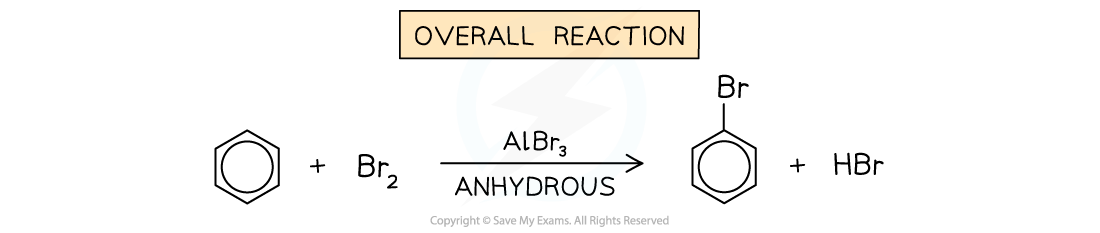

During bromination, a hydrogen atom is substituted by a bromine atom and during nitration, a hydrogen atom is substituted by a nitro group
Step 1: Generating the Br+ and NO2+ electrophiles
-
For the halogenation reaction:
- This is achieved by reacting the halogen with a halogen carrier
- The halogen molecules form a dative bond with the halogen carrier by donating a lone pair of electrons from one of its halogen atoms into an empty 3p orbital of the halogen carrier
Step 1 of the halogenation of arenes
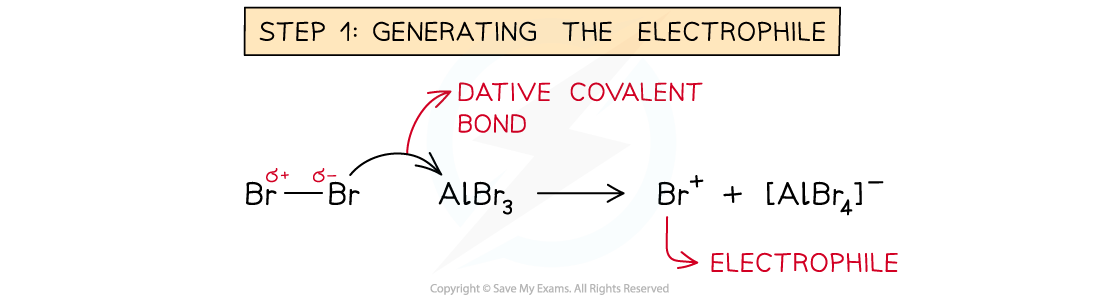
During bromination, an AlBr3halogen carrier catalyst is used and during chlorination an AlCl3halogen carrier catalyst is used
-
For the nitration reaction:
- The electrophile NO2+ion is generated by reacting it with concentrated nitric acid (HNO3) and concentrated sulfuric acid (H2SO4)
Step 1 of the nitration of arenes
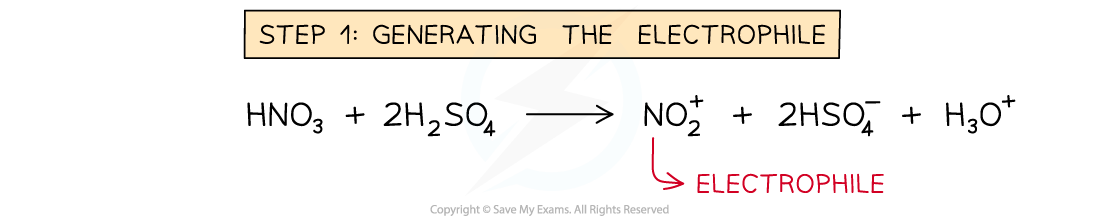
During nitration, concentrated nitric acid and concentrated sulfuric acid react to form the NO2+electrophile
Step 2: Electrophilic attack by the Br+ and NO2+ electrophiles
-
Once the electrophile has been generated, it will carry out an electrophilic attack on the benzene ring
- The nitrating mixture of HNO3 and H2SO4 is refluxed with the arene at 25 - 60 oC
-
A pair of electrons from the benzene ring is donated to the electrophile to form a covalent bond
- This disrupts the aromaticity in the ring as there are now only four π electrons and there is a positive charge spread over the five carbon atoms
Step 2 of the halogenation of arenes

A pair of electrons from the benzene ring is donated to the Br+electrophile to form a covalent bond causing a loss in aromaticity
Step 2 of the nitration of arenes

A pair of electrons from the benzene ring is donated to the NO2+electrophile to form a covalent bond causing a loss in aromaticity
Step 3: Regenerating / restoring aromaticity
-
In the final step of the reaction, this aromaticity is restored by heterolytic cleavage of the C-H bond
- This means that the bonding pair of electrons goes into the benzene π bonding system
Step 3 of the halogenation of arenes
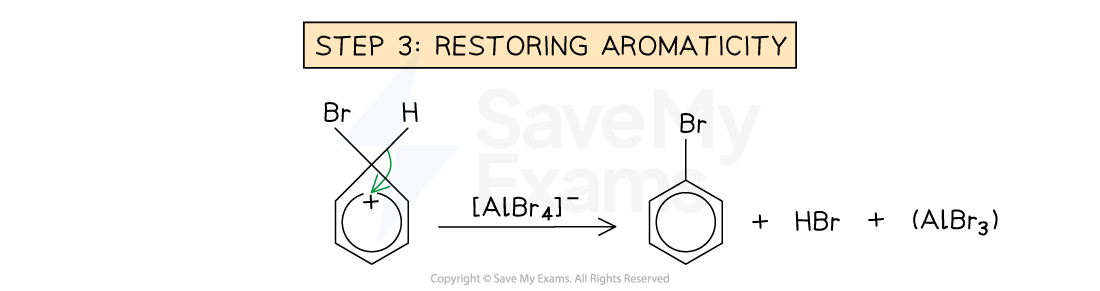
Step 3 of the nitration of arenes

In both reactions, the C–H bond of the substituted carbon atom breaks and the electrons go back into the benzene π bonding system, restoring aromaticity
Addition reactions of arenes
-
The delocalisation of electrons(also called aromatic stabilisation) in arenes is the main reason why arenes predominantly undergo substitution reactions over addition reactions
-
In substitution reactions, the aromaticity is restored by heterolytic cleavage of the C-H bond
-
In addition reactions, on the other hand, the aromaticity is not restored and is in some cases completely lost
- The hydrogenation of arenes is an example of an addition reaction during which the aromatic stabilisation of the arene is completely lost
- The cyclohexane formed is energetically less stable than the benzene
Was this revision note helpful?
Build on this topic