Enthalpies of Solution & Hydration (Cambridge International A-Level Chemistry)
Enthalpy Change of Hydration & Solution
Enthalpy change of solution
-
The standard enthalpy change of solution (ΔH solθ) **is the enthalpy change when 1 mole of an ionic substance dissolves in sufficient water to form a very dilute solution under standard conditions
-
The symbol**(aq) is used to show that the solid is dissolved in sufficient water
- For example, the enthalpy changes of solution for potassium chloride are described by the following equations:
KCl (s) + aq → KCl (aq)
OR
KCl (s) + aq → K+(aq) + Cl– (aq)
- ΔHsolθ can be exothermic(negative) or endothermic(positive)
Enthalpy change of hydration
-
The lattice energy (ΔHlattθ) of KCl is -711 kJ mol-1
- This means that 711 kJ mol-1 is **released **when the KCl ionic lattice is formed
- Therefore, to break the attractive forces between the K+ and Cl- ions, +711 kJ mol-1 is needed
-
However, the ΔH solθ of KCl is +26 kJ mol-**1
-
This means that another +685 kJ mol-1** **(711 - 26) is required to break the KCl lattice
-
This is** compensated for by the standard enthalpy change of hydration (ΔHhydθ)
- The standard enthalpy change of hydration (ΔH hydθ) is the enthalpy change when 1 mole of a specified gaseous ion dissolves in sufficient water to form a very dilute solution under standard conditions
Mg2+(g) + aq → Mg2+(aq)
-
Hydration enthalpies are the measure of the energy that is released when there is an attraction formed between the ions and water molecules
- Hydration enthalpies are exothermic
Ion–Dipole interactions during dissolution
- When an ionic solid dissolves in water, it breaks into positive and negative ions
- Water is a polar molecule, with a δ⁻ oxygen atom and δ⁺ hydrogen atoms
- The oxygen atom is attracted to positive ions (cations)
- The hydrogen atoms are attracted to negative ions (anions)
- These attractions form ion–dipole bonds between the water molecules and the ions
Interactions of polar water molecules and other ions in solution
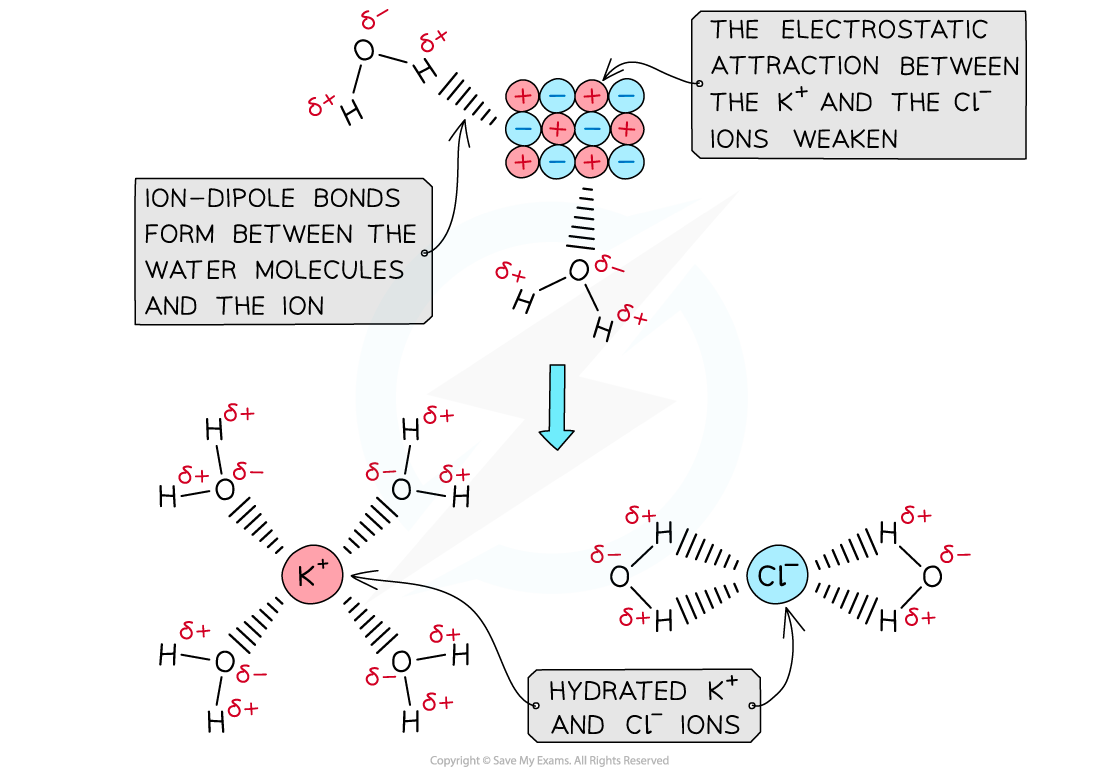
The polar water molecules will form ion-dipole bonds with the ions in solution (a) causing the ions to become hydrated (b)
Was this revision note helpful?