Multi-step Synthetic Routes (Cambridge International A-Level Chemistry)
Spec point —
21.1.2
Multi-Step Synthetic Routes
-
A large number of organic products are made from a few starting compounds using appropriate reagents and conditions
-
Knowing how organic functional groups are related to each other is key to the synthesis of a given molecule
-
The main functional groups you need to know are
- Alkanes
- Alkenes
- Haloalkanes
- Nitriles
- Amines
- Alcohols
- Carbonyls (aldehydes & ketones)
- Hydroxynitriles
- Carboxylic acids
- Esters
- Acyl chlorides
- Primary and secondary amides
Exam Hint You also need to be able to identify the functional groups of these chemicals in structures that are given to you
Aliphatic Reaction Pathways
- The key interconversions between functional groups are summarised here:
Aliphatic Reactions Table
| Reactant | Product | Reagents | Reaction |
|---|---|---|---|
| Alkene | Haloalkane | Hydrogen halide | Electrophilic addition |
| Alkene | Alcohol | Hydration | Steam + H2SO4 / heat |
| Alkene | Alkane | Hydrogen + Ni catalyst / 150 °C | Electrophilic addition / hydrogenation |
| Alcohol | Alkene | Al2O3 or conc. acid / heat | Elimination / dehydration |
| Alcohol | Haloalkane | NaX + H2SO4 / heat under reflux | Nucleophilic substitution |
| Haloalkane | Alcohol | NaOH (aq) / heat under reflux | Nucleophilic substitution |
| Alkane | Haloalkane | Halogen / UV light | Free radical substitution |
| Primary alcohol | Aldehyde | K2Cr2O7 / H2SO4 / Distillation | Oxidation |
| Secondary alcohol | Ketone | K2Cr2O7 / H2SO4 / Heat under reflux | Oxidation |
| Primary alcohol | Carboxylic acid | K2Cr2O7 / H2SO4 / Heat under reflux | Oxidation |
| Aldehyde | Primary alcohol | NaBH4 / H2O | Reduction |
| Ketone | Secondary alcohol | NaBH4 / H2O, NaCN | Reduction |
| Haloalkane | Nitrile | KCN/ethanol | Nucleophilic substitution |
| Haloalkane | Amine | NH3 / ethanol | Nucleophilic substitution |
| Nitrile | Carboxylic acid | H2O / HCl | Hydrolysis |
| Aldehyde | Hydroxynitrile | NaCN / H+ | Nucleophilic addition |
| Alcohol | Ester | Carboxylic acid / H2SO4 | Esterification |
| Carboxylic acid | Ester | Alcohol / H2SO4 | Esterification |
| Ester | NaOH(aq) | Alkaline hydrolysis | Carboxylate salt and alcohol |
| Ester | Carboxylic acid | Dilute acid | Acid hydrolysis |
| Carboxylic acid | Acyl chloride | SOCl2 | Chlorination |
| Acyl chloride | Carboxylic acid | H2O | Hydrolysis |
| Acyl chloride | Primary amide | NH3 | Nucleophilic addition elimination |
| Acyl chloride | Secondary amide | Primary amine | Nucleophilic addition elimination |
Aromatic Reaction Pathways
- The key aromatic reactions are summarised here:
Aromatic Reactions Table
| Reactant | Product | Reagents | Reaction |
|---|---|---|---|
| Benzene | Methylbenzene | CH3Cl / AlCl3 | Alkylation / Electrophilic substitution |
| Benzene | Bromobenzene | Br2 / FeBr3 | Bromination / Electrophilic substitution |
| Benzene | Chlorobenzene | Cl2 / AlCl3 | Chlorination / Electrophilic substitution |
| Benzene | Nitrobenzene | HNO3 / H2SO4 | Nitration / Electrophilic substitution |
| Nitrobenzene | Aminobenzene / phenylamine / aniline | Sn / HCl | Reduction |
| Aminobenzene | 2,4,6-tribromoaminobenzene / 2,4,6-tribromoaniline | Bromine | Electrophilic substitution |
| Benzene | Phenylethanone | CH3COCl / AlCl3 | Acylation / Electrophilic substitution |
| Phenylethanone | 1-Phenylethanol | NaBH4 | Reduction |
Designing a Reaction Pathway
-
The given molecule is usually called the target molecule and chemists try to design a synthesis as efficiently as possible
-
Designing a reaction pathway starts by drawing the structures of the target molecule and the starting molecule
-
Determine if they have the same number of carbon atoms
- If you need to lengthen the carbon chain you will need to put on a nitrile group by nucleophilic substitution
-
Work out all the compounds that can be made from the starting molecule and all the molecules that can be made into the target molecule
- Match the groups they have in common and work out the reagents and conditions needed
Worked Example Suggest how the following synthesis could be carried out:
Ethene to 1-aminopropane
Answer
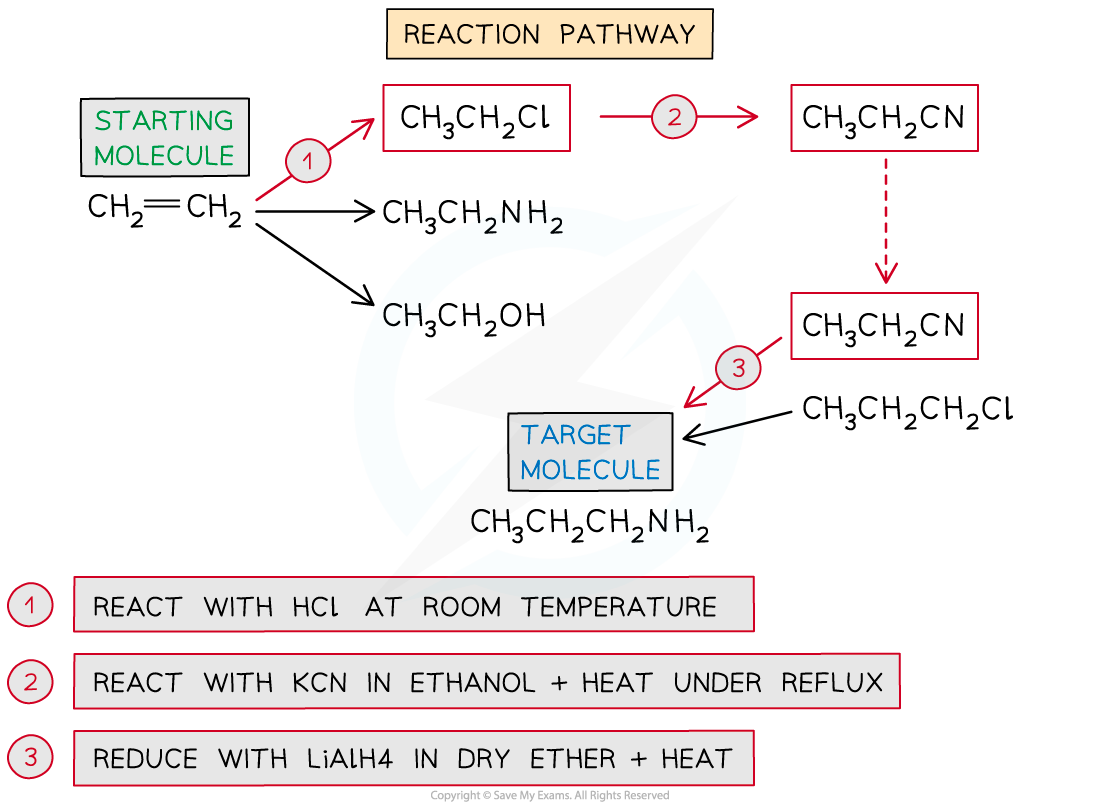
Exam Hint Sound knowledge of all of the different reactions is beneficial as the A-level course simply states that you should be able to design a multistage synthesis
Past papers generally go to four steps in a multistep reaction although there is no clear limit stated
Was this revision note helpful?
Build on this topic