Stereoisomerism in Transition Element Complexes (Cambridge International A-Level Chemistry)
Geometrical & Optical Stereoisomerism in Complexes
Spec point —
28.4.1
- Transition element complexes can exhibit stereoisomerism
Geometrical (cis-trans) isomerism
-
Even though transition element complexes do not have a double bond, they can still have geometrical isomers
-
Square planar and octahedral complexes with two pairs of different ligands exhibit cis-trans isomerism
-
An example of a square planar complex with two pairs of ligands is the anti-cancer drug cisplatin
- Cisplatin has beneficial medical effects by binding to DNA in cancer cells
- Whereas, transplatin cannot be used in cancer treatment
Cisplatin is a square planar transition element complex
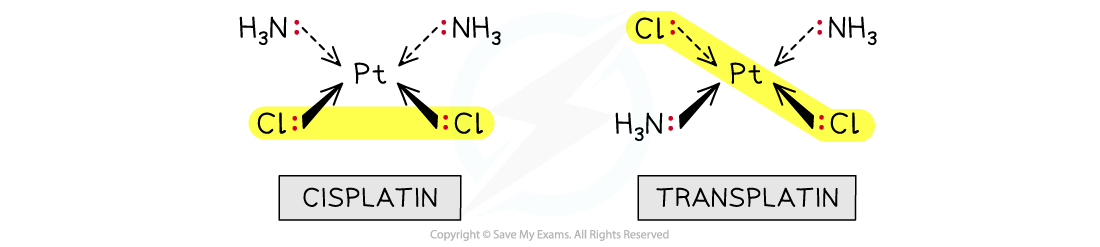
Cisplatin has 2 adjacent chloride ligands while transplatin has 2 chloride ligands opposite each other, meaning they exhibit geometrical isomerism
-
As long as an octahedral complex ion has two ligands attached to it that are different to the rest, then the complex can display geometric isomerism
-
Examples of octahedral complexes that exhibit geometrical isomerism are the [Co(NH3)4(H2O)2]2+ and [Ni(H2NCH2CH2NH2)2(H2O)2]2+ complexes
- [Ni(H2NCH2CH2NH2)2(H2O)2]2+ can also be written as [Ni(en)2(H2O)2]2+
-
Like in the square planar complexes, if the two ‘different’ ligands are next to each other then that is the ‘cis’ isomer, and if the two ‘different’ ligands are opposite each other then this is the ‘trans’ isomer
- In [Co(NH3)4(H2O)2]2+, the two water ligands are next door to each other in the cis isomer and are opposite each other in the trans isomer
Octahedral transition metal complexes exhibiting geometrical isomerism
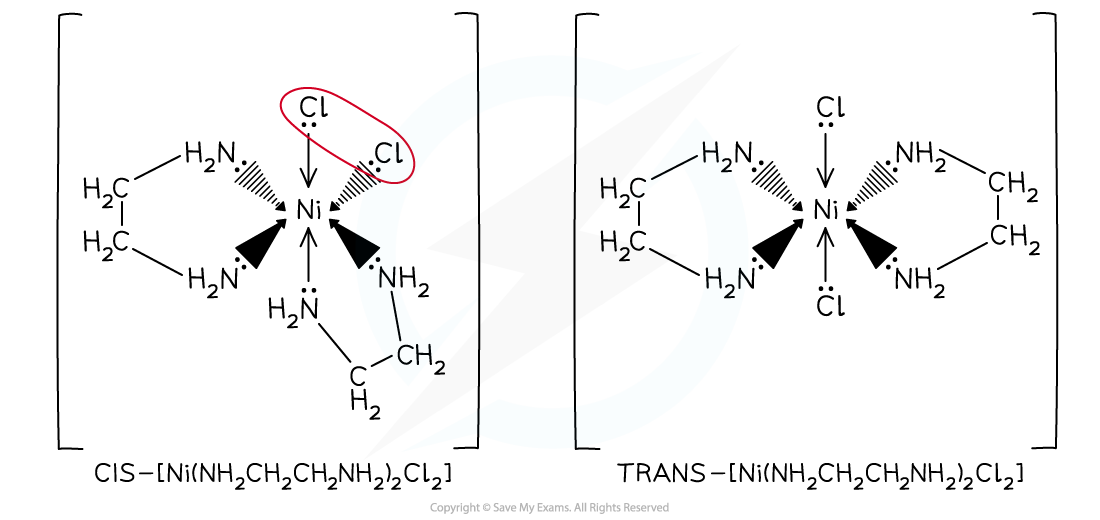
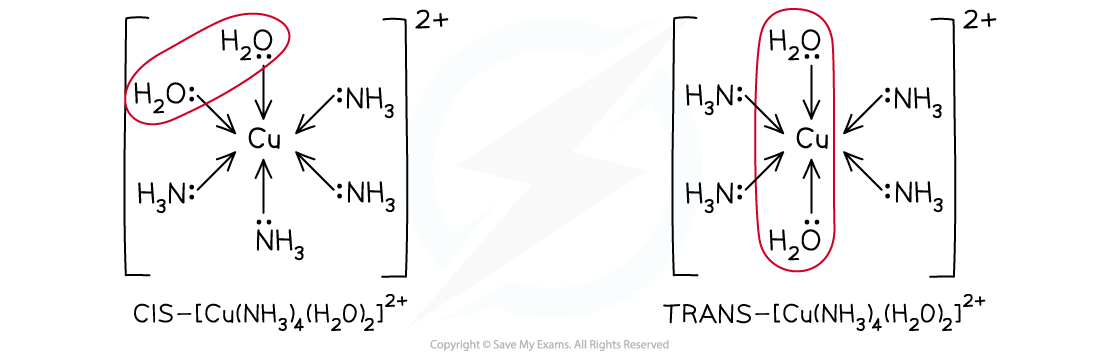
Octahedral complexes exhibit geometrical isomerism when they have 2 ligands attached that are different to the rest
Optical isomerism
-
Octahedral complexes with bidentate ligands also have optical isomers
-
This means that the two forms are non-superimposable mirror images of each other
- They have no plane of symmetry, and one image cannot be placed directly on top of the other
-
The optical isomers only differ in their ability to rotate the plane of polarised light in opposite directions
-
Examples of octahedral complexes that have optical isomers are the [Ni(H2NCH2CH2NH2)3]2+and [Ni(H2NCH2CH2NH2)2(H2O)2]2+ complexes
- The ligand H2NCH2CH2NH2 can also be written as ‘en’ instead
Octahedral transition metal complexes exhibiting optical isomerism
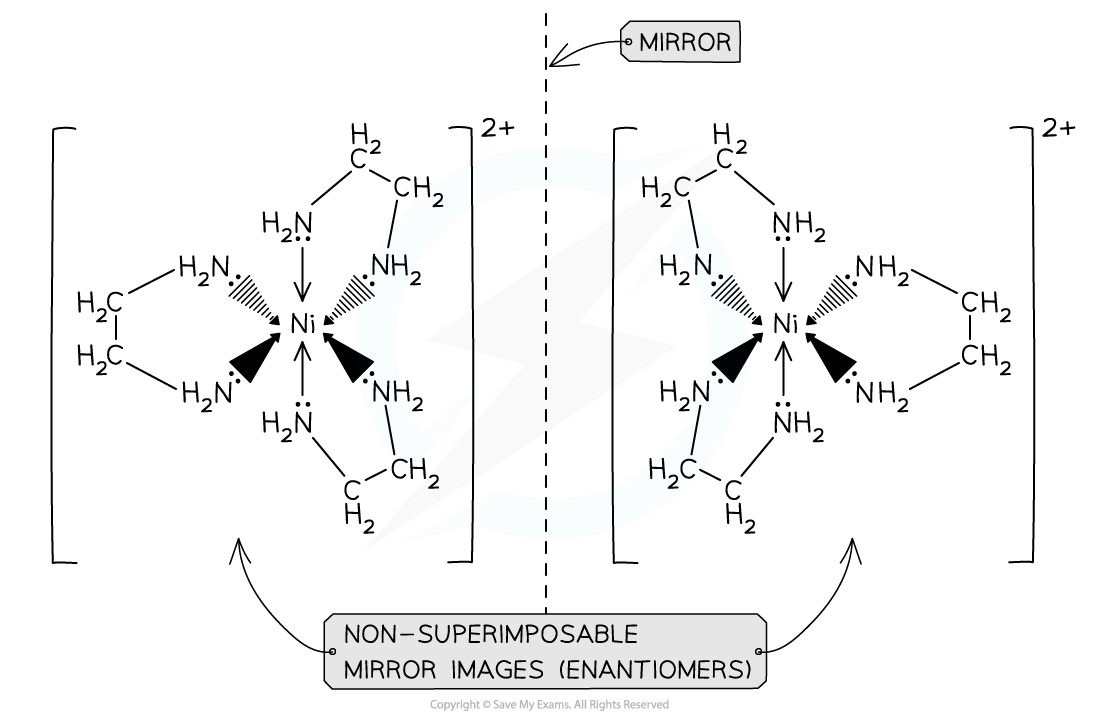
The orientation of the ligands can cause the complex to exhibit optical isomerism
Polarity of Complexes
Spec point —
28.4.2
- The isomers of transition elements complexes may be polar or non-polar
- This is caused by differences in electronegativity of the atoms in the ligands that form the dative bond to the complex ion
Polarity in square planar complexes
-
In cisplatin, the two chlorine atoms are on the same side
- These atoms have a stronger pull on the electrons in the dative bond and will carry a partial negative charge
- As a result, there is an imbalance of charge causing the complex to become polar
-
In transplatin, the same ligands are on opposite sides of each other
- The pull on electrons in the dative bonds to the complex ion is therefore balanced
- The overall charge is balanced and the complex is non-polar
-
Therefore, transplatin does not have the same medical benefits as cisplatin
Polarity in a square planar complex
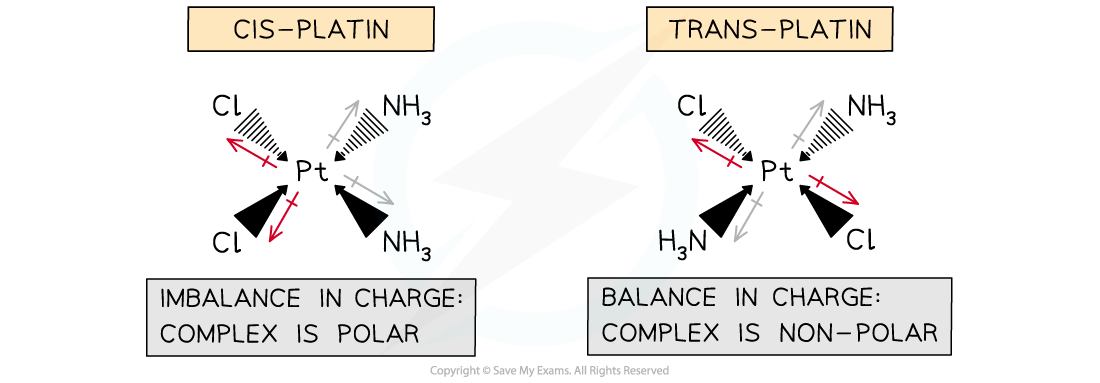
The polar and non-polar complexes are due to the geometric isomers
Polarity in octahedral complexes
- Again, the trans-isomer in octahedral complexes is non-polar whereas the cis-isomer is slightly polar
- In cis-[Co(NH3)4(H2O)2]2+ for example, the oxygen atoms in the H2O ligands are more electronegative than the nitrogen atoms in the NH3 ligands
- This causes the side of the water ligands to be partially negative
- Resulting in a charge imbalance causing the complex to become polar
- The symmetrical arrangement in the trans isomers means that the charge is evenly distributed in the complex
- Trans-isomers are therefore non-polar
Polarity in an octahedral complex
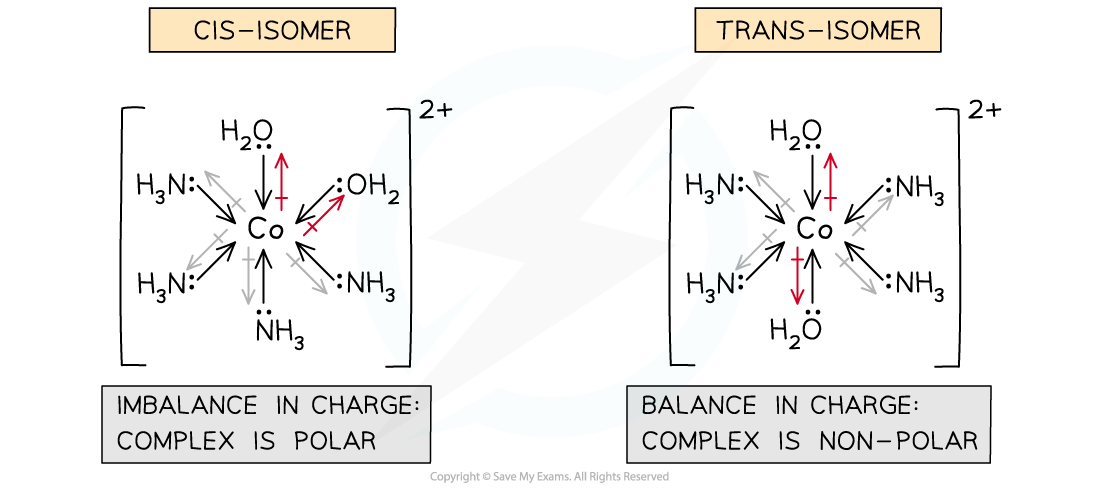
The polar and non-polar complexes are due to the geometric isomers
Was this revision note helpful?