Non-Standard Conditions (Cambridge International A-Level Chemistry)
Exam board Cambridge International · A-LevelUpdated 2026-07-02
Effect of Concentration on Electrode Potential
- Changes in temperature and concentration of aqueous ions will affect the standard electrode potential (Eꝋ) of a half-cell
- Under these non-standard conditions, E is used as a symbol for the electrode potential instead of Eꝋ
Increasing the concentration of the species on the left
- If the concentration of the species on the left is increased, the position of equilibrium will shift to the right
- This means that the species on the left gets more easily reduced
- The E value becomes more positive(or less negative)
- Let’s look at the half-cell below as an example
Zn2+(aq) + 2e- ⇌ Zn (s) Eꝋ = -0.76 V
- If the concentration of Zn2+ (species on the left) is increased, the equilibrium position will shift to the right
- The species on the left(Zn2+) will get more easily reduced
- Therefore, the E value becomes less negative and will change too, for example, -0.50 V instead
- This principle can also be applied to a half-cell with a positive Eꝋ value such as:
Fe3+(aq) + e- ⇌ Fe2+(aq) Eꝋ = +0.77 V
- If the concentration of Fe3+ (species on the left) is increased, the equilibrium position will shift to the right
- The species on the left(Fe3+) will get more easily reduced
- Therefore, the E value becomes more positive and will change too, for example, +0.89 V instead
Increasing the concentration of species on the right
- If the concentration of the species on the right is increased, the position of equilibrium will shift to the left
- This means that the species on the left get less easily reduced
- The E value becomes less positive(or more negative)
- Let’s look again at the half-cell below
Zn2+(aq) + 2e- ⇌ Zn (s) Eꝋ = -0.76 V
- If the concentration of Zn (species on the right) is increased, the equilibrium position will shift to the left
- The species on the left(Zn2+) will get less easily reduced
- Therefore, the E value becomes more negative and will change too, for example, -0.82 V instead
- This principle can, again, also be applied to a half-cell with a positive Eꝋ value:
Fe3+(aq) + e- ⇌ Fe2+(aq) Eꝋ = +0.77 V
- If the concentration of Fe2+ (species on the right) is increased, the equilibrium position will shift to the left
- The species on the left(Fe3+) will get less easily reduced
- Therefore, the E value becomes less positive and will change too, for example, +0.56 V instead
Effect of concentration on the electrode potential
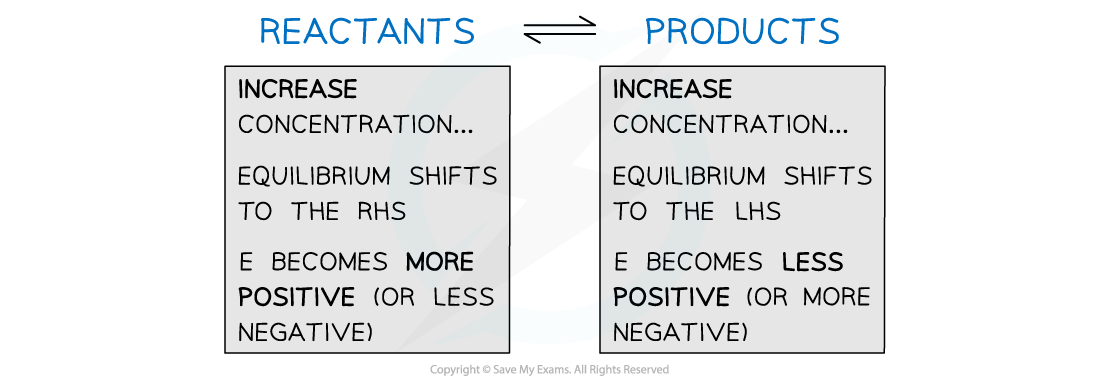
Summarising the effects of changing the concentration of reactants and products
Was this revision note helpful?
Build on this topic