The Common Ion Effect (Cambridge International A-Level Chemistry)
The Solubility Product & the Common Ion Effect
-
A saturated solution is a solution that contains the maximum amount of dissolved salt
-
If a second compound, which has an ion in common with the dissolved salt, is added to the saturated solution, the solubility of the salt reduces, and a solid precipitate will be formed
-
This is also known as the common ion effect
-
For example, if a solution of potassium chloride(KCl) is added to a saturated solution of silver chloride (AgCl) a precipitate of silver chloride will be formed
- The chloride ion is the common ion
-
The solubility product can be used to predict whether a precipitate will form or not
- A precipitate will form if the product of the ion concentrations is greater than the solubility product (Ksp)
Common ion effect in silver chloride
- When a KCl solution is added to a saturated solution of AgCl, an AgCl precipitate forms
- In a saturated AgCl solution, the silver chloride is in equilibrium with its ions
AgCl (s) ⇌ Ag+(aq) + Cl-(aq)
-
When a solution of potassium chloride is added:
- Both KCl and AgCl have the common Cl- ion
- There is an increased Cl- concentration so the equilibrium position shifts to the left
- The increase in Cl- concentration also means that [Ag+ (aq)] [Cl-(aq)] is greater than the Ksp for AgCl
- As a result, the AgCl is precipitated
The common ion effect with KCl (aq) and AgCl (aq)
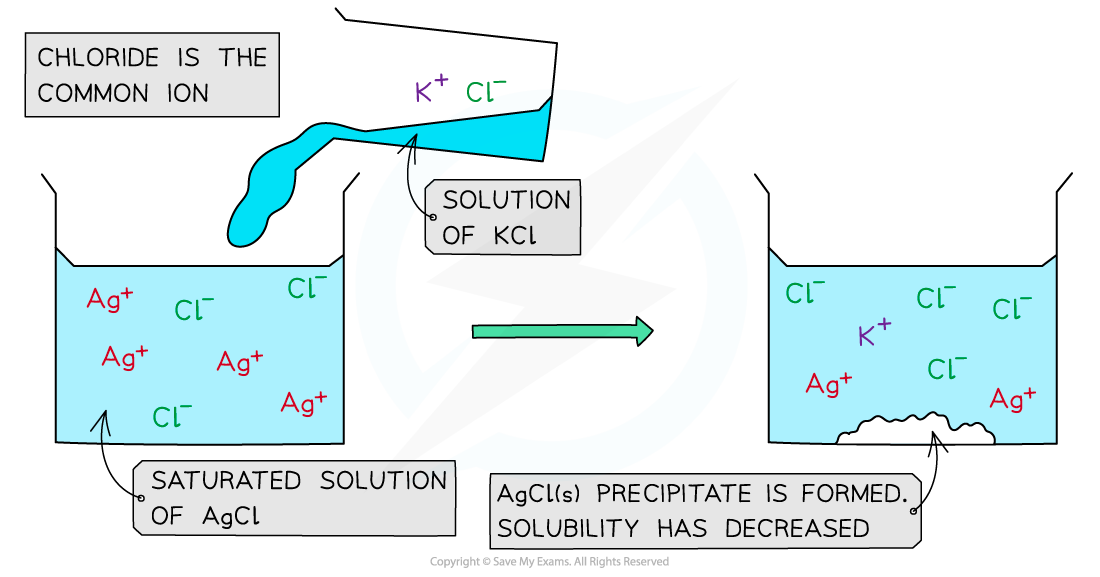
The addition of potassium chloride to a saturated solution of silver chloride results in the precipitate of silver chloride
Worked Example Calculations using the Ksp values and the concentration of the common ion **
Predict whether a precipitate of CaSO4 will form if a saturated solution of 1.0 x 10⁻³ mol dm-3 CaSO4 is mixed with an equal volume of 1.0 x 10⁻³ mol dm-3 Na2SO4.
Ksp* *CaSO4 = 2.0 x 10⁻⁵ mol2 dm-6.
Answer
- **Step 1: **Determine the equilibrium reaction of CaSO4:
CaSO4** (s) ⇌ Ca**2+** (aq) + SO 42- (aq)**
- **Step 2: **Write down the equilibrium expression for Ksp:
Ksp** = [Ca**2+** (aq)] [SO 42- (aq)]**
-** Step 3: Determine the concentrations of the ions:
There are equal volumes of each solution
This means that the total solution was diluted by a factor of 2
The new concentration of the Ca2+ ion is halved:
- [Ca2+] =
- [Ca2+] = 5.0 x 10⁻⁴ mol dm-3
The sulfate ion concentration remains the same as it is a common ion and its concentration is the same in both solutions
Step 4: Substitute the values into the expression:
- Product of the ion concentrations = [Ca2+ (aq)] x [SO42- (aq)]
- Product of the ion concentrations = (5.0 x 10-4) x (1.0 x 10-3)
- Product of the ion concentrations = 5.0 x 10⁻⁷ mol2 dm-6
Step 5: Determine if a precipitate will form:
- As the product of the ion concentration (5.0 x 10⁻⁷ mol dm-3) is smaller than the Ksp value (2.0 x 10⁻⁵ mol2 dm-6), the CaSO4 precipitate will not be formed
Was this revision note helpful?
Build on this topic