Reactions of Phenol (Cambridge International A-Level Chemistry)
Spec point —
32.2.7
Reactions of Phenol
-
Phenols can undergo many types of reactions as both the electron-rich benzene ring and the polar -OH group can participate in chemical reactions
-
Some of the reactions of phenols include:
- With bases
- With reactive metals
- With diazonium salts
- Nitration
- Bromination
Reactions of the -OH group in phenols
- The -OH group in phenols has a slightly acidic character
- It can therefore act as an acid and take part in acid-base reactions
Reaction with bases
- Phenols are only slightly soluble in water due to the large non-polar benzene ring
- However, they do dissolve in alkaline solutions and undergo acid-base reactions with bases to form a soluble salt and water
Phenol in acid-base reactions

Phenols are weak acids and undergo acid-base reactions in alkaline solutions
Reaction with reactive metals
- Molten phenols react vigorously with reactive metals such as sodium(Na)
- This is also an acid-base reaction
- Now, a soluble salt is formed and hydrogen gas is given off
Phenol with metals reaction

Molten phenols react vigorously with reactive metals to form a soluble salt and hydrogen gas
Reaction with diazonium ions
- Diazonium ions are very reactive compounds containing an -N2+ group
- When phenols are dissolved in sodium hydroxide (NaOH), a solution of sodium phenoxide is obtained
- This solution is cooled in ice and cold diazonium ion is added to the sodium phenoxide
- After the reaction has occurred, a yellow-orange solution or precipitate of an azo compound is formed
- These are compounds in which two benzene rings are linked by a nitrogen bridge
Phenol in diazonium ion reactions
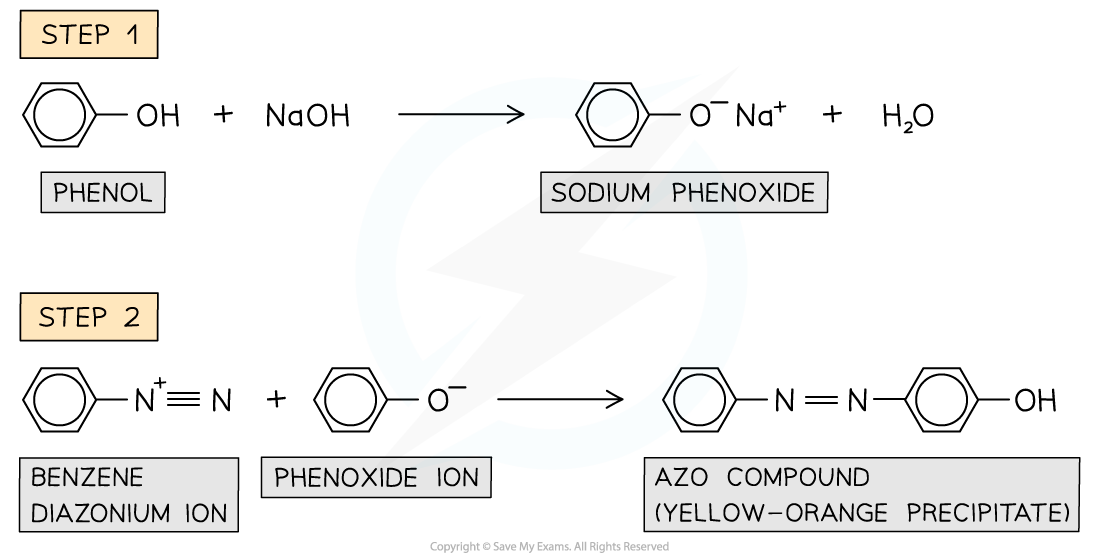
Azo compounds are formed from the reaction of phenols with diazonium ions
Reactions of the aromatic ring in phenols
- Phenols react more readily with electrophiles compared to benzene
- This is because one of the lone pairs of electrons on the oxygen atom in -OH overlaps with the π bonding system
- This increases the electron density of the benzene ring making it more susceptible to electrophilic attack
- The -OH group in phenols is activating and directs incoming electrophiles to the 2, 4, and 6 positions
Nitration
-
Phenols can undergo electrophilic substitution reactions when reacted with dilute nitric acid(HNO3) at room temperature to give a mixture of 2-nitrophenol and 4-nitrophenol
- When concentrated HNO3 is used, the product will be 2,4,6-trinitrophenol instead
-
A hydrogen atom in the benzene ring is substituted by a nitro (-NO2) group
-
This is also known as the nitration of phenol
Phenol in nitration reactions
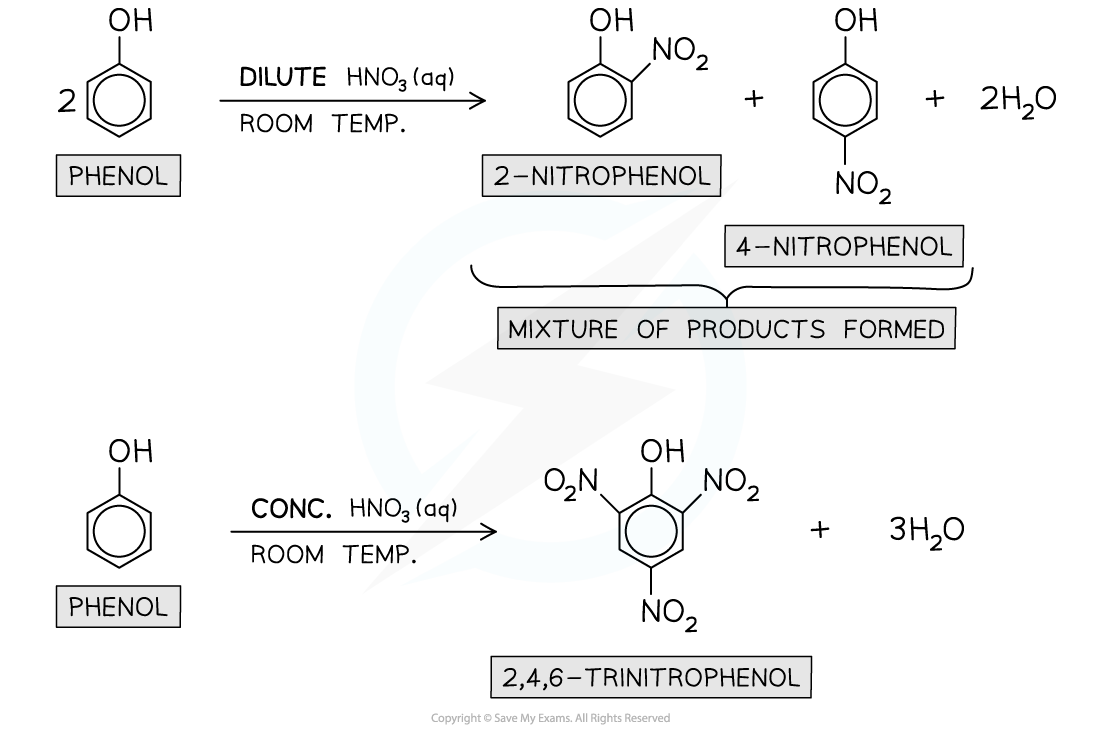
Phenols undergo nitration when reacted with dilute HNO3at room temperature
Bromination
- Phenols also undergo electrophilic substitution reactions when reacted with bromine water at room temperature
- Phenol decolourises the orange bromine solution to form a white precipitate of 2,4,6-tribromophenol
- This is also known as the bromination of phenol
Phenol in bromination reactions
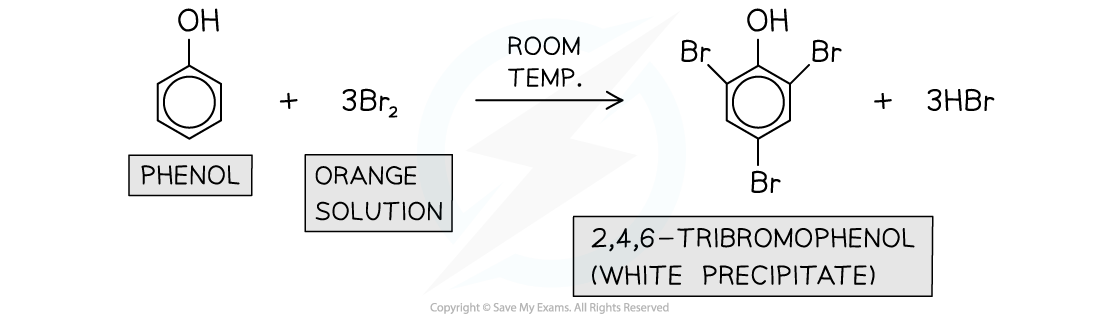
Phenols undergo bromination when reacted with bromine water at room temperature
Was this revision note helpful?
Build on this topic