Conjugate Acids & Bases (Cambridge International A-Level Chemistry)
Conjugate Acids & Bases
- A Brønsted-Lowry acid is a species that can donate a proton
- A Brønsted-Lowry base is a species that can accept a proton
- In an equilibrium reaction, the products are formed at the same rate as the reactants are used
CH3COOH (aq) + H2O (l) ⇌ CH3COO- (aq) + H3O+ (aq)
acid base conjugate base conjugate acid
-
The reactant CH3COOH is linked to the product CH3COO- by the transfer of a proton from the acid to the base
- Similarly, the H2O molecule is linked to H3O+ ion by the transfer of a proton
-
These pairs are therefore called conjugate acid-base pairs
-
A conjugate acid-base pair is two species that are different from each other by a H+ ion
- Conjugate here means related
- In other words, the acid and base are related to each other by one proton difference
-
Worked Example Identifying conjugate acid-base pairs
Identify the conjugate acid-base pairs in the following equilibrium reaction:
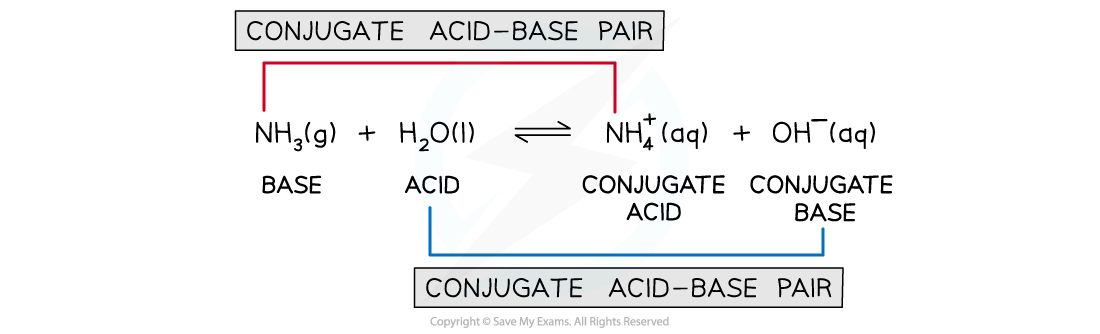
NH3(g) + H2O (l)NH4+(aq) + OH–(aq)
Answer:
In the forward reaction:
- NH4+ is the conjugate acid of the base NH3
- OH- is the conjugate base of the acid H2O
In the reverse reaction
- NH3 is the conjugate base of the acid NH4+
- H2O is the conjugate acid of the base OH–
Worked Example In the equilibrium reaction shown below, which species are a conjugate acid-base pair?
CH3CH2CH2COOH (aq) + H2O (l) ⇌ CH3CH2CH2COO- (aq) + H3O+(aq)
A. CH3CH2CH2COOH and H2O
B. H2O and H3O+
C. H2O and CH3CH2CH2COO-
D. CH3CH2CH2COO- and H3O+
Answer:
The correct option in B
- A conjugate acid-base pair differ only by an H+ ion
Was this revision note helpful?
Build on this topic