Methods of Inventory Management (Cambridge International A-Level Business)
The purpose of inventory
- Inventory is the goods and materials a business holds for the ultimate goal of resale or for use in production
Types of inventory
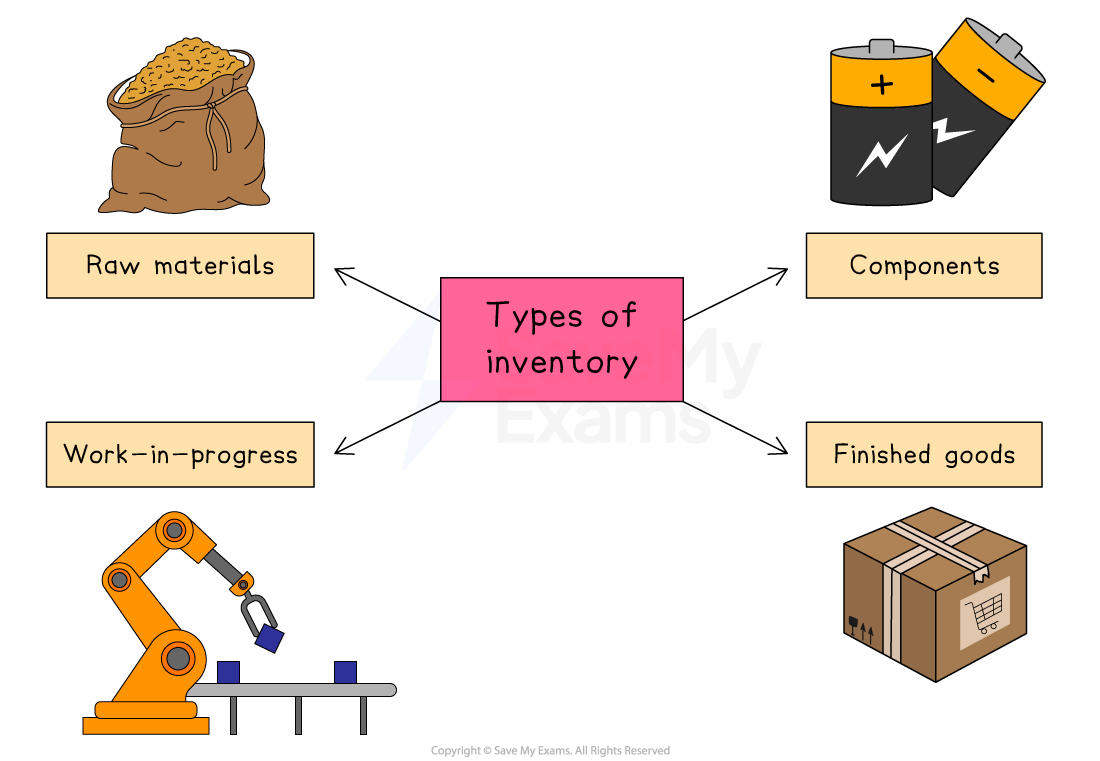
Inventory consists of raw materials, components, work-in-progress and finished goods
| Raw materials | Components |
|---|---|
| - These are the natural resources or goods that are used to make other products - Examples in vehicle production include steel, plastic and oil | - The parts used in the production of goods - Examples in vehicle production include circuit boards, body panels and gearboxes |
| Work-in-progress | Finished goods |
| - This includes partially finished products awaiting completion - In car production, this could include vehicles awaiting spray-painting or quality control checks | - These are completed products which require no further manufacturing - In car production, these are vehicles ready for sale to the final customers |
Costs and benefits of holding inventory
-
The management of stock is an important consideration for businesses
-
Problems may arise from holding inventory
- Storage costs (e.g. warehouse rental, security costs) will be higher than necessary
- The risk of spoilage and stock *shrinkage is increased, leading to increased costs
- Money tied up in stock could be used elsewhere in the business
- Time and resources are needed to monitor and track stock levels
-
However, if a business holds inventory, it means that
- Products are available when needed, improving customer satisfaction
- Buying quantities of inventory and storing it may reduce unit costs due to bulk buying discounts
- Production isn't held up by supply issues
- Extra stock helps meet peaks in sales, such as during holiday periods
The importance of supply chain management
-
The supply chain is the network of organisations, people, activities and resources that move a product from its basic raw material right through to the final customer
-
It includes the following:
- Stock control:****planning, implementing and monitoring the movement of raw materials, components, work-in-progress and finished goods
- Quality control:** **ensuring output meets standards so that the end product is safe and meets customer expectations
- Transport networks:** **ensuring efficient deliveries of goods to customers, taking account of speed, reliability and costs
- Supplier networks:**** developing strong relationships with suppliers willing to work collaboratively to improve quality
-
Global supply chains require these activities to be coordinated across international borders
-
Some stages can be completed at lower cost in certain countries
- E.g. China has a reputation for producing high quality, low-cost electronics components
-
Labour-intensive processing, such as clothes manufacturing, is outsourced to countries with low labour costs,such as Vietnam
-
Scarce raw materials may only be available in certain countries/regions
-
Building an effective supply chain
| Decision area | What it involves |
|---|---|
| Make or buy (produce in-house or outsource) | - Decide whether to produce in-house or buy from specialists |
| Choosing suppliers | - Single, trusted supplier or multiple backup options - Local or global sources |
| Purchasing approach | - Bulk buying for discounts or frequent, small orders for flexibility |
| Information sharing and use of technology | - Real-time data, bar codes, RFID and cloud systems keep production partners fully informed |
| Logistics structure | - How many and where warehouses are needed - Transport options — use an external haulier or keep control of deliveries |
Why does an effective supply chain matter?
- Faster delivery to customers
- When every link is well-coordinated, products move quickly from factory to shelf, beating slower rivals
- Lower operating costs
- Just-in-time (JIT) deliveries and bulk purchasing agreements reduce storage, handling and material expenses
- E.g*. Aldi negotiates long-term contracts with a small group of trusted suppliers, helping it minimise warehouse inventory and keep prices low
- Consistent quality
- Close, long-term relationships with suppliers make it easier to enforce standards and fix problems early
- Greater resilience to shocks
- A well-planned supply chain includes backup suppliers and effective data sharing so the business can adapt when something goes wrong
Inventory control charts
- An inventory control diagram shows how inventory moves into and out of a business over time
An inventory control diagram
An example of an inventory control diagram for a small manufacturing business
-
The maximum inventory level is the maximum amount of stock a business is able to hold in normal circumstances (1,600)
-
The reorder level is the level at which a business places a new order with its supplier (800)
-
The minimum stock level is also known as the buffer inventory level and is the lowest level to which a business is willing to allow inventory levels to fall (400)
-
Lead time is the length of time from the point of inventory being ordered from the supplier to it being delivered (one week)
-
The stock level line shows how inventory levels change over the given time period
- As inventory is used up, a downwards slope is plotted
- When an order is delivered by a supplier, the stock level line shoots upwards
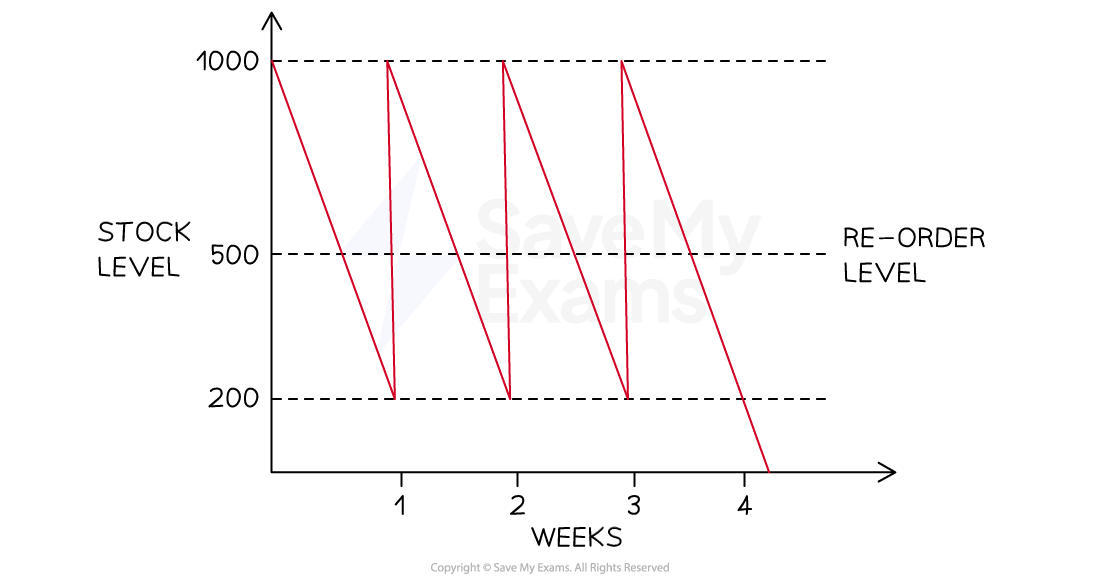
Worked Example The diagram below shows inventory movements of kitchen shelving units sold by TamFix Limited*.*
Identify the following points:
- The minimum stock level
- The reorder level
- The reorder quantity
- The lead time for kitchen shelving units
(4)
Answer:
Step 1: Identify the minimum stock level
- The minimum stock level is identified by the bottommost dotted line
- In this case, it shows that the minimum stock level is 200 units (1)
Step 2: Identify the reorder level
- The reorder level is clearly identified on the diagram
- In this case, it shows that the reorder level is 500 units (1)
Step 3: Identify the reorder quantity
- The reorder quantity is the difference between the maximum stock level (shown by the topmost dotted line) and the minimum stock level
The reorder quantity is, therefore, 800 units (1)
Step 4: Identify the lead time for kitchen shelving units
- The lead time is the difference in time between the time an order is placed and the time the inventory is delivered
- In this case, assuming a five-day working week, the lead time for shelving units is two days (1)
Exam Hint Always clearly label lead time, reorder level and buffer stock, and include units
Show your workings — examiners award method marks even if the final figure is wrong
Buffer inventory
-
Buffer inventory is a quantity of stock kept in case of shortages
- This can provide a competitive edge * over rivals unable to meet demand
- This approach is commonly called ‘just in case’ stock control
-
The decision to keep buffer stocks is one that businesses have to weigh up very carefully
- The decision will be influenced by the nature of the business and the product/service it provides
Evaluating the use of buffer stocks
| Advantages | Disadvantages |
|---|---|
| - Stability in supply Buffer stocks ensure a stable supply of goods which is able to respond to unexpected customer demand - Price stabilisation Buffer stocks can help prevent extreme price fluctuations, as it helps the market avoid shortages, which would result in rapid price increases - Raw materials security Businesses that are dependent on particular raw materials avoid disruption to their supply - Competitive advantage By having a reliable supply of goods, businesses can gain a reputation for always being able to meet the needs of their customers | - Cost Holding buffer stocks can be expensive, as it requires storage facilities and inventory management systems - Risk of obsolescence Buffer stocks can become obsolete if the demand for a particular product or input declines - Opportunity cost Holding buffer stocks ties up capital that could be invested in other areas of the business |
Was this revision note helpful?
Build on this topic