The Impact of Corporate Social Responsibility (Cambridge International A-Level Business)
The impact of corporate social responsibility on business
- Corporate social responsibility (CSR) refers to the concept that businesses have a responsibility to consider and positively impact society
- Companies voluntarily integrate social and environmental concerns into their business operations and interactions with stakeholders
Social responsibility goals
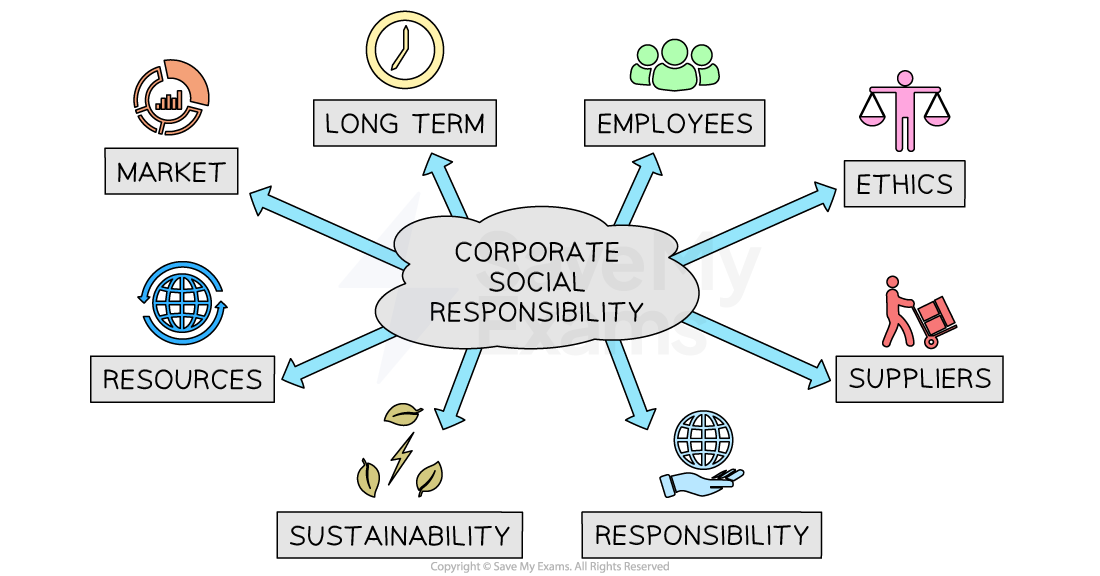
Corporate social responsibility goals can be focused on a range of different stakeholders
- CSR involves taking into account the impact of business activities on various stakeholders, including employees, customers, communities, the environment and society as a whole
Examples of socially responsible activities
| Activity | Example |
|---|---|
| Sustainable sourcing of raw materials and components | - Patagonia is moving its entire clothing range to 100 % recycled or renewable fibres - It publishes detailed, regularly updated supply-chain maps so anyone can check where materials come from |
| Responsible marketing | - The LEGO Group does not directly advertise to under-12s - It also limits data collection and send clear, age-appropriate messages in communication |
| Protecting the environment | - Starbucks gives customers a discount when they bring a clean reusable cup into its US and Canadian stores, cutting single-use waste |
| Responsible customer service | - Costco offers a 100% satisfaction guarantee - Products can be returned at any time for a full refund |
Ethics and CSR
-
Ethics relates to the rights or wrongs of making a strategic decision that are beyond legal requirements
-
Some businesses adopt an ethical code of practice which informs decision-making and may set out how they
- Behave responsibly with regards to the environment and avoid negative impacts on animals
- Adopt fair working practices
- Implement **equitable supply chains *
- Takes steps to** eliminate corruption
- Adopt ethical accounting practices
- Avoid controversial products or take steps to minimise their impact or access to them
-
Many large companies carry out and publish annual social audits which provide an review of the steps being taken to meet their commitments
The impact of implementing CSR
-
Businesses experience a range of benefits as a result of implementing CSR
- They attract long-term loyalty from employees and customers
- Their approach provides a useful competitive advantage
- They receive the support of the local community and local government, especially if they share their aims
- Employees are likely to be motivated, loyal and productive, as they are proud of working for a responsible firm
-
However, suppliers and competitors often change their approach to ensure that they do not lose sales to more ethical rivals
-
In addition, taking an ethical approach costs more and may reduce the overall level of profits if prices cannot be raised to compensate
Case Study Fashion retailer Uniqlo has adopted an eco-friendly strategy in recent years
- It focuses on technologies that make the production of new clothing from recycled materials possible
- It has invested significant sums in energy-efficient production facilities
- It supports the campaign to safeguard the islands and coastal regions of Japan’s threatened Seto Inland Sea
Community and pressure group needs
-
A business's community is everyone touched by a its activities, including
- Local residents
- Employees and their families
- Customers
- Suppliers
- Schools
- Charities
- Local government
-
Winning community support gives a business a social licence to operate; without it, business projects can be delayed, boycotted or shut down
Why businesses should listen to their communities
| Benefit to the business | What can go wrong if ignored |
|---|---|
| - Reputation and brand loyalty - Positive media coverage, word-of-mouth and higher customer retention | - Negative headlines, social-media backlash or long-term brand damage |
| - Customer demand - Communities increasingly prefer ethical, eco-friendly and inclusive products | - Falling sales as people switch to rivals or start a boycott |
| - Access to investment and new talent - Many investors and job-seekers look for responsible firms | - Higher cost of capital and difficulties in recruiting staff |
Pressure groups
-
A pressure group is an organisation that tries to influence the decisions of businesses or governments in favour of a particular cause, such as animal welfare, climate action, or workers' rights
-
Common tactics used by pressure groups include
- Public petitions and letter-writing campaigns
- Social-media 'naming and shaming' or viral videos
- Peaceful protests, strikes, or sit-ins
- Lobbying politicians for new laws
- Buying shares to speak at a company’s AGM
- Legal action (e.g. climate lawsuits against oil firms)
-
Consumers can act as a particularly powerful pressure group
- Buying behavior, e.g., choosing Fairtrade coffee or USDA-organic fruit, rewards ethical producers
- Social media, e.g., praising green firms and exposing polluters at low cost
- Direct feedback, e.g., e-mails, online reviews, polls and focus groups, tells firms which practices are unacceptable
- Boycotts, e.g., refusing to purchase from a harmful brand or deliberately supporting a responsible rival
Examples of pressure group influence
| Pressure group | Business impact |
|---|---|
| Greenpeace | - Engages in direct action at oil rigs and palm-oil plantations - Helped secure a worldwide ban on commercial whaling (1982) - Pushed major retailers to remove microbeads from toiletries (2018) |
| Buglife | - Halted a building development in 2015 that threatened a rare insect species, saving local biodiversity and forcing the developer to redesign plans |
| Consumer boycott of Nike | - Highlighted sweatshop labour, leading Nike to publish supplier lists and raise factory standards |
Was this revision note helpful?