Social Influences (Cambridge International A-Level Business)
An introduction to social influences
- Social influences are attitudes, values and culture that affect business decisions
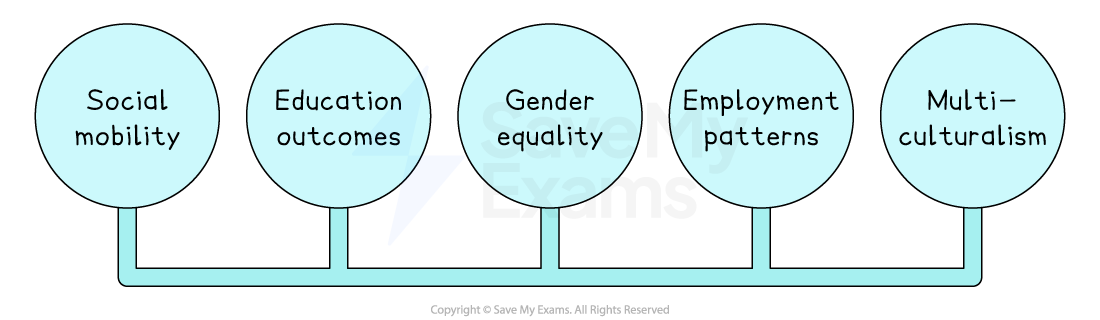
Social mobility, education outcomes, gender equality, employment patterns and multiculturalism affect business decisions
- High social mobility, good schooling, gender equality and varied work patterns give firms a larger, better-skilled labour pool
- Educated, multicultural and gender-inclusive societies increase spending power and mix viewpoints, helping businesses exploit new customer needs and create fresh ideas
Social mobility
-
Social mobility refers to how easily someone can climb from a low-income or low-status background to the middle or top of society
- Denmark has the highest level of social mobility in the world
- India has relatively low levels of social mobility
Ways social mobility affects business
| Impact on business | High mobility | Low mobility |
|---|---|---|
| Availability of skilled workers | - Plenty of educated, healthy people to hire, so recruitment is easy and cheap | - A smaller skilled pool of labour, so firms compete, pay more or import talent |
| Wages and labour costs | - Pay gaps are smaller and predictable, so labour costs stay steady | - Big pay gaps emerge as low-skilled labour is cheap but top talent is expensive |
| Size of the customer market | - Many move into the middle class, so there is broad, reliable demand for goods and services | - Spending power sits with a few wealthy groups so firms target budget or luxury segments |
| Start-ups and innovation | - Anyone with a good idea can get education and funding, so more new firms are set up and fresh ideas generated | - Barriers in class, caste, location block ideas, so fewer businesses are set up and innovation is slower |
Education outcomes
- Spending on good schools and skilled teachers in Singapore is very high
- In contrast, South Africa lacks education resources and quality problems hold learning back
How education levels affect business
| Impact on business | High educational outcomes | Low educational outcomes |
|---|---|---|
| Skilled worker supply | - A large pool of well-qualified staff, especially in maths and science, makes hiring easy | - A shortage of engineers, IT and health workers makes vacancies hard to fill |
| Training and recruitment costs | - New recruits arrive work-ready, so firms spend less time and money on basic training | - Companies must run extra training programmes or recruit overseas, raising costs |
| Innovation and investment | - Availability of talented workers attracts technology, biotech and finance firms to set up R&D and head offices | - Skills gaps make global investors cautious about setting up high-tech factories or research labs |
| Consumer spending power | - Graduate salaries create a broad middle class that buys a wide range of goods | - Many workers stuck in low-paid jobs limit demand for anything beyond essentials |
Gender equality
-
Gender equality means giving people of all genders the same rights, responsibilities, opportunities and respect
- Everyone can study, work, earn, own property and take part in decisions without discrimination
- Rewards such as pay, promotion or investment are based on merit, not gender
-
Sweden has a high level of gender equality, where women earn about 90% of men’s pay
-
Japan has high levels of gender inequality, with a gender pay gap of around 22%, and only 14 % of company directors are women
How gender equality affects businesses
| Impact on business | High gender equality | Low gender equality |
|---|---|---|
| Size of the talent pool | - Women take part in every occupation, so firms can choose from almost the whole population when hiring | - Many skilled women are shut out of top jobs - Companies struggle to fill senior roles and may need to pay more to recruit |
| Productivity and new ideas | - Mixed-gender teams bring different views, leading to better problem-solving and faster innovation | - If almost everyone in a team is male, with similar backgrounds and experiences they may all think in the same way - This can slow down product design and decision-making |
| Reputation with customers and investors | - Equal-pay audits, flexible leave and gender-neutral adverts signal fairness - This strengthens the brand and is attractive to investors | - A large pay gap and few female directors hurt global image - Some investors demand change before investing |
| Legal compliance and costs | - Clear rules mean fewer discrimination claims | - Stock-exchange quotas and mandatory pay-gap reporting force rapid change - Firms that lag behind face fines or bad press |
Patterns of employment
-
New technology, changing lifestyles and worker expectations mean that many jobs have changes significantly in recent years
- Employees work shorter weeks, split their time between home and office, take on project-based jobs or rely on digital tools to complete tasks
Changes in patterns of employment
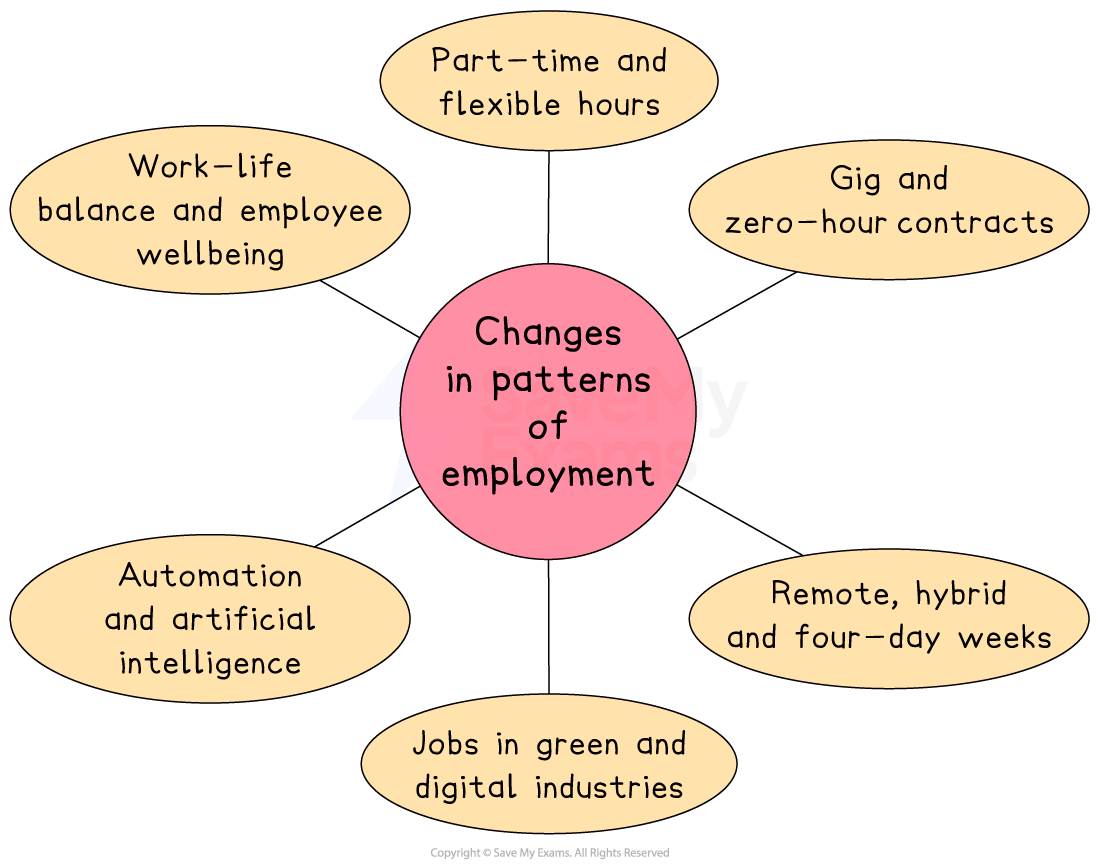
Employment patterns have changed in recent years, with flexible arrangements, informal contracts and technology impacting the nature of job roles
| Change | Explanation | Impact on business |
|---|---|---|
| Growth of part-time and flexible hours | - More employees work shorter weeks, vary start and finish times - They may work compressed hours to balance work with study, parenting or leisure | - Bigger talent pool includes parents, students and retirees - Rotas and payroll are more complex |
| Expansion of gig and zero-hour contracts | - Companies increasingly use project-based workers rather than employing permanent staff | - Lower fixed wage bills - Harder to build loyalty and maintain consistent quality |
| Move to remote, hybrid and four-day weeks | - Technology allows many roles to be done partly or fully from home, and some businesses have trialled 32-hour weeks | - Save money on office space - Can recruit staff from anywhere - Need effective online communication |
| New jobs in green and digital industries | - Demand is rising for skills in renewable energy, electric vehicles, cybersecurity, cloud services and e-commerce | - New markets open up - Shortage of skilled staff can push wages up |
| Automation and artificial intelligence reshaping tasks | - Routine or data-heavy activities are increasingly handled by robots, software or AI assistants | - Faster output and lower long-term costs - High up-front technology investment spending and staff retraining. |
| Greater focus on work–life balance and employee wellbeing | - Workers expect mental health support, flexible leave and meaningful work | - Better morale and fewer sick days - Extra cost if financial benefits are improved |
Multiculturalism
-
A multicultural society is one where many cultural, ethnic and religious groups live side by side and are recognised as equal
- Customers, employees and suppliers may bring different languages, values, tastes and traditions
How multiculturalism shapes business decisions
| Decision | Typical responses from firms |
|---|---|
| Product design and ranges | - Adapting flavours, sizes or features to suit diverse preferences - e.g. halal menus, skin-tone cosmetics and multilingual packaging |
| Marketing and branding | - Using inclusive images and language - Avoiding stereotypes - Scheduling promotional campaigns around festivals such as Diwali, Ramadan or Lunar New Year |
| Customer service | - Training staff in cultural sensitivity - Offering interpretation - Respecting religious dress or service needs |
| Human resources | - Recruiting from a wider talent pool - Supporting faith-based leave - Flexible dress codes |
| Team communication | - Clear guidelines on language use - Cross-cultural teamwork training and mentoring |
| Location and supply chain | - Setting up outlets in multicultural districts - Sourcing authentic ingredients - Partnering with minority-owned suppliers |
| Legal compliance and reputation | - Meeting equality laws and demonstrating corporate social responsibility |
Was this revision note helpful?