Approaches to Costing (Cambridge International A-Level Business)
An introduction to costing
-
Businesses can choose how to calculate the costs of manufacturing products, accounting for
- Direct costs, such as raw materials, components and direct labour
- Indirect costs, including overheads such as rent, rates, selling costs and administration expenses
-
Two of the most commonly used methods are
-
Full costing
- This method allocates all costs, direct and indirect, equally across all products a business manufactures
-
Contribution costing
- This method allocates only direct costs to products manufactured by a business
- Indirect costs are covered and profits generated by contribution
-
The principles of full costing
- If a business manufactures one type of product, full costing can be used to allocate all costs, direct and indirect, equally across all products
Stages in full Costing
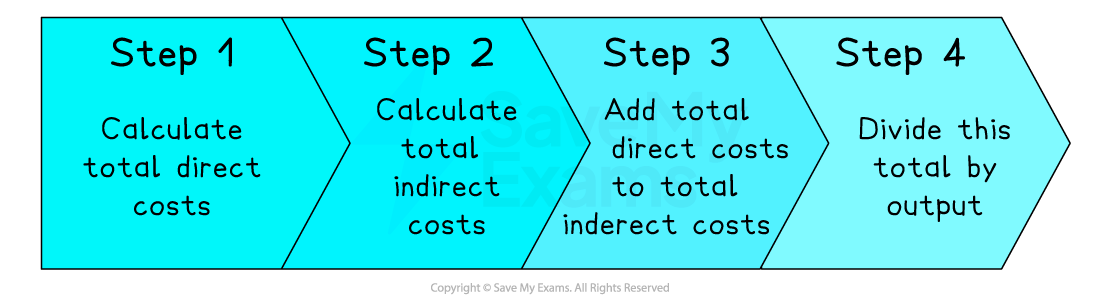
Full costing involves dividing the total costs by the volume of output
Worked Example Luftig Soft Drinks Gmbh uses full costing to determine the cost of manufacturing each bottle it produces.
In 2023 it manufactured 455,000 bottles of soft drink, and recorded the following costs:
Total Direct Costs €52,300
Total Indirect Costs €120,600
Calculate the full cost of producing each bottle of soft drink.
(2)
Step 1: Add total direct costs to total indirect costs
(1)
Step 2: Divide total costs by output
(1)
-
When a business manufactures more than one product, it needs to decide how to allocate indirect costs across the range of products
-
Each product may i ncur a different proportion of indirect costs
- E.g. they may require more workers, machinery or factory space, or may be manufactured in greater volumes
-
These decisions are unlikely to be straightforward and should remain constant over time
- Inappropriate allocation of costs can lead to incorrect pricing decisions
- Using different methods makes comparison over time difficult
-
Allocations of indirect costs must be calculated first, before the full cost can be determined
-
Worked Example Luftig Soft Drinks Gmbh manufactures three different types of soft drink.
In 2023 each product incurred the following direct costs as well as a proportion of the business's €120,600 indirect costs, broadly based on the level of output.
Product Output Direct Costs Allocation of Indirect Costs (%) KirschKick 116,500 €14,550 25 HimbeerLeck 136,000 €18,220 30 Apfana 202,500 €19,530 45 Calculate the full cost of manufacturing each bottle of HimbeerLeck.
(3)
Step 1: Calculate the value of indirect costs allocated to the product
(1)
Step 2: Add total direct costs to allocated indirect costs
(1)
Step 3: Divide total costs by output
(1)
Uses and limitations of full costing
Uses of full Costing
- Full costing is a simple method that is particularly useful when a business manufactures just one type of product or where determining the allocation of indirect costs across more than one product is straightforward
- All costs are allocated to manufactured products, meaning managers can plan for a guaranteed profit if prices are set higher than the full cost
- Decision-making and performance can be measured and assessed over time, as long as the method of allocating indirect costs remains the same
Limitations of full costing
-
Determining the allocation of indirect costs can be difficult
- A decision has to made about whether indirect costs should be allocated according to labour used, factory space used, machinery or storage space used, or whether other factors such as the level of output would be more appropriate
- The method used should remain consistent to allow for comparisons over time
-
Full costing is often used to predict costs
- If actual output levels differ to those used in full costing calculations, calculations will be inaccurate
- Inappropriate pricing decisions made using these predicted costs could affect the level of profit made on sales
The nature of contribution costing
-
Contribution costing is a method of costing where direct costs are allocated to products or departments of a business
- It assumes that indirect costs must be paid during a particular time period, regardless of the level of production for each product
- Each profitable product contributes towards paying these overheads
-
These products or departments are often referred to as cost centres or profit centres
Calculating contribution
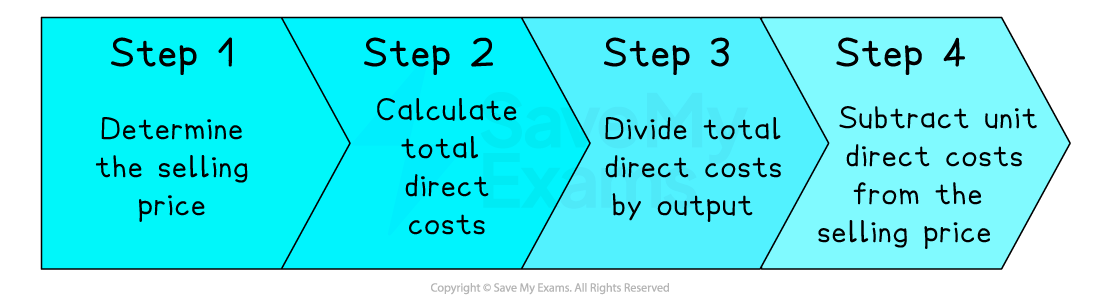
Contribution is calculated by subtracting the average direct costs of production from the intended selling price
-
Contribution costing can help a business determine the most worthwhile products to sell
- Those which make the **greatest contribution **to fixed costs and profit should be retained
- Those making a small contribution to fixed costs and profit may also be retained, as long as continuing to do so meets business objectives, as phasing them out would reduce profit
- Those with negative contribution to fixed costs and profit should be phased out, leading to** increased profit**
Case Study Lickety Split Desserts
- Lickety Split Desserts is a seaside ice cream café
- It sells a range of ice cream and sorbet-based desserts
- The table below shows a contribution analysis for its top-selling products
Contribution analysis for Lickety Split's top-selling desserts
Product Average selling price ($)** Average indirect cost ($) Unit contribution to indirect costs ($) Super Sundae 8.95 3.45 5.50 Nutty Surprise 9.95 4.25 5.70 Fruit Supreme 8.95 4.30 4.65 Ice Magic 8.95 2.25 6.70 ChocoLick 9.95 6.60 3.35
Nutty Surprise is the strongest product
- It earns the** highest contribution **($5.70) to indirect costs per product sold
ChocoLick is the weakest product
- It earns the** lowest contribution ($3.35) to indirect costs per product sold
- Twice as many ChocoLick as Ice Magic desserts would need to be sold to generate the same level of contribution
This positive contribution from all of Lickety Split's profitable products can go towards paying the indirect costs of operating the café
Once these indirect costs are covered in full, Lickety Split will make a profit
The difference between contribution and profit
- Contribution and profit are related concepts, but there is an important difference
Contribution and profit
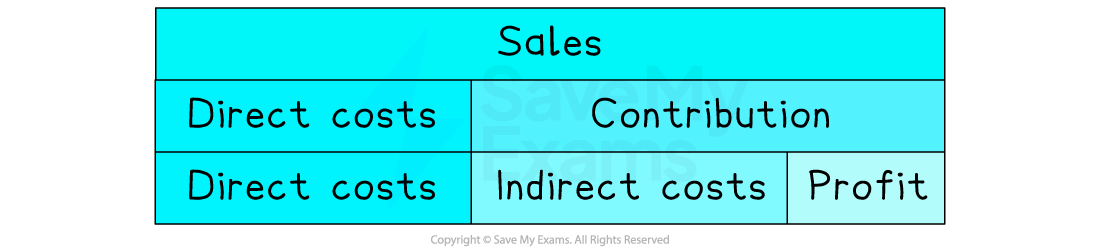
Contribution is the difference between selling price and direct costs that can be used to cover the payment of indirect costs and contribute to profit
-
Contribution shows the difference between the sales price and direct costs for specific products
- This contributes to the payment of indirect costs
- Once indirect costs are fully covered, contribution goes towards the profit of the business
-
Profit takes into account all direct and indirect costs incurred during production
Limitations of contribution costing
-
As indirect costs are not considered in calculations, there is no guarantee that a business will make a profit
- It ignores the fact that some products may incur higher indirect costs than others
-
The potential of products that make a small or negative contribution now but may be more successful in the future is often ignored
-
Qualitative factors such as the ability of a business to maintain a full product range, or the image a product contributes to the business are overlooked
- E.g. As one of its heritage products, Cadbury's Turkish Delight is retained in the company's product range, despite making a minimal contribution to fixed costs and profit
-
Contribution costing and special order decisions
-
Managers often have to decide whether to accept a special order at a lower price than it would normally charge
- If spare capacity exists, it may be tempting to accept the order
- As long as the special order details are not shared with existing customers, it could be an effective way to attract a new customer
- However, if indirect costs are increased by accepting the order, it may be more difficult to justify
-
Contribution costing can determine whether accepting the order will make a positive contribution to indirect costs and whether it will increase profit
- In many cases, unprofitable special orders may be worthwhile as they can make a positive contribution to indirect costs
Worked Example Sunrise Hotel and Spa in Sri Lanka offers luxury adult breaks through exclusive travel agencies.
It has been approached by a specialist business travel agency to host a large party of guests for one night, at a price of $400 per person. This price is significantly lower than that charged to its usual guests.
The manager is considering whether to agree to this special order and is considering the hotel's cost data.
Hotel stays: full cost data Direct labour $84 Direct materials $72 Overheads Apportion $316 Full unit cost $472 Should the manager accept the special order? Explain your answer.
(4)
Step 1: Total direct costs and subtract from the selling price
= \ 400 - ( $ 84 + $ 72 )
= $ 400 - $ 156
= $ 244$****(1)**
Step 2: State your answer and explain your reasoning
- The manager** should accept the special order (1)
- It would make a positive contribution of $244 to indirect costs, though it would not contribute to increased profit, as the full unit cost is $472, some $72 higher than the selling price of $400 **(1)
- Given that the normal selling price is 'significantly higher,' the hotel would be likely to be making a significant profit on hotel stays at other times** (1)
Was this revision note helpful?
Build on this topic