Contingency Planning and Crisis Management (Cambridge International A-Level Business)
Contingency planning
-
Contingency planning involves a business predicting risky or unwanted events, then developing a set of suitable responses
-
*Risk assessments of potential disruptions and impacts are carried out
-
Procedures commonly cover risks such as fire or weather-related emergencies
- Evacuation plans are drawn up and practised
- Key staff are given emergency responsibilities
- Alarm systems are tested
- Preventative measures protect stock and equipment, e.g. installation of fireproof doors
-
-
Contingency planning can help a business to survive and recover from a period of crisis
- However, drawing up detailed contingency plans requires time and investment
Evaluating contingency planning
| Factor | Benefits | Limitations |
|---|---|---|
| Time | - Helps businesses to respond immediately - Clear staff roles & responsibilities - Resources are identified and available - Procedures are shared in advance | - A time-consuming process - Risk assessment takes valuable management time - Plans need to be revisited regularly - Staff require training |
| Cost | - Can reduce costs - Emergency equipment/resources are purchased in advance - Financial losses are likely to be lower | - Spending on resources needed in a crisis may be wasted if not needed - Difficult to budget for unknown crisis situations |
| Safety | - Procedures keep stakeholders such as staff and customers safe - Training increases awareness - Legal obligations should be met (e.g. fire regulations) | - Bureaucratic and difficult to implement swiftly - Leadership and compliance from staff or other stakeholders is needed |
| Risk | - Most likely threats are considered in detail - Reduces legal risks if procedures are followed | - Requires up to date and complete information to be effective - Human reactions such as fear and panic cannot be fully mitigated |
Crisis management
-
Crisis management refers to the immediate handling of a disruptive and unexpected event
-
It includes communication, coordination, resource mobilisation and decision-making under pressure
- Short-term significant disruption is likely and long-term business survival is affected
- Radical solutions such as autocratic leadership and centralised decision-making could ensure business continuity
- Work activity may need rapid reorganisation
- E.g. many businesses swiftly implemented remote working for staff during the Covid-19 pandemic
-
Examples of crisis situations
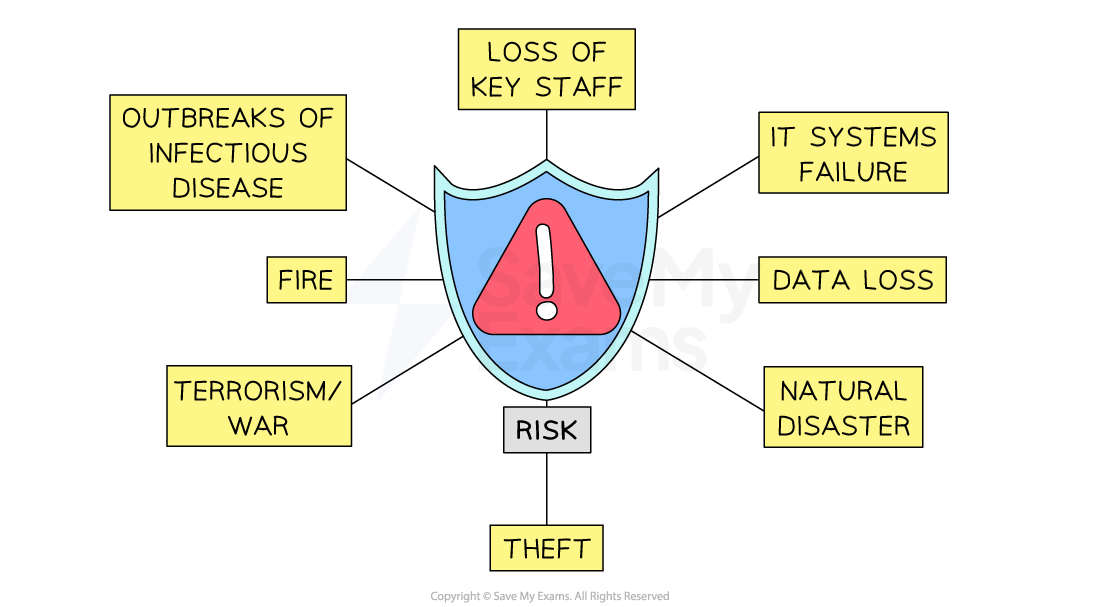
Businesses face threats from a range of sources including IT systems failure, natural disasters and theft
-
Crises do not have to be large-scale
- The unexpected loss of a CEO, a warehouse fire, or an outbreak of infection within a business can cause a significant crisis that requires a prompt, transparent, and well-communicated response
- Losing customers' data could be classed as a crisis requiring immediate response from management
Factors affecting crisis management
| Speed | Transparency |
|---|---|
| - A rapid response can contain or reduce damage - E.g. Procter and Gamble's crisis team responded rapidly when a viral challenge encouraged teenagers to film themselves eating Tide Pods detergent - It quickly published warnings and updated disclaimers on its website - This quick response protected P&G from legal action | - Keeping customers informed and telling the truth can protect reputation - E.g. Supply issues in 2018 caused KFC to run out of chicken, leading to the temporary closure of half of its UK outlets - It used humour on social media to keep customers informed - It apologised and quickly addressed customer concerns, turning the negative story into positive PR |
| Control | Communication |
| - Ensuring that leaders have the authority and resources to perform at the highest level in a crisis - E.g. Walmart's Emergency Operation Center operates 24 hours a day - It manages the company's response to events that could affect operations - Coordinated by senior Walmart leaders, it can assemble support teams immediately | - The rapid issue of press releases can reassure stakeholders and reduce recovery time - E.g. Scandinavia Airlines (SAS) used social media effectively during the 2010 Icelandic volcanic ash cloud crisis - Customers were directed to SAS's Facebook page - Staff responded to every message, comment and post - Problems were solved immediately; regular updates kept customers satisfied |
-
Crisis management and contingency planning cannot eliminate the risk of business disruption
- Even the best plans can go wrong when a crisis hits
-
The fact that businesses engage in this kind of planning does provide significant benefits, including
- Business **resilience **can be improved
- Negative impacts may be reduced
- Stakeholders are likely to have greater** confidence** in the business
Was this revision note helpful?
Build on this topic