Enzyme Inhibitors (Cambridge International A-Level Biology)
Spec point —
3.2.3· explain the effects of reversible inhibitors, both competitive and non-competitive, on enzyme activity
Enzyme inhibitors
-
An enzyme's activity can be reduced or stopped, temporarily, by a reversible inhibitor
-
There are two types of reversible inhibitors:
-
Competitive inhibitors have a similar shape to that of the substrate molecules
- This means they compete with the substrate for the active site
-
Non-competitive inhibitors bind to the enzyme at an alternative site, which alters the shape of the active site
- This prevents the substrate from binding to it
-
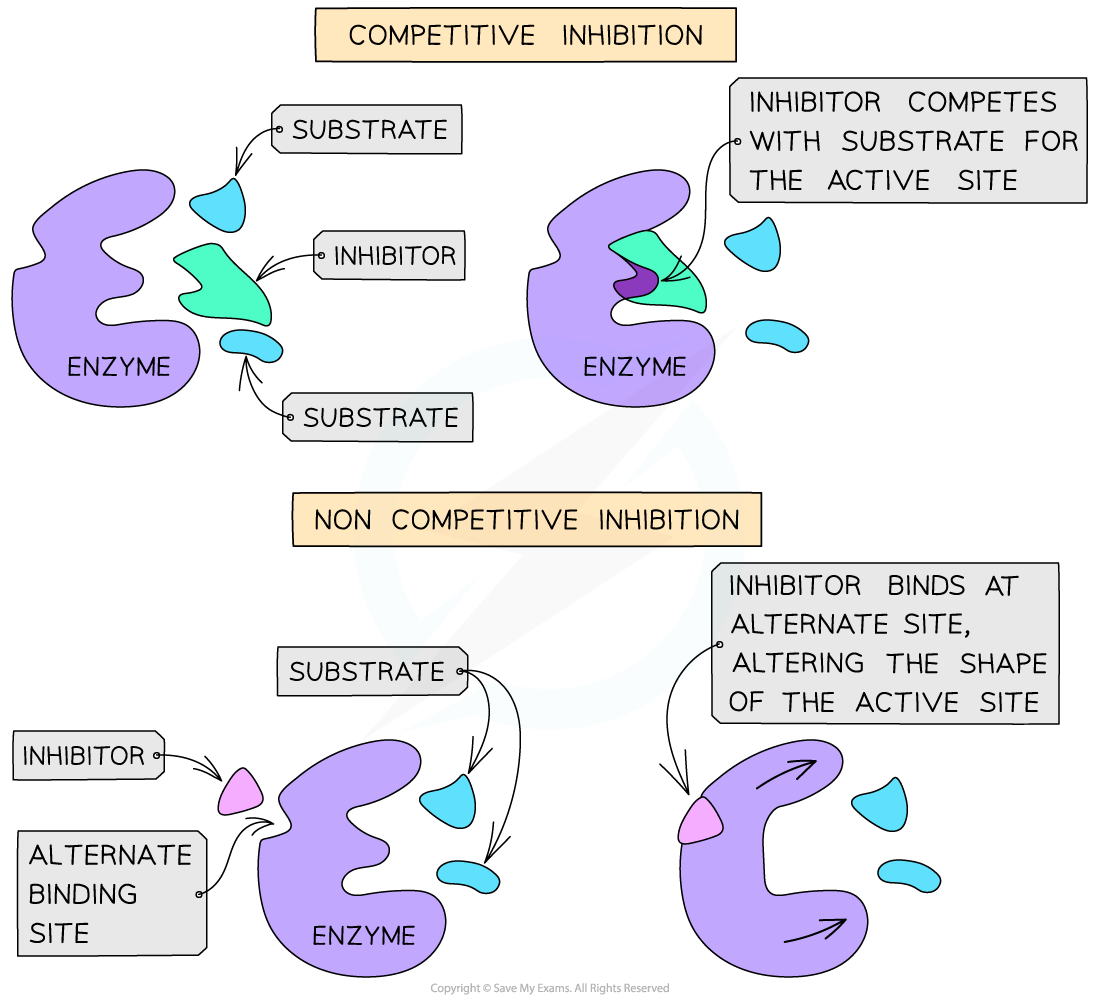
*Competitive and non-competitive inhibition by reversible inhibitors *
-
Reversible inhibitors can act as regulators in metabolic pathways
-
Metabolic reactions must be very tightly controlled and balanced, so that no single enzyme can ‘run wild’ and continuously and uncontrollably generate more and more of a particular product
-
Metabolic reactions can be controlled by using the end-product of a particular sequence of metabolic reactions as a non-competitive, reversible inhibitor:
- As the enzyme converts substrate to product, the process is itself slowed down as the end-product of the reaction binds to an alternative site on the original enzyme, changing the shape of the active site and preventing the formation of further enzyme-substrate complexes
- The end-product can then detach from the enzyme and be used elsewhere, allowing the active site to reform and the enzyme's shape to return to an active state
- This means that as product levels fall, the enzyme begins catalysing the reaction once again, in a continuous feedback loop
- This process is known as end-product inhibition
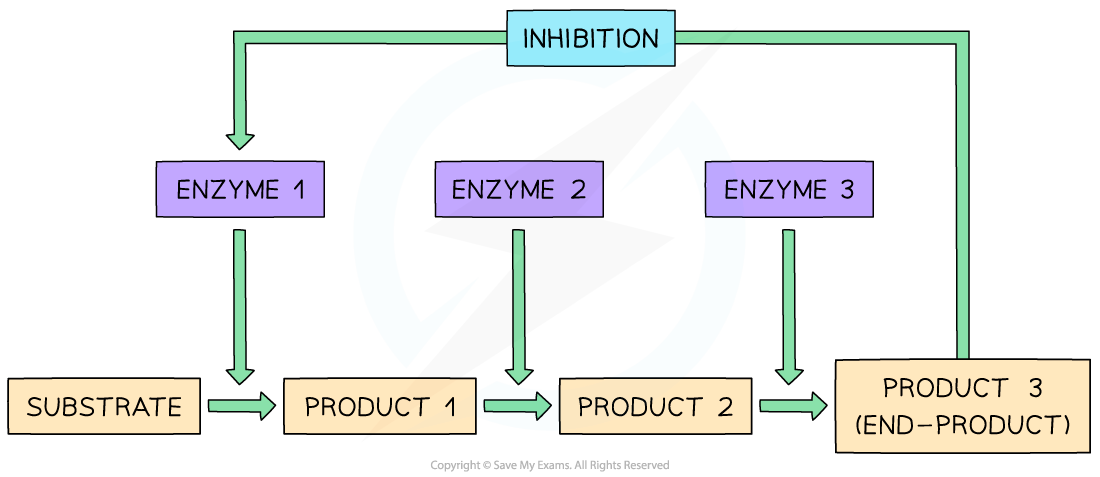
End-product inhibition
Was this revision note helpful?
Build on this topic