Abscisic Acid & Stomatal Closure (Cambridge International A-Level Biology)
Spec point —
14.2.4· describe the role of abscisic acid in the closure of stomata during times of water stress, including the role of calcium ions as a second messenger
Abscisic acid & stomatal closure
-
During times of water stress, the hormone abscisic acid (ABA) is produced by plants to stimulate the closing of their stomata
- Certain environmental conditions can cause water stress, such as very high temperatures or reduced water supplies
-
Guard cells have ABA receptors on their cell surface membranes
-
ABA binds with these receptors, inhibiting the proton pumps and therefore stopping the active transport of hydrogen (H+) ions out of the guard cells
-
ABA also causes calcium (Ca2+) ions to move into the cytoplasm of the guard cells through the cell surface membranes
-
The calcium ions act as second messengers:
- They cause channel proteins****to open that allow negatively charged ions to leave the guard cells
- This stimulates the opening of further channel proteins that allow potassium (K+) ions to leave the guard cells
- The calcium ions also stimulate the closing of channel proteins that allow potassium (K+) ions to enter the guard cells
-
This loss of ions increases the water potential of the guard cells
-
Water leaves the guard cells by osmosis
-
The guard cells become flaccid, causing the stomata to close
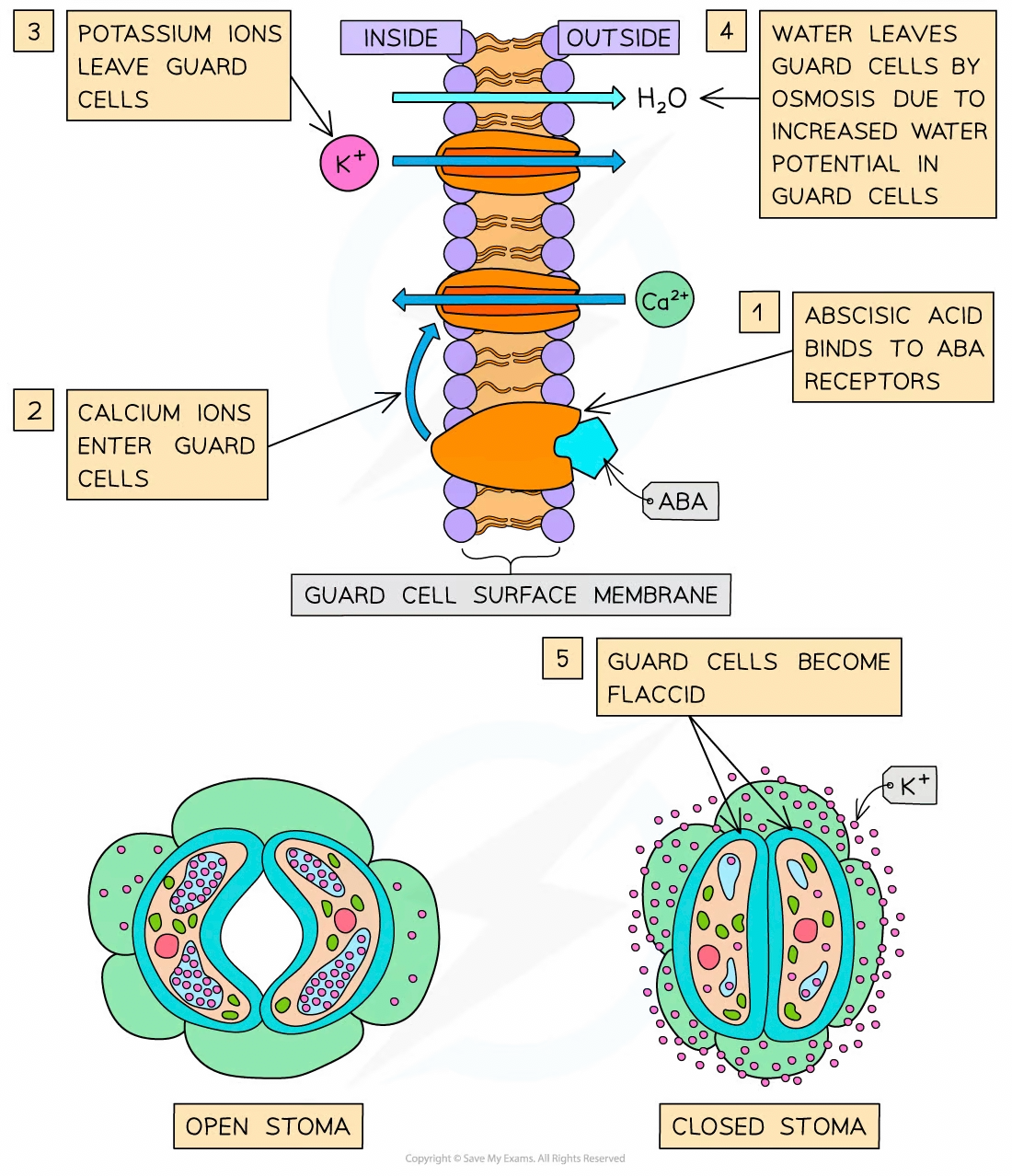
Closure of a stoma in response to abscisic acid (ABA)
Was this revision note helpful?
Build on this topic