Electromagnetic (EM) Waves (Edexcel IGCSE Science)
Properties of em waves
Spec point —
5.10· know that light is part of a continuous electromagnetic spectrum that includes radio, microwave, infrared, visible, ultraviolet, x-ray and gamma ray radiations and that all these waves travel at the same speed in free space
-
Light is part of a continuous electromagnetic spectrum that consists of the following types of radiation:
- radio
- microwave
- infrared
- visible
- ultraviolet
- x-ray
- gamma ray
-
All waves in the electromagnetic spectrum share the following properties:
- They are all transverse
- They can all travel through free space (a vacuum)
- They all travel at the same speed in free space
The EM spectrum
Spec point —
5.11· know the order of the electromagnetic spectrum in terms of decreasing wavelength and increasing frequency, including the colours of the visible spectrum
-
The types of radiation found in the electromagnetic spectrum have a specific order based on their wavelength (and frequency)
-
This order listed above has:
- radio waves at one end because they have the longest wavelength (and lowest frequency)
- gamma rays at the other end because they have the shortest wavelength (and highest frequency)
-
Wavelength and frequency are inversely proportional to each other, which, according to the Wave equation, means that:
- as wavelength increases (towards the red end of the spectrum), frequency decreases
- as wavelength decreases (towards the violet end of the spectrum), frequency increases
Radiation in the EM spectrum, from longest to shortest wavelength
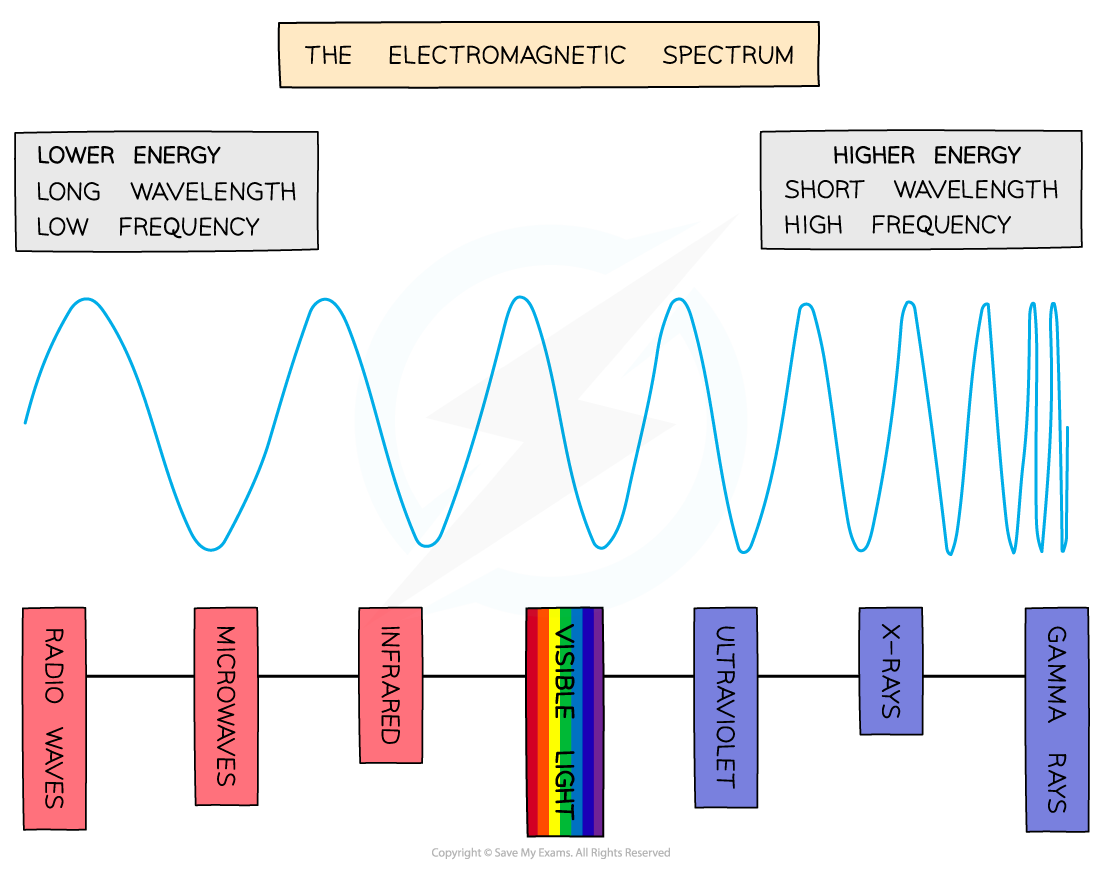
Visible light is just one small part of a much bigger spectrum: The electromagnetic spectrum
The visible light spectrum
-
Visible light is the only part of the EM spectrum detectable by the human eye
- However, it is only a very small part of the whole electromagnetic spectrum
- In the natural world, many animals, such as birds, bees and certain fish, can perceive beyond visible light and use infra-red and UV wavelengths of light to see
-
Each colour within the visible light spectrum corresponds to a narrow band of wavelength and frequency
-
The different colours of visible light waves correspond to different wavelengths:
- red light has the longest wavelength (and the lowest frequency)
- violet light has the shortest wavelength (and the highest frequency)
The colours of the visible spectrum
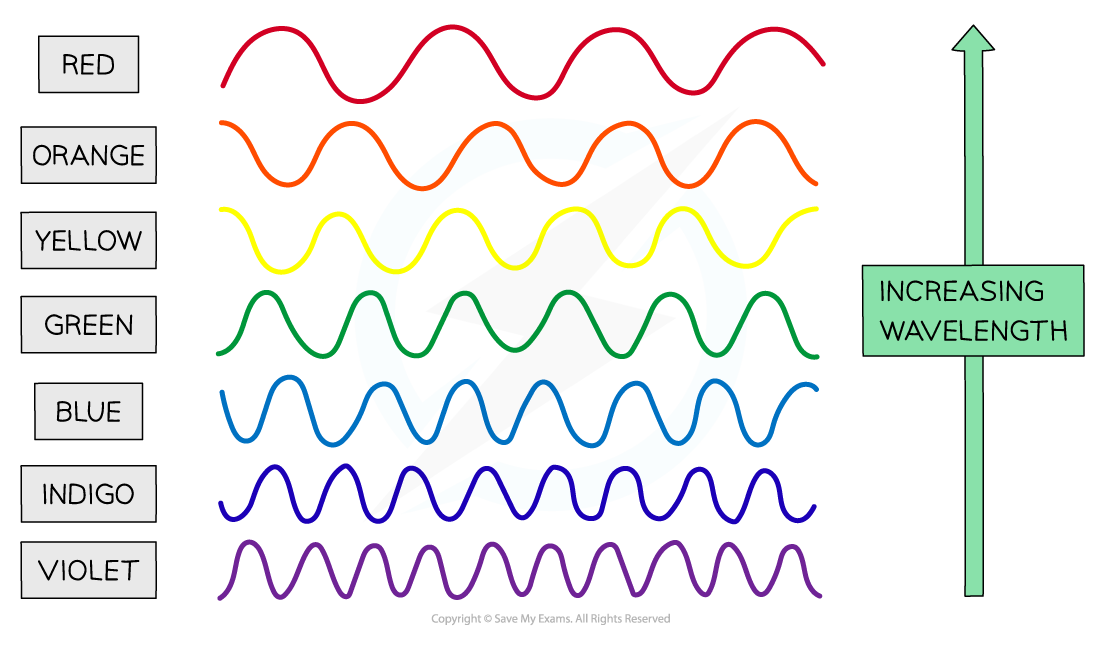
The colours of the visible spectrum: red has the longest wavelength; violet has the shortest
Exam Hint See if you can make up a mnemonic to help you remember the order of the colours of visible light in the EM spectrum!.
One possibility is:
Raging Martians Invaded Venus Using X-ray Guns
To remember the colours of the visible spectrum you could remember either:
- The name “Roy G. Biv”
- Or the saying “Richard Of York Gave Battle In Vain”
You could even combine both to have a mega mnemonic:
Raging Martians Invaded Roy G. Biv Using X-ray Guns!
The electromagnetic spectrum is usually given in order of decreasing wavelength and increasing frequency i.e. from radio waves to gamma waves
Remember:
- Radios are big (long wavelength)
- Gamma rays are emitted from atoms which are very small (short wavelength)

Was this revision note helpful?
Build on this topic