Kinetic Theory (Edexcel IGCSE Science)
Kinetic theory of gases
Spec point —
6.1· explain how molecules in a gas have random motion and that they exert a force, and hence a pressure, on the walls of a container
Random motion
-
Molecules in a gas are in constant random motion at high speeds
-
Random motion means that the molecules are travelling in no specific path and undergo sudden changes in their motion if they collide:
- with the walls of its container
- with other molecules
-
The random motion of tiny particles in a fluid is known as Brownian motion
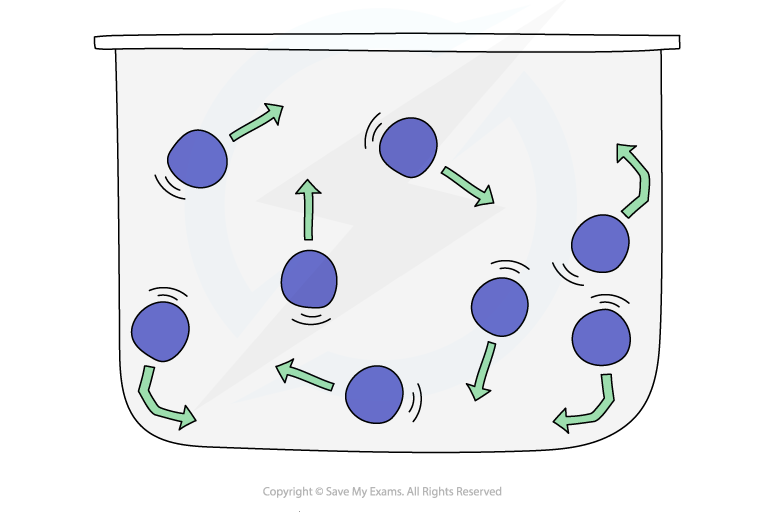
Random motion of gas molecules in a container, caused by collisions
-
Brownian motion provides evidence that air is made of small particles
-
This is because when larger particles, such as smoke particles or pollen, are observed floating in the air:
- the larger particles move with random motion
- this is a result of the larger particles colliding with smaller particles that are invisible to the naked eye
Pressure
- A feature of gases is that they fill their container
- The pressure is defined as the force per unit area
-
Where:
- p = pressure in pascals Pa
- F = force in newtons N
- A = area in metres-squared m2
-
As the gas particles move about randomly they collide with the walls of their containers
-
These collisions produce a net force at right angles to the wall of the gas container (or any surface)
-
Therefore, a gas at high pressure has more frequent collisions with the container walls and a greater force
- Hence the higher the pressure, the higher the force exerted per unit area
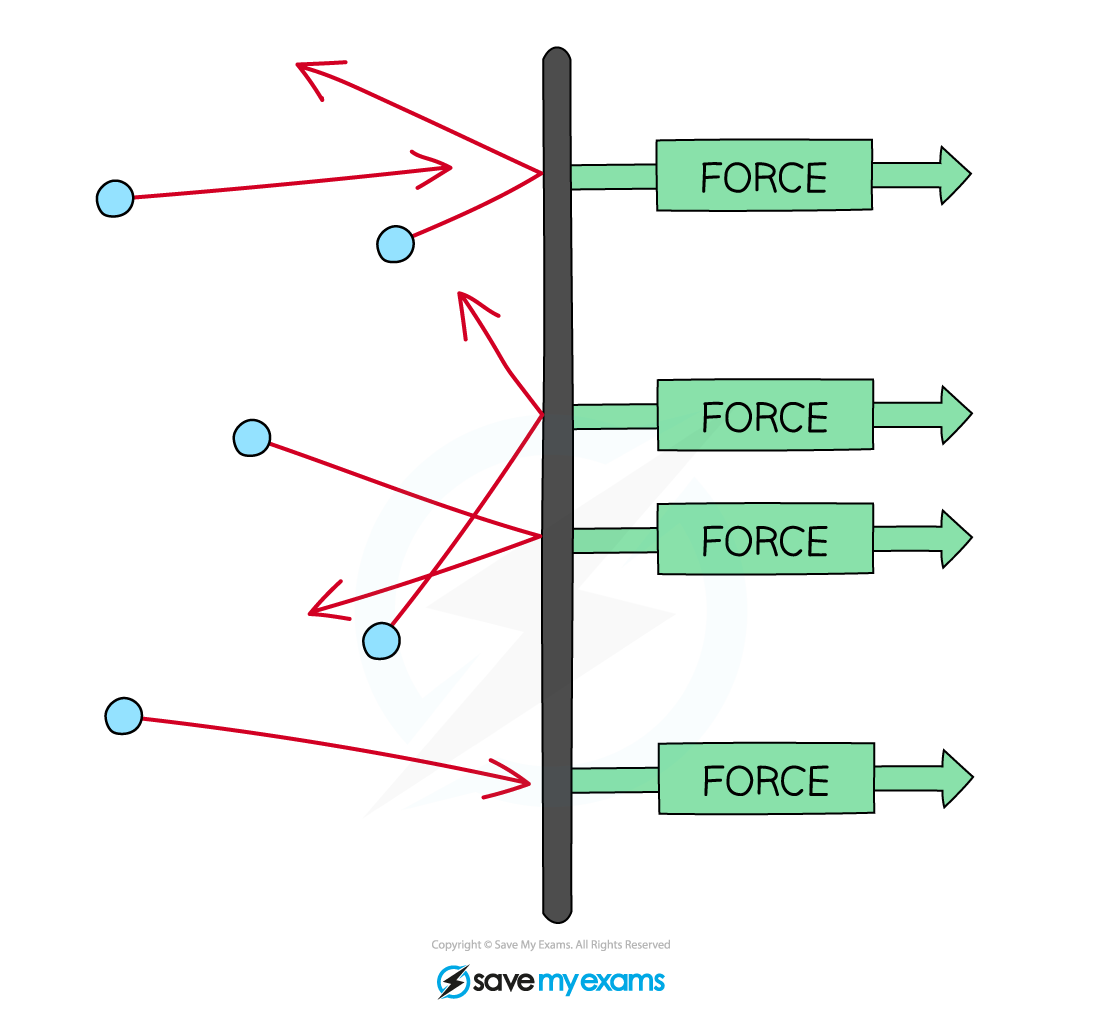
Gas molecules colliding with the walls of a container, exerting a force over the area and hence generating pressure
Was this revision note helpful?
Build on this topic