Nuclear Fusion (Edexcel IGCSE Science)
Fusion
Spec point —
8.24· describe nuclear fusion as the creation of larger nuclei resulting in a loss of mass from smaller nuclei, accompanied by a release of energy
- Small nuclei can react to release energy in a process called nuclear fusion
- Nuclear fusion is defined as:
When two light nuclei join to form a heavier nucleus
-
This process requires extremely high temperatures to maintain
- This is why nuclear fusion has proven very hard to reproduce on Earth
-
Stars, including the Sun, use nuclear fusion to produce energy
- Therefore, fusion reactions are very important to life on Earth
-
In most stars, hydrogen atoms are fused together to form helium and produce lots of energy
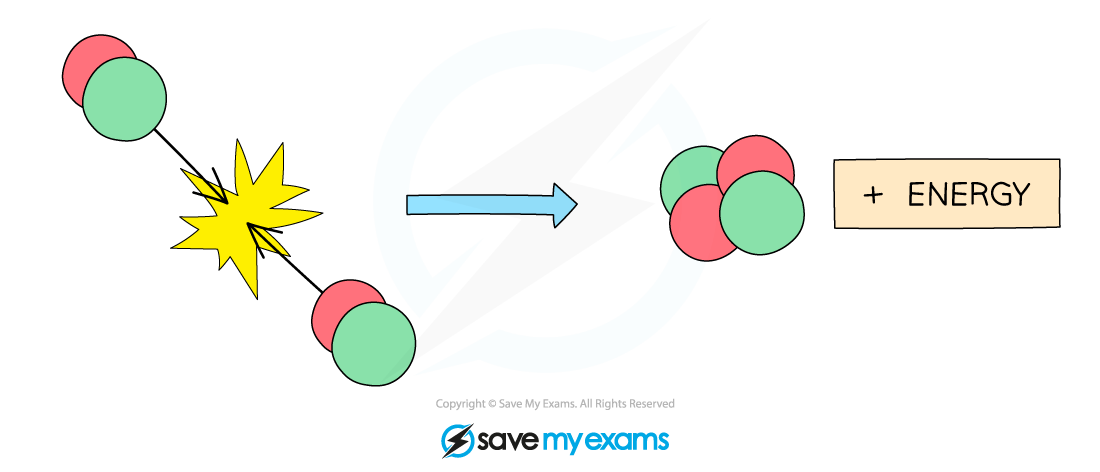
Two hydrogen nuclei are fusing to form a helium nuclei
-
The energy produced during nuclear fusion comes from a very small amount of the particle’s mass being converted into energy
-
The amount of energy released during nuclear fusion is huge
- The energy from 1 kg of hydrogen that undergoes fusion is equivalent to the energy from burning about 10 million kilograms of coal
Fusion vs fission
Spec point —
8.23· explain the difference between nuclear fusion and nuclear fission
- The following table summarises some of the key differences between fusion and fission:
Comparison of fusion and fission table
| Fusion | Fission | |
|---|---|---|
| the process of... | nuclei joining together | nuclei splitting |
| nuclei are | small e.g. hydrogen | large e.g. uranium |
| occurs in | stars | nuclear reactors |
| produces | a large amount of energy larger nuclei (usually stable and not radioactive) | a large amount of energy smaller daughter nuclei (usually unstable and radioactive) 2 or 3 neutrons |
| requires | very high temperatures very high pressures | thermal neutrons to induce fission |
- Nuclear fission reactors are an increasingly common method of electricity generation on Earth
- Nuclear fusion reactors are not yet a commercially viable method for generating electricity, but they are in development
- In the future, fusion reactors are likely to have several advantages over fission reactors
Advantages of fusion reactors
- Nuclear fusion reactions are capable of generating more energy than fission reactions (per kilogram of fuel)
- The nuclear fuel required for fusion (isotopes of hydrogen found in water) is more abundant than the fuel required for fission (uranium and plutonium)
- Nuclear fusion produces no long-lived nuclear waste products
Disadvantage of fusion reactors
- The conditions for nuclear fusion are much harder to achieve and maintain on Earth than fission
Was this revision note helpful?
Build on this topic