The Conditions for Fusion (Edexcel IGCSE Science)
Fusion in stars
Spec point —
8.25· know that fusion is the energy source for stars
- Stars are huge balls of (mostly) hydrogen gas
- In the centre of a star, hydrogen nuclei undergo nuclear fusion to form helium nuclei
- An equation for a possible fusion reaction is:
H _ 1 ^ 2 + H _ 1 ^ 3 -> He _ 2 ^ 4 + n _ 0 ^ 1
-
Where (deuterium) and
H _ 1 ^ 3(tritium) are both isotopes of hydrogen- These are formed through other fusion reactions in the star
-
Fusion reactions release a huge amount of energy
-
The heat from fusion provides a pressure that prevents the star from collapsing under its own gravity
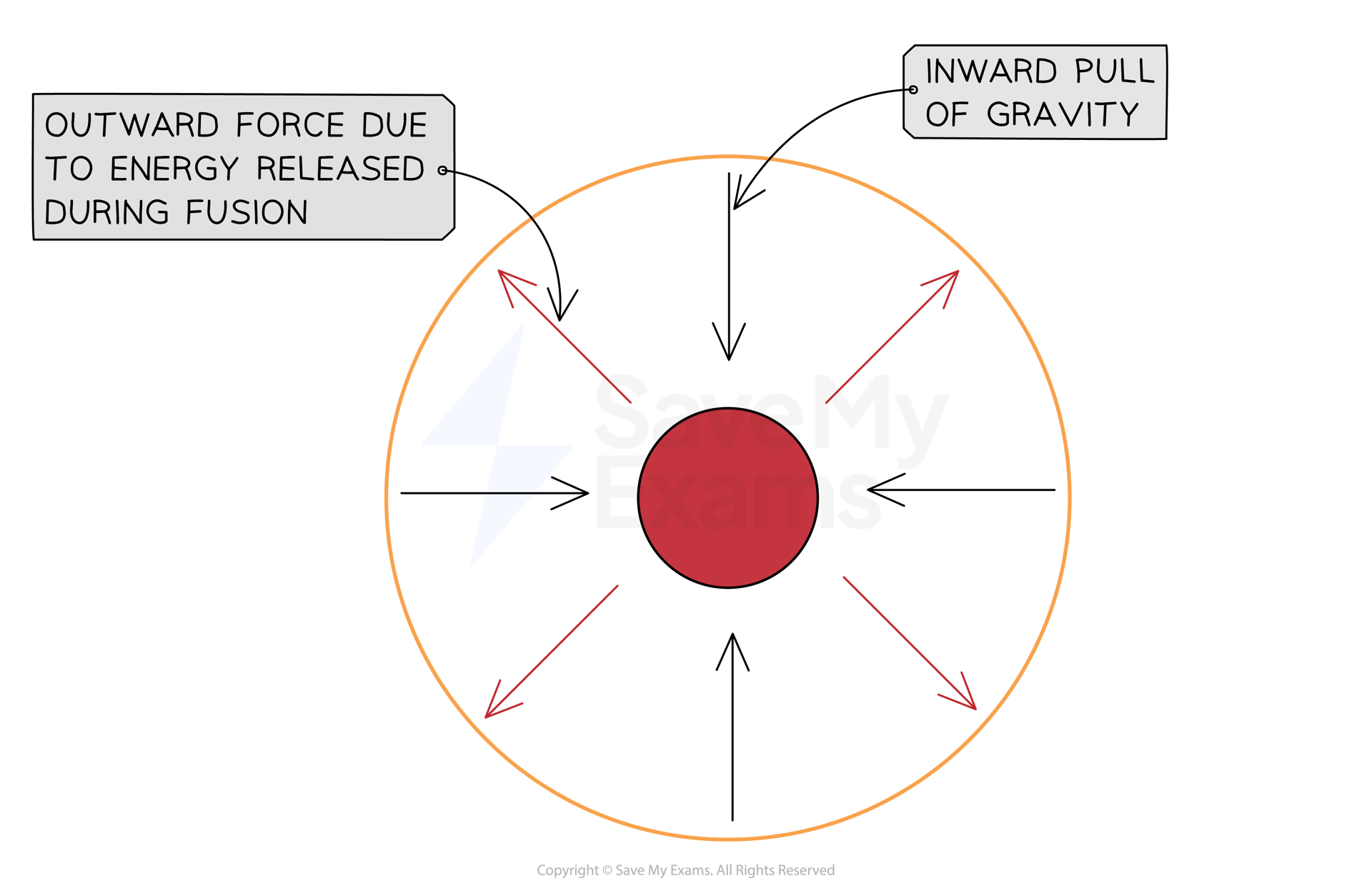
The outwards and inwards forces within a star are in equilibrium. The centre red circle represents the star's core and the orange circle represents the star's outer layers
- In larger stars where the temperature gets hot enough, helium nuclei can fuse into heavier elements
Exam Hint It is useful to remember that hydrogen is the fuel within stars, but the details of the reaction between deuterium and tritium is not required at this level.
The conditions for fusion
Spec point —
8.26· explain why nuclear fusion does not happen at low temperatures and pressures, due to electrostatic repulsion of protons
-
Nuclear fusion requires
- extremely high temperatures
- extremely high pressures
-
These conditions are required because of the electrostatic repulsion between protons
- Since protons have a positive charge, they repel each other
- Therefore, to overcome this repulsion, protons must have very high kinetic energies to allow them to get close enough to fuse
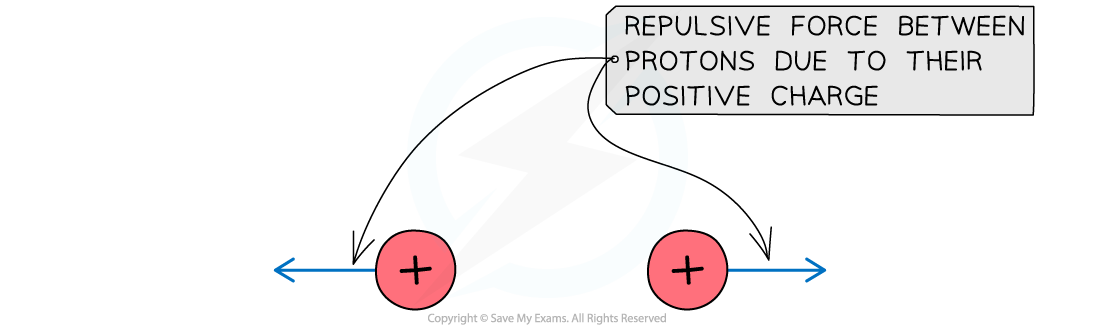
Hydrogen nuclei are positively charged protons which repel one another, making it difficult to achieve fusion under normal conditions
-
For hydrogen nuclei to travel at such speeds, the gas has to be heated to millions of degrees Celsius
- Such high temperatures are usually only achievable in the cores of stars
-
In regular conditions, such as on Earth, the possibility of collisions between nuclei which result in fusion is very low
- To increase the number of collisions (and hence fusion reactions) that occur between nuclei, high densities (and hence pressures) are also needed
Worked Example An example of a hydrogen fusion reaction which takes place in stars is shown here.
H _ 1 ^ 2 + H _ 1 ^ 1 -> He _ 2 ^ 3Which of the following is a valid reason as to why hydrogen fusion is not currently possible on Earth?
A. Hydrogen fusion produces dangerous radioactive waste
B. Hydrogen nuclei require very high temperature to fuse together
C. Hydrogen is a rare element that would be difficult to get large amounts of
D. Hydrogen fusion does not produce enough energy to be commercially viable
ANSWER: B
Hydrogen nuclei have positive charges
So two hydrogen nuclei would have a repulsive force between them
High temperatures are required to give the nuclei enough energy to overcome the repulsive force
The answer is not A because the product of the hydrogen fusion shown in the reaction is helium
- Helium is an inert gas, it is not dangerous or radioactive
The answer is not C because hydrogen is a very abundant element
- It is the most common element in the universe
The answer is not D because hydrogen fusion would produce a huge amount of energy
Was this revision note helpful?
Build on this topic