Resultant Forces (Edexcel IGCSE Physics)
Calculating resultant force
Spec point —
1.15· calculate the resultant force of forces that act along a line
What is a resultant force?
-
A resultant force is a single force that describes all of the forces operating on a body
-
When multiple forces act on one object, the forces can be combined to produce one net force that describes the combined action of all of the forces
-
This single resultant force determines:
- The direction in which the object will move as a result of all of the forces
- The magnitude of the net force experienced by the object
Adding forces to find the resultant force
-
Resultant forces can be calculated by adding all of the forces acting on the object
- Forces working in opposite directions are subtracted from each other
- Forces working in the same direction are added together
-
If the forces acting in opposite directions are equal in size, then there will be no resultant force – the forces are said to be balanced
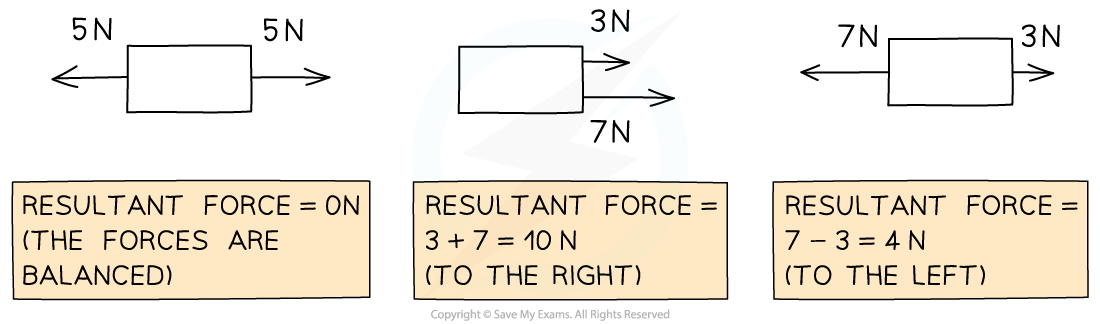
Diagram showing the resultant forces on three different objects
-
Imagine the forces on the boxes as two people pushing on either side
- In the first scenario, the two people are evenly matched - the box doesn't move
- In the second scenario, the two people are pushing on the same side of the box, it moves to the right with their combined strength
- In the third scenario, the two people are pushing against each other and are not evenly matched, so there is a resultant force to the left
Worked Example Calculate the magnitude and direction of the resultant force in the diagram below.
Answer:
Step 1: Add up all of the forces directed to the right
4 N + 8 N = 12 N
Step 2: Subtract the forces on the right from the forces on the left
14 N – 12 N = 2 N
Step 3: Evaluate the direction of the resultant force
- The force to the left is greater than the force to the right therefore the resultant force is directed to the left
Step 4: State the magnitude and direction of the resultant force
- The resultant force is 2 N to the left

Exam Hint When calculating resultant forces, always remember to provide units for your answer and to state whether the force is to the left, to the right, or maybe up or down. Always provide your final answer as a description of the magnitude and the direction, for example:
- Resultant Force = 4 N to the right
Friction
Spec point —
1.16· know that friction is a force that opposes motion
- Friction is defined as:
A force which opposes the motion of an object
-
Frictional forces always act in the opposite direction to the object's motion
-
Friction occurs when two (or more) surfaces rub against each other
- At a molecular level, both surfaces contain imperfections- i.e. they are not perfectly smooth
- These imperfections tend to push against each other
Friction acting between the surface of a sledge and the surface of the snow
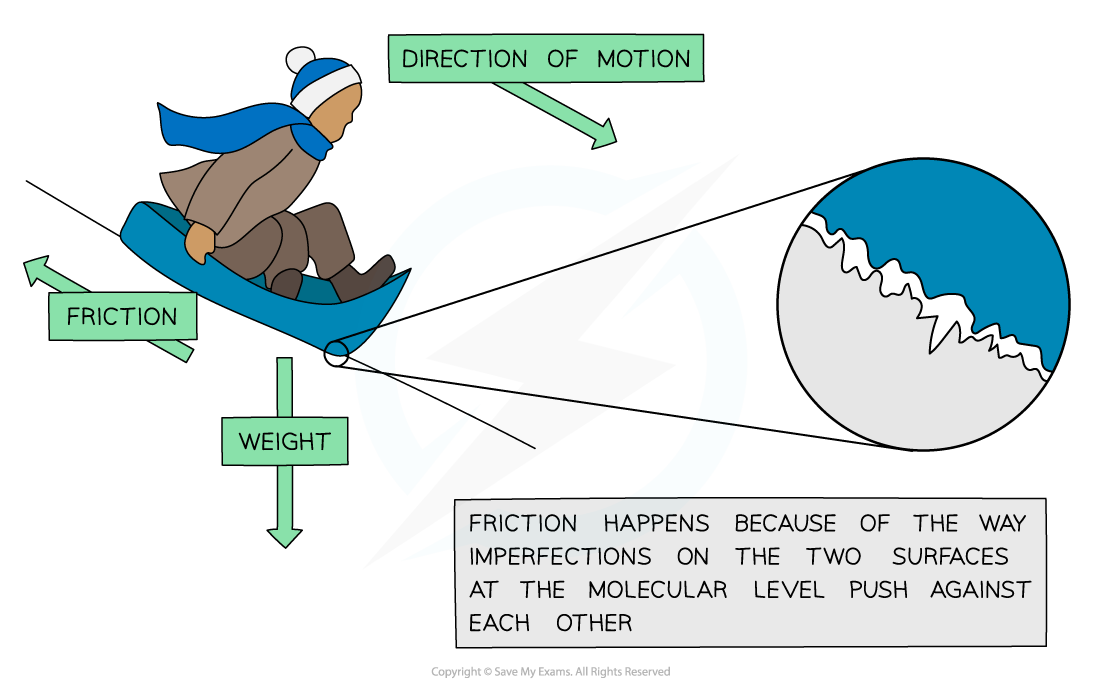
Friction is a force which opposes an objects motion, acting in the opposite direction to the motion of the object
Exam Hint Remember from the revision note Types of Forces that drag force is a type of friction that acts to oppose the motion of objects moving through a fluid (a liquid or a gas).
Air resistance is a type of drag force, and therefore a type of friction, that acts to oppose the motion of objects moving through air.
Was this revision note helpful?