Solids, Liquids & Gases (Edexcel IGCSE Physics)
Exam board Pearson Edexcel · IGCSEUpdated 2024-08-29
Spec point —
4.10P· describe the arrangement and motion of particles in solids, liquids and gases (physics only)
Solids, liquids & gases
- There are three different states of matter: solid, liquid, or gas
Solid state of matter
-
In a solid state of matter:
- The particles are closely packed
- The particles vibrate about fixed positions
-
Solids have:
- A definite shape (they are rigid)
- A definite volume
Liquid state of matter
-
In a liquid state of matter:
- The particles are closely packed
- The particles can flow over one another
-
Liquids have:
- No definite shape – they are able to flow and will take the shape of a container
- A definite volume
Gas state of matter
-
In a gas state of matter:
- The particles are far apart
- The particles move randomly
-
Gases have:
- No definite shape – they will take the shape of their container
- No fixed volume – if placed in an evacuated container they will expand to fill the container
-
Gases are highly compressible, this is because:
- There are large gaps between the particles
- It is easier to push the particles closer together than in solids or liquids
The three states of matter
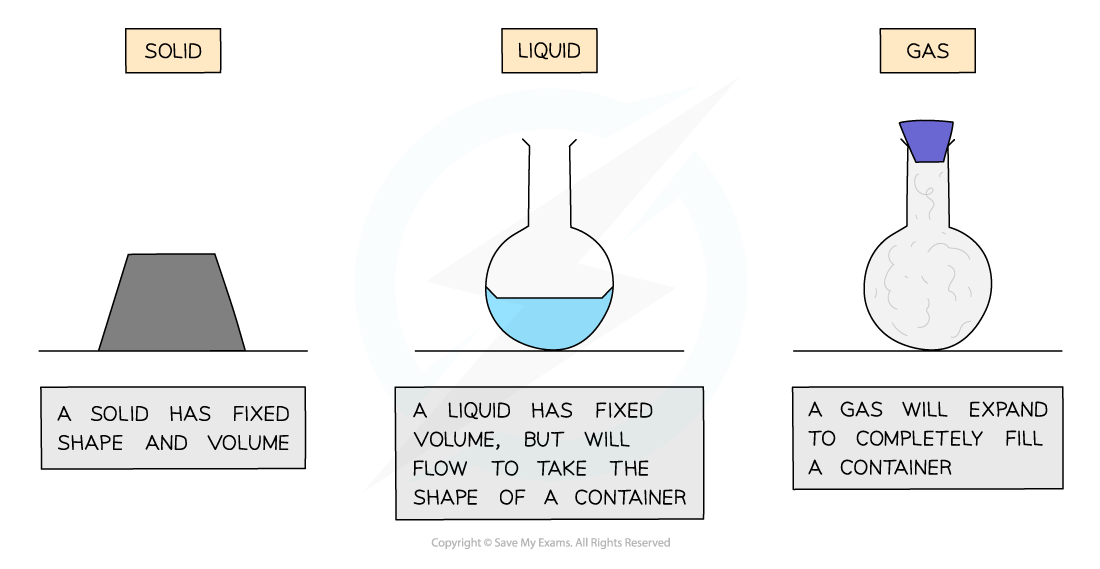
Diagram showing the three states of matter in terms of shape and volume
Properties of states of matter
| State | Solid | Liquid | Gas |
|---|---|---|---|
| Density | High | Medium | Low |
| Arrangement of particles | Regular pattern | Randomly arranged | Randomly arranged |
| Movement of particles | Vibrate around a fixed position | Move around each other | Move quickly in all directions |
| Energy of particles | Low energy | Greater energy | Highest energy |
Exam Hint In your exam, you may be asked to explain the particle arrangement and behaviour for each state of matter. These are easy marks but make sure you learn all the possible things you can say.
Was this revision note helpful?
Build on this topic