Absolute Zero (Edexcel IGCSE Physics)
Guided lessons are live for this note
Work through it step by step — key points, depth layers, a worked example and self-checks.
Spec point —
5.16· understand why there is an absolute zero of temperature which is –273 °C
Absolute zero
-
The amount of pressure that a gas exerts on its container is dependent on the temperature of the gas
- This is because particles move with more energy as their temperature increases
-
As the temperature of the gas decreases, the pressure on the container also decreases
-
In 1848, mathematician and physicist, Lord Kelvin, recognised that there must be a temperature at which the particles in a gas exert no pressure
- At this temperature they must no longer be moving, and hence not colliding with their container
-
This temperature is called absolute zero and is equal to −273 °C
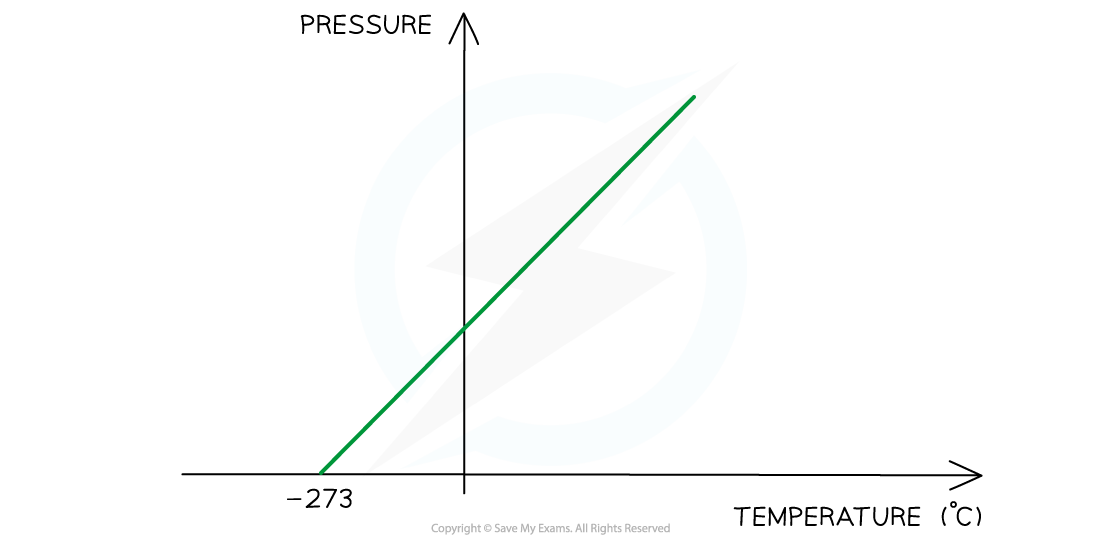
At absolute zero, or −273 °C, particles will have no net movement. It is therefore not possible to have a lower temperature
- Absolute zero is defined as: The temperature at which the molecules in a substance have zero kinetic energy
- This means for a system at absolute zero, it is not possible to remove any more energy from it
- Even in space, the temperature is roughly 2.7 K above absolute zero
The Kelvin scale
Spec point —
5.17· describe the Kelvin scale of temperature and be able to convert between the Kelvin and Celsius scales
-
The Kelvin temperature scale begins at absolute zero
- 0 K is equal to -273 °C
- An increase of 1 K is the same change as an increase of 1 °C
-
It is not possible to have a temperature lower than 0 K
-
This means a temperature in Kelvin will never be a negative value
-
To convert between temperatures θ in the Celsius scale, and T in the Kelvin scale, use the following conversion:
θ / °C = T / K − 273
T / K = θ / °C + 273
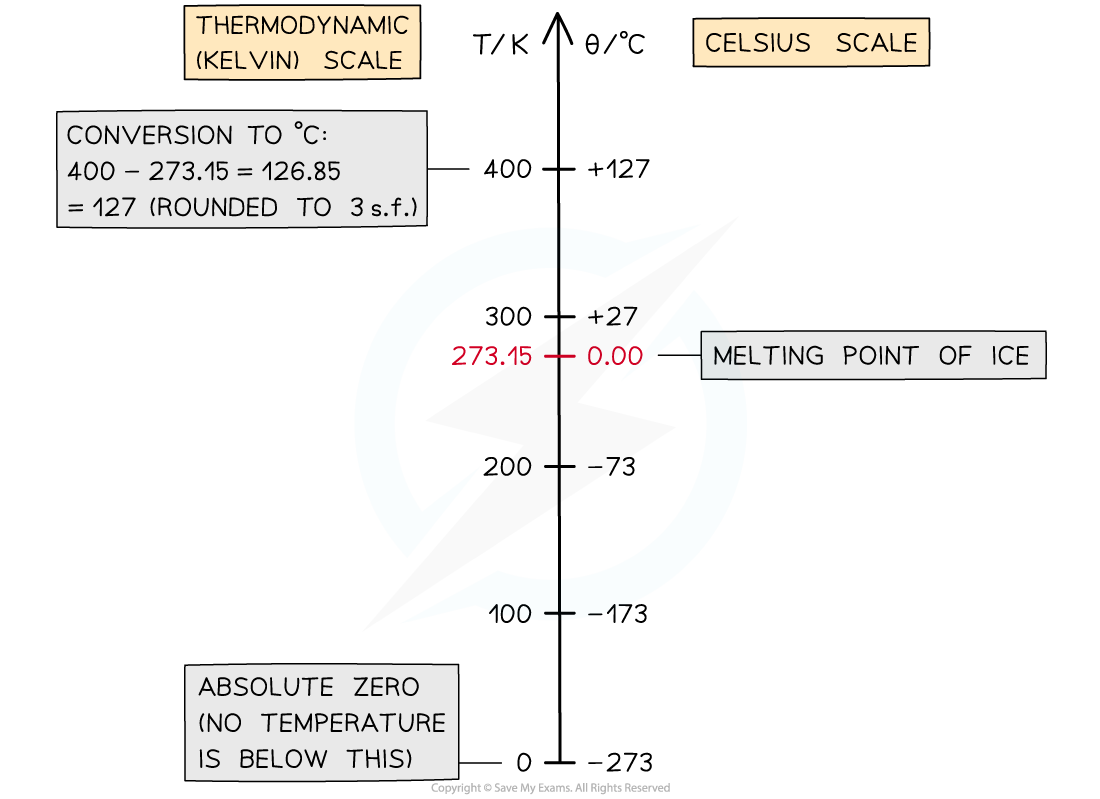
Conversion chart relating the temperature on the Kelvin and Celsius scales
- The divisions on both scales are equal. This means: A change in a temperature of 1 K is equal to a change in temperature of 1 °C
Worked Example The temperature in a room is 300 K.
What is this temperature in Celsius?
Answer:
Step 1: Kelvin to Celsius equation
θ / °C = T / K − 273
Step 2: substitute in value of 300 K
300 K − 273 = 27 °C
Exam Hint If you forget in the exam whether it’s +273 or −273, just remember that 0 °C = 273 K. This way, when you know that you need to +273 to a temperature in degrees to get a temperature in Kelvin. For example: 0 °C + 273 = 273 K.
Was this revision note helpful?
Build on this topic