The Big Bang Theory (Edexcel IGCSE Physics)
Spec point —
8.13P· describe the past evolution of the universe and the main arguments in favour of the Big Bang (physics only)
The Big Bang theory
-
Around 14 billion years ago, the Universe began from a very small region that was extremely hot and dense
-
Then there was a giant explosion, which is known as the Big Bang
-
This caused the universe to expand from a single point, cooling as it does so, to form the universe today
-
Each point expands away from the others
- This is seen from galaxies moving away from each other, and the further away they are the faster they move
-
As a result of the initial explosion, the Universe continues to expand

All galaxies are moving away from each other, indicating that the universe is expanding
-
An analogy of this is points drawn on a balloon where the balloon represents space and the points as galaxies
-
When the balloon is deflated, all the points are close together and an equal distance apart
-
As the balloon expands, all the points become further apart by the same amount
-
This is because the space itself has expanded between the galaxies
- Therefore, the density of galaxies falls as the Universe expands
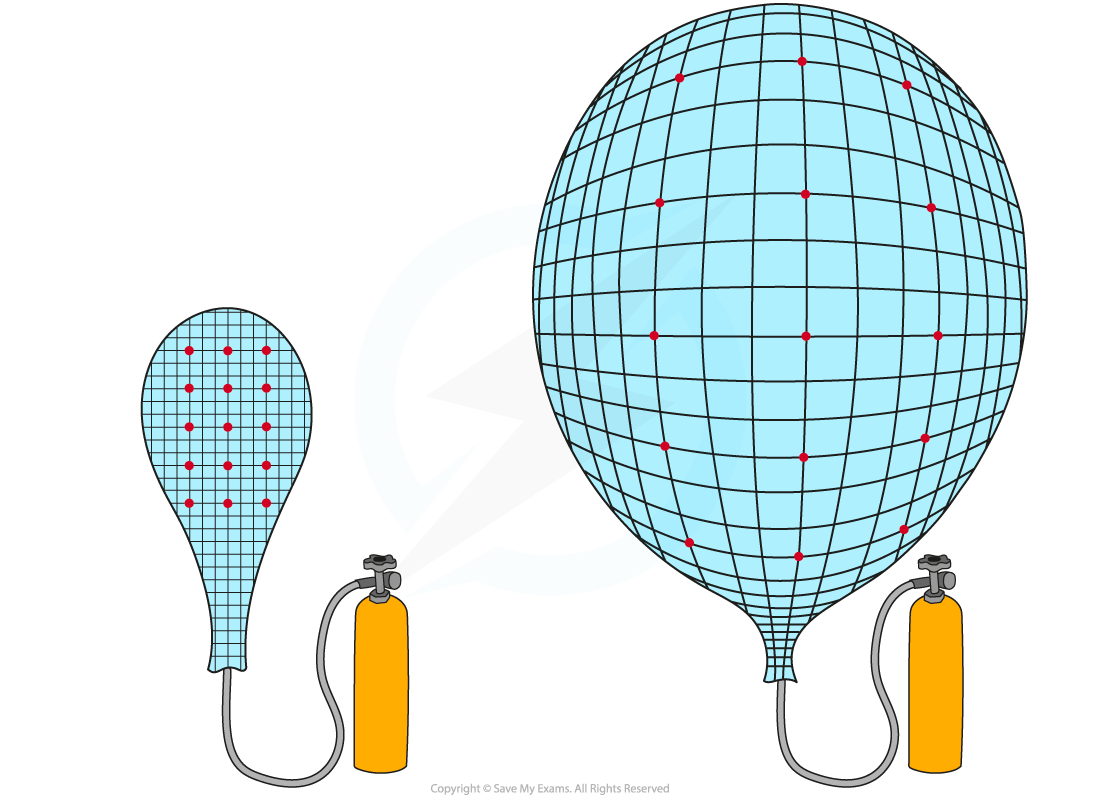
A balloon inflating is similar to the stretching of the space between galaxies
Evidence for the Big Bang
Spec point —
8.14P· describe evidence that supports the Big Bang theory (red-shift and cosmic microwave background (CMB) radiation) (physics only)
What are two pieces of evidence that support the Big Bang theory?
-
Since there is more evidence supporting the Big Bang theory than the Steady State theory, it is the currently accepted model for the origin of the Universe
-
The two main pieces of evidence supporting the Big Bang are
- Galactic red-shift
- Cosmic Microwave Background (CMB) radiation
Evidence from galactic red-shift
-
By observing the light spectrums from supernovae in other galaxies there is evidence to suggest that distant galaxies are receding (moving further apart) even faster than nearby galaxies
- These observations were first made in 1998
-
The light spectrums show that light from distant galaxies is redshifted, which is evidence that the universe is expanding
-
As a result, astronomers have concluded that:
- All galaxies are moving away from the Earth
- Galaxies are moving away from each other
-
This is what is expected after an explosion
- Matter is first densely packed and as it explodes it, it moves out in all directions getting further and further from the source of the explosion
- Some matter will be lighter and travel at a greater speed, further from the source of the explosion
- Some matter will be heavier and travel at a slower speed, closer to the source of the explosion
-
If someone were to travel back in time and compare the separation distance of the galaxies:
- It would be seen that galaxies would become closer and closer together until the entire universe was a single point
-
If the galaxies were originally all grouped together at a single point and were then exploded a similar effect would be observed
- The galaxies that are the furthest are moving the fastest - their distance is proportional to their speed
- The galaxies that are closer are moving slower
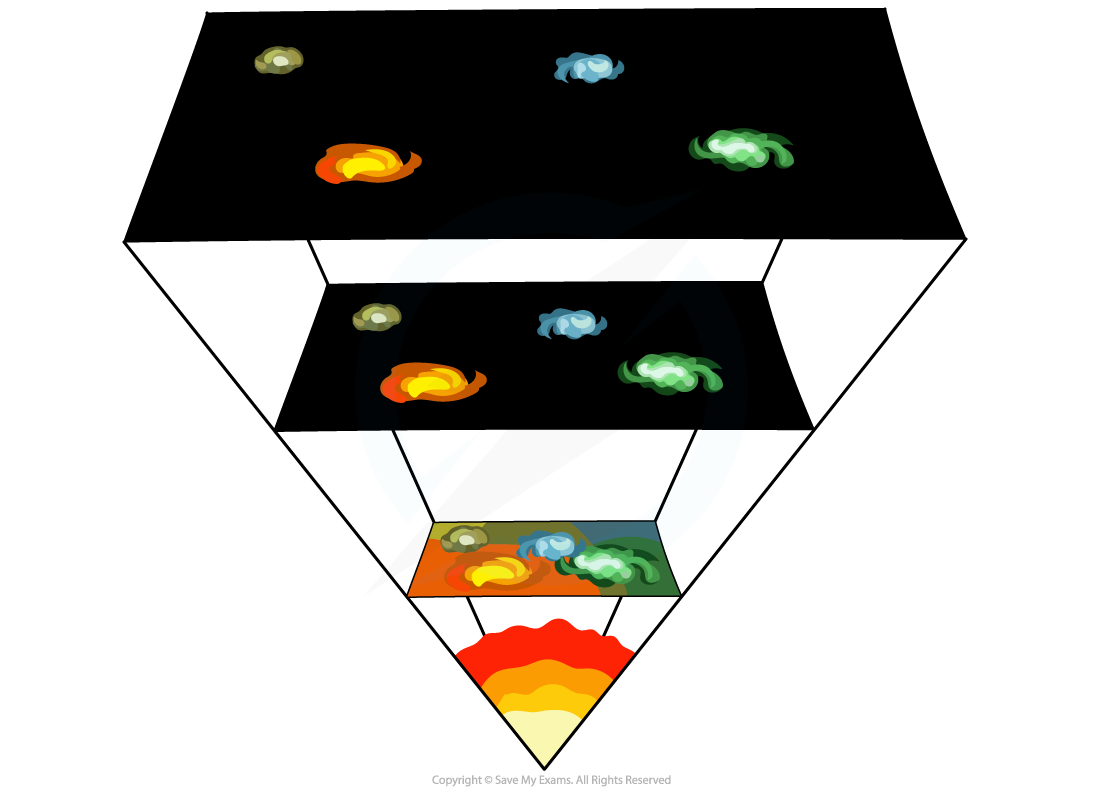
Tracing the expansion of the universe back to the beginning of time leads to the idea the universe began with a “big bang”
Evidence from CMB radiation
-
The discovery of the CMB (Cosmic Microwave Background) led to the Big Bang theory becoming the currently accepted model
- The CMB is a type of electromagnetic radiation which is a remnant from the early stages of the Universe
- It has a wavelength of around 1 mm making it a microwave, hence the name Cosmic Microwave Background
-
In 1964, Astronomers discovered radiation in the microwave region of the electromagnetic spectrum coming from all directions and at a generally uniform temperature of 2.73 K
- They were unable to do this any earlier since microwaves are absorbed by the atmosphere
- Around this time, space flight was developed which enabled astronomers to send telescopes into orbit above the atmosphere
-
According to the Big Bang theory, the early Universe was an extremely hot and dense environment
- As a result of this, it must have emitted thermal radiation
-
The radiation is in the microwave region
- This is because over the past 14 billion years or so, the radiation initially from the Big Bang has become redshifted as the Universe has expanded
- Initially, this would have been high energy radiation, towards the gamma end of the spectrum
- As the Universe expanded, the wavelength of the radiation increased
- Over time, it has increased so much that it is now in the microwave region of the spectrum
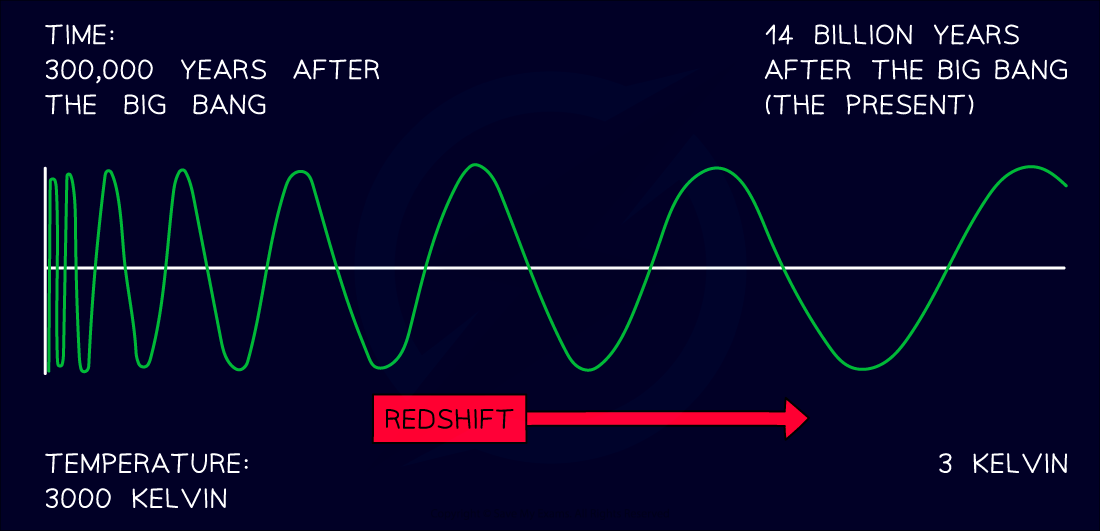
The CMB is a result of high energy radiation being redshifted over billions of years
-
The CMB radiation is very uniform and has the exact profile expected to be emitted from a hot body that has cooled down over a very long time
- This phenomenon is something that other theories (such as the Steady State Theory) cannot explain
-
The CMB is represented by the following map:
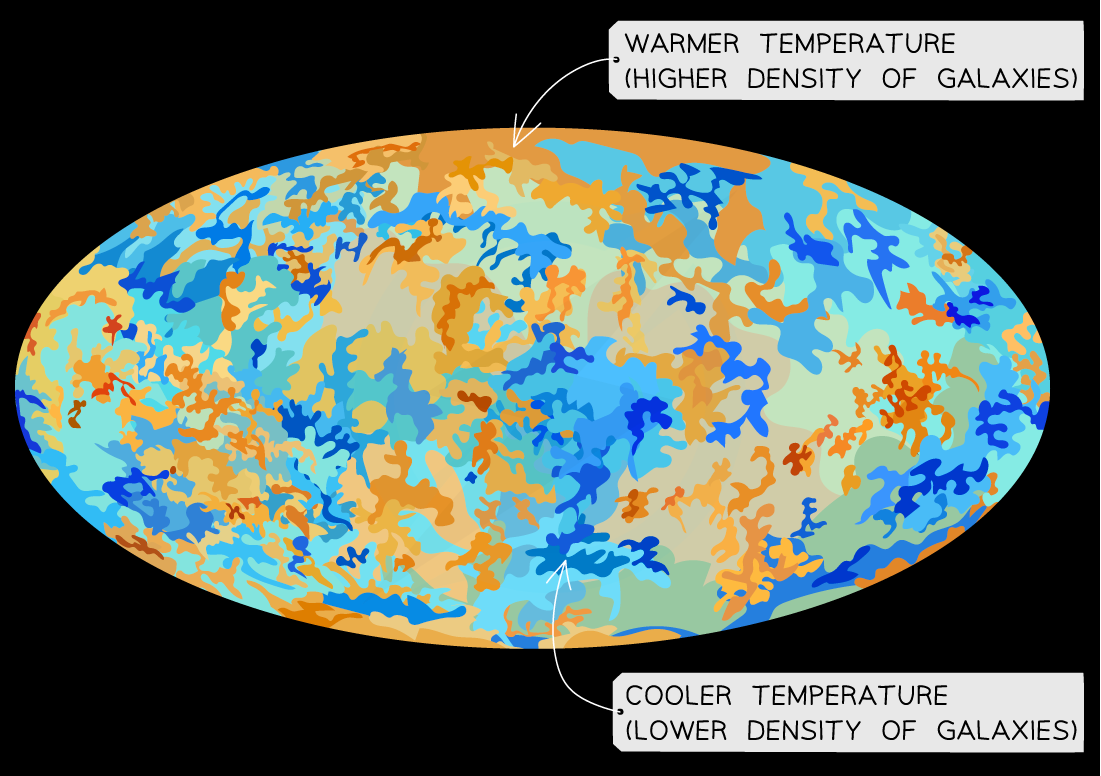
The CMB map with areas of higher and lower temperature. Places with higher temperature have a higher concentration of galaxies, Suns and planets
-
This is the closest image to a map of the Universe
-
The different colours represent different temperatures
- The red/ orange / brown regions represent warmer temperature indicating a higher density of galaxies
- The blue regions represents cooler temperature indicating a lower density of galaxies
-
The temperature of the CMB is mostly uniform, however, there are minuscule temperature fluctuations (on the order of 0.00001 K)
- This implies that all objects in the Universe are more or less uniformly spread out
Was this revision note helpful?
Build on this topic