Electric Charge (Edexcel IGCSE Physics)
Guided lessons are live for this note
Work through it step by step — key points, depth layers, a worked example and self-checks.
Electric forces between charges
Spec point —
2.25P· know that there are forces of attraction between unlike charges and forces of repulsion between like charges (physics only)
-
The charge of a particle can be:
- positive
- negative
- neutral (no charge)
-
Electrons are negatively charged particles, whilst protons are positive and neutrons are neutral
-
This is why in a neutral atom, the number of electrons is equal to the number of protons
- This is so the equal (but opposite) charges cancel out to make the overall charge of the atom zero
Diagram of a model of an atom
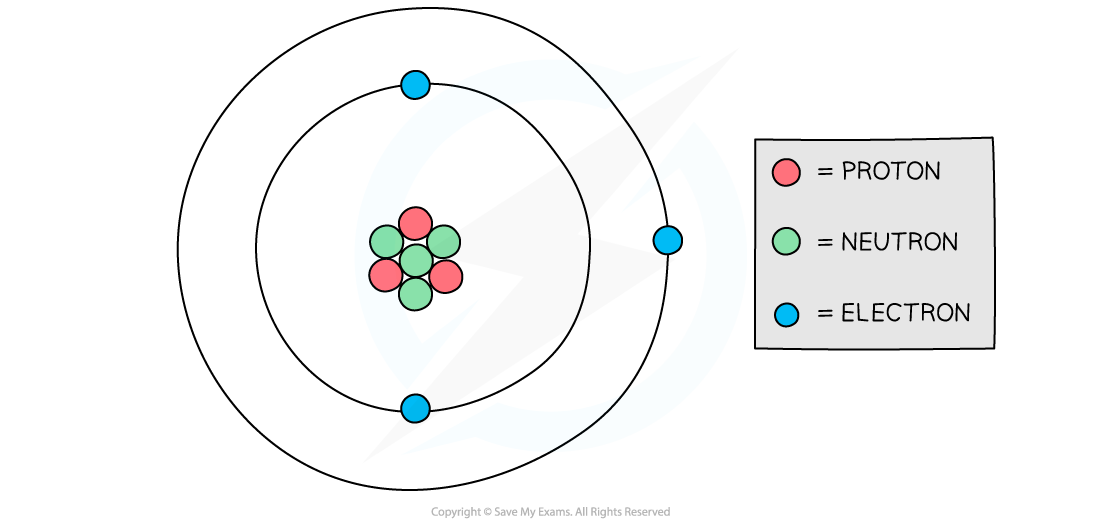
The number of negative electrons in an atom balances the number of positive protons
-
Therefore, an object becomes negatively charged when it gains electrons and positively charged when it loses electrons
-
When two charged particles or objects are close together, they also exert a force on each other
-
This force could be:
- Attractive (the objects get closer together)
- Repulsive (the objects move further apart)
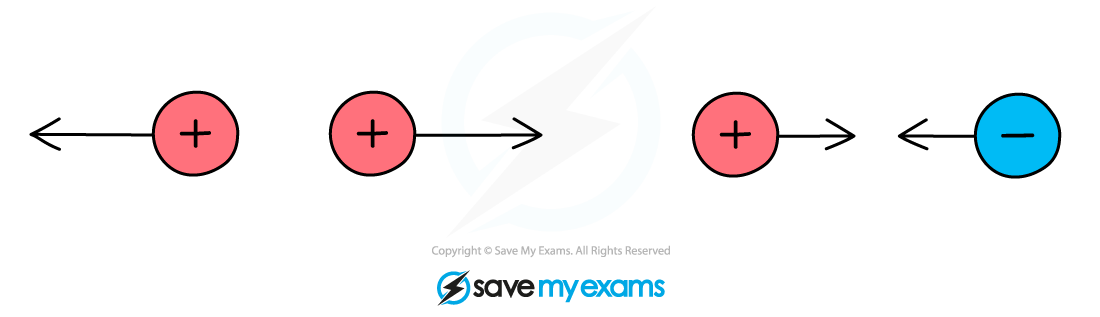
Opposite charges attract, like charges repel
-
Whether two objects attract or repel depends on their charge
- If the charges are the opposite, they will attract
- If the charges are the same, they will repel– charges which are the same (e.g. both positive) are often referred to as like charges
-
The force is stronger if the objects are closer together
Attraction or repulsion summary table
| Charge of object 1 | Charge of object 2 | Attract or repel? |
|---|---|---|
| positive | positive | repel |
| positive | negative | attract |
| negative | positive | attract |
| negative | negative | repel |
-
Attraction and repulsion between two charged objects are examples of a non-contact force
- This is a force that acts on an object without being physically in contact with it
Exam Hint Remember the saying “opposites attract” when answering questions about forces between charged particles.
Production of static
Spec point —
2.24P· explain how positive and negative electrostatic charges are produced on materials by the loss and gain of electrons (physics only)
-
Static electricity refers to the accumulation of charge on an object, which then attracts other objects or can even produce sparks
-
When certain insulating materials are rubbed against each other they become electrically charged
- This is called charging by friction
-
The charges remain on the insulators and cannot immediately flow away
- One becomes positive and the other negative
-
An example of this is a plastic or polythene rod being charged by rubbing it with a cloth
- Both the rod and cloth are insulating materials
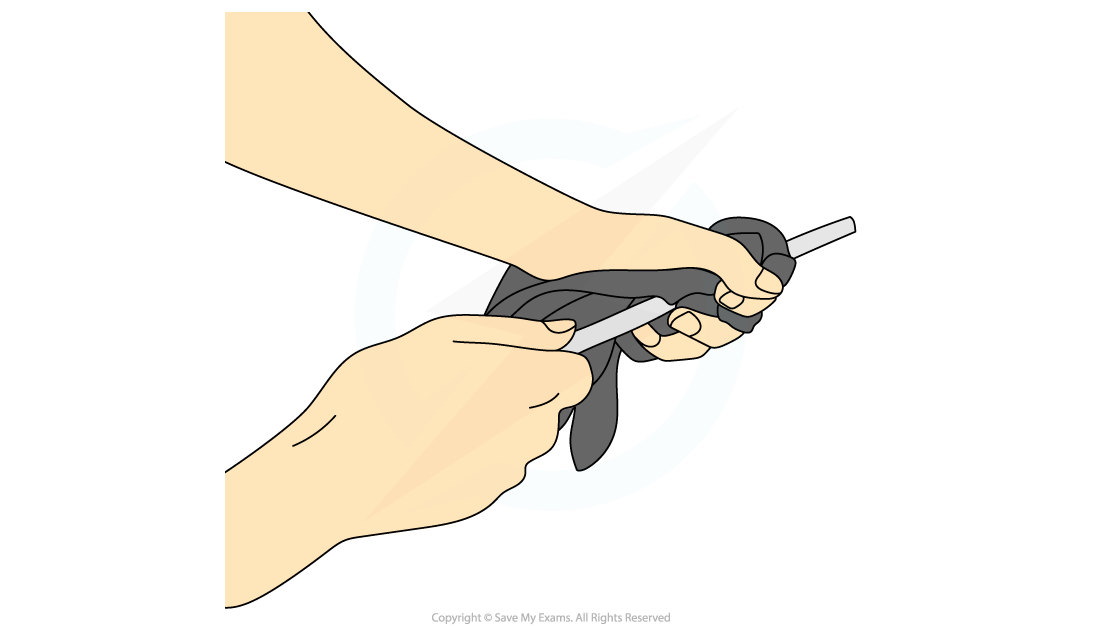
A polythene rod may be given a charge by rubbing it with a cloth
-
This occurs because negatively charged electrons are transferred from one material to the other
- The material, in this case, the rod, gains electrons
-
Since electrons are negatively charged, the rod becomes negatively charged
- As a result, the cloth has lost electrons and therefore is left with an equal positive charge
Exam Hint At this level, if asked to explain how things gain or lose charge, you must discuss electrons and explain whether something has gained or lost them. Remember when charging by friction, it is only the electrons that can move, not any 'positive' charge, therefore if an object gains a negative charge, something else must have gained a positive charge by losing negative electrons.
Movement of electrons
Spec point —
2.26P· explain electrostatic phenomena in terms of the movement of electrons (physics only)
-
All objects are initially electrically neutral, meaning the negative and positive charges are evenly distributed
-
However, when the electrons are transferred through friction, one object becomes negatively charged and the other positively charged
- The object the electrons are transferred to becomes negatively charged
- The object the electrons transfer from becomes positively charged
-
This difference in charges leads to a force of attraction between itself and other objects which are also electrically neutral
- This is done by attracting the opposite charge to the surface of the objects they are attracted to
-
In the example below, when the cloth and acetate rod are rubbed together, the electrons are transferred from the rod to the cloth
-
This results in an attractive force between the two objects once separated
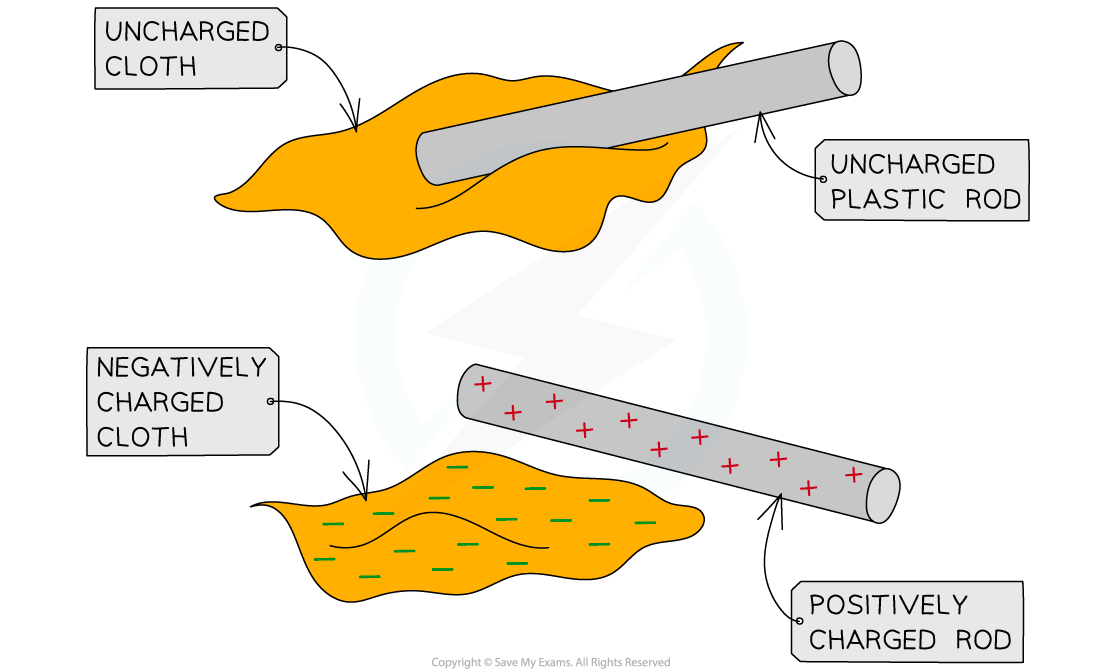
Electrons are transferred from the rod to the cloth as they are rubbed together. This leaves the cloth negatively charged and the rod positively charged
Was this revision note helpful?
Build on this topic