Nuclear Fission (Edexcel IGCSE Physics)
Fission
Spec point —
7.18· understand how a nucleus of U-235 can be split (the process of fission) by collision with a neutron, and that this process releases energy as kinetic energy of the fission products
Nuclear fission
- Nuclear fission is defined as: The splitting of a large, unstable nucleus into two smaller nuclei
- Some isotopes of uranium and plutonium are known as fissile materials
- This means they can undergo fission under the right conditions
- This makes them ideal to use as fuels in nuclear power stations
Spontaneous and induced fission
-
It is rare for nuclei to undergo fission without additional energy being put into the nucleus
- When nuclear fission occurs in this way it is called spontaneous fission
-
Usually, for fission to occur, the unstable nucleus must first absorb a neutron
-
This makes a nucleus more unstable so that it decays almost immediately
- When nuclear fission occurs in this way it is called induced fission
Fission of uranium-235
-
Uranium-235 is commonly used as a fuel in nuclear reactors
-
It has a very long half-life of 700 million years
- This means that it has a low activity and releases energy very slowly
- This is unsuitable for producing energy in a nuclear power station
-
Therefore, the fission of uranium-235 must be induced
-
During induced fission, the uranium-235 nucleus absorbs a neutron and becomes uranium-236
-
Uranium-236 is very unstable and splits by nuclear fission almost immediately to produce
- two smaller daughter nuclei
- two or three neutrons
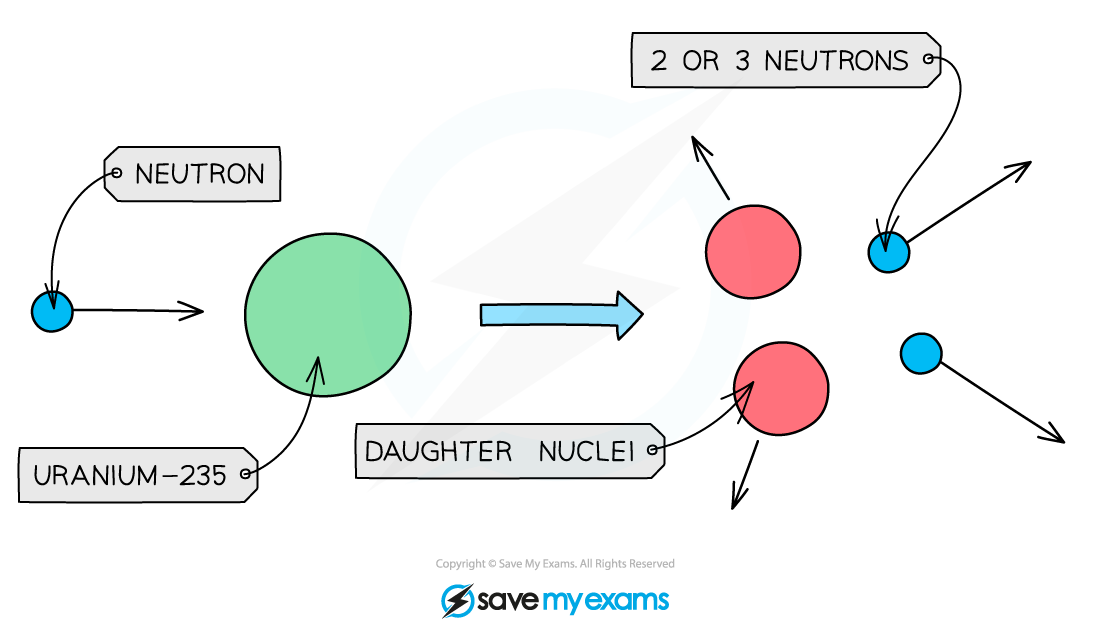
When a uranium-235 nucleus is struck by a neutron, it breaks into two smaller daughter nuclei and 2 or 3 neutrons
Exam Hint You need to remember that uranium and plutonium are possible elements for fission, but you do not need to know the specific daughter nuclei that are formed.
Use your knowledge of balancing nuclear equations to work these out.
Products of fission
Spec point —
7.19· know that the fission of U-235 produces two radioactive daughter nuclei and a small number of neutrons
-
During fission, when a neutron collides with an unstable nucleus, the nucleus splits into
- two smaller nuclei (daughter nuclei)
- two or three neutrons
- gamma rays are also emitted
-
One of the many decay reactions uranium-235 can undergo is shown below:
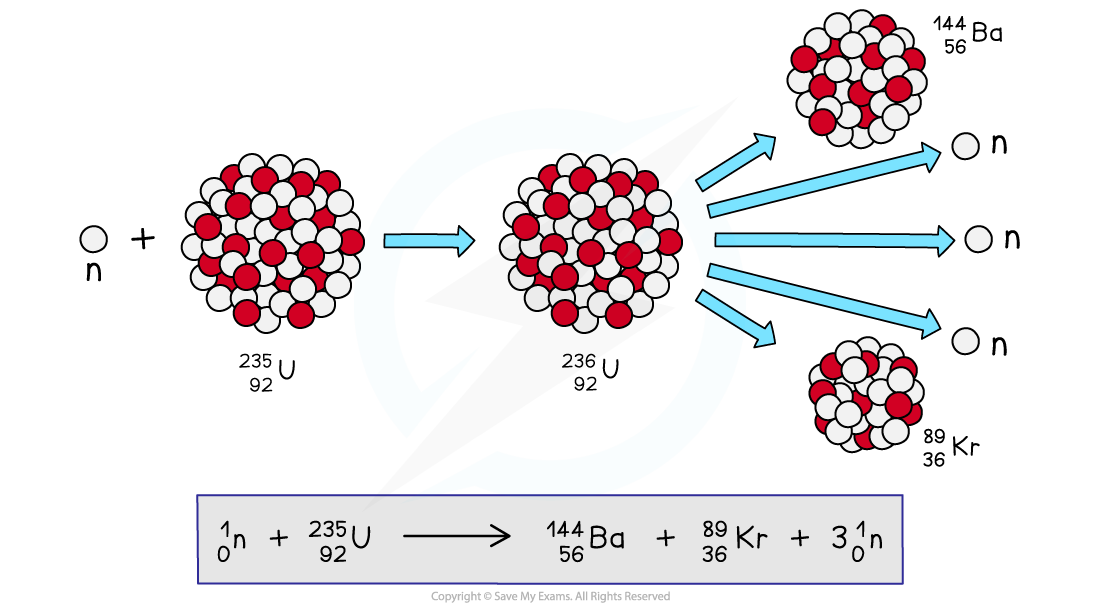
When fission is induced in a uranium-235 nucleus it may split into two smaller daughter nuclei, such as barium-144 and krypton-89
- The products of the fission reaction move away very quickly
- This is because energy is transferred from the nuclear potential energy stored in the original nucleus into the **kinetic energy **of the products
- In a nuclear power station, this energy can be harnessed and converted into** electrical energy**
Worked Example During a particular spontaneous fission reaction, plutonium-239 splits as shown in the equation below:
Pu _ 94 ^ 239 -> Pd _ 46 ^ 112 + Cd _ 48 ^ 124 + . _... ^... ..Which answer shows the section missing from this equation?
A.
B.
C.
D.
3 n _ 0 ^ 1ANSWER: D
Step 1: Identify the different mass and atomic numbers
- Pu (plutonium) has mass number 239 and atomic number 94
- Pd (palladium) has mass number 112 and atomic number 46
- Cd (cadmium) has mass number of 124 and atomic number 48
Step 2: Calculate the mass and atomic number of the missing section
- Mass number is equal to the difference between the mass numbers of the reactants and the products
mass number = 239 – (112 + 124) = 3
- Atomic number is equal to the difference between the atomic numbers of the reactants and the products
atomic number = 94 – (46 + 48) = 0
- The answer is therefore not B or C
Step 3: Determine the correct notation
- Neutrons have a mass number of 1
- The answer is therefore not A
- Therefore, this must be three neutrons, which corresponds to D
Was this revision note helpful?
Build on this topic