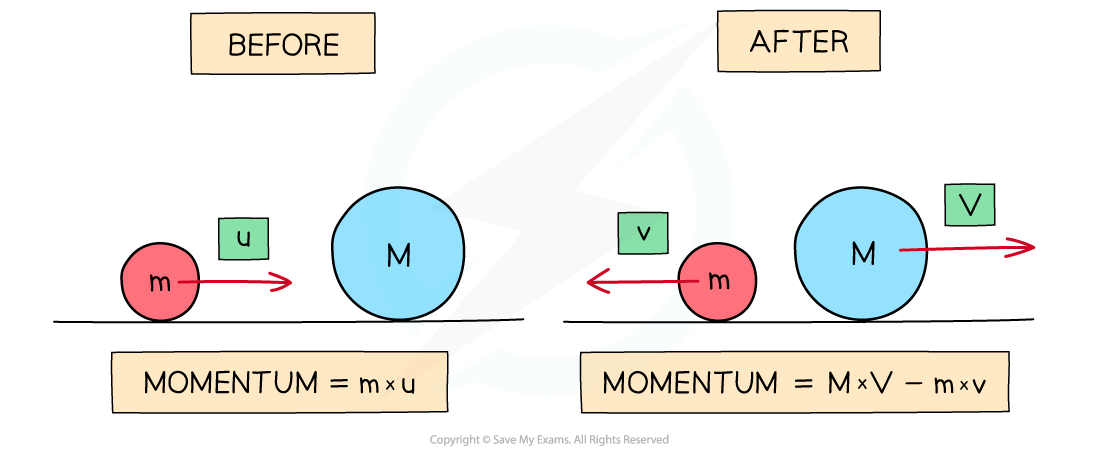
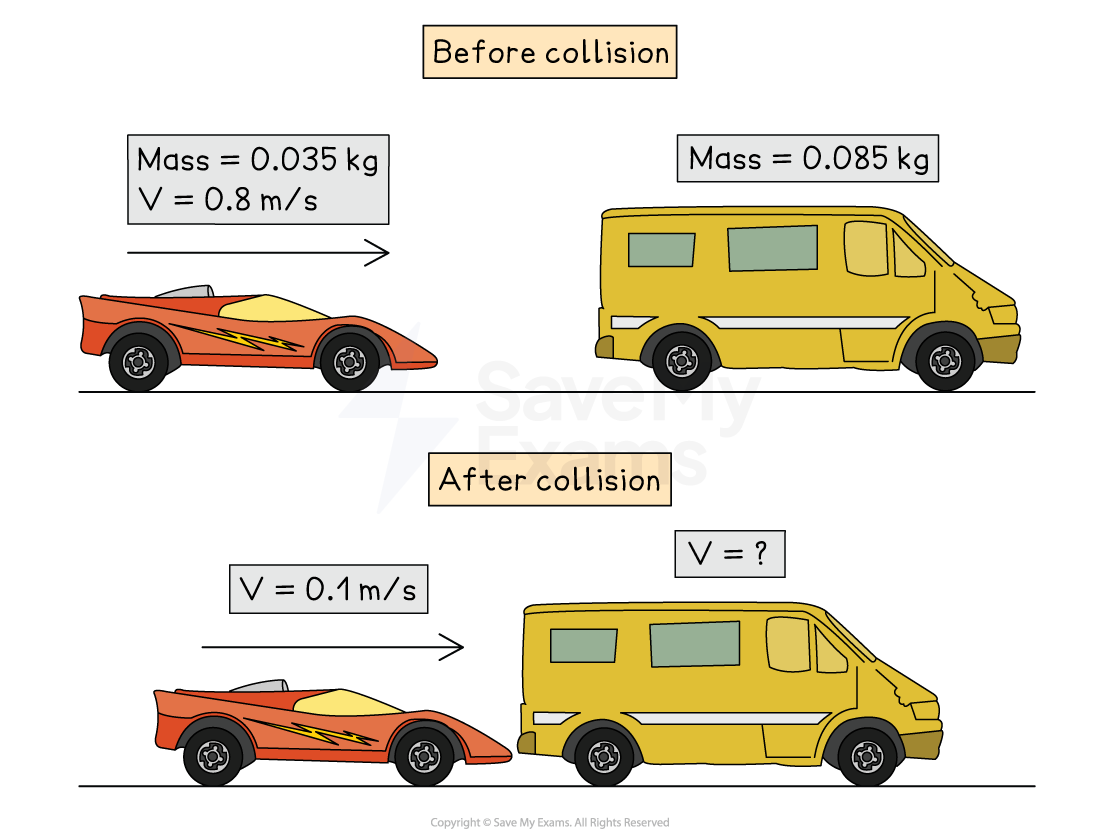
Momentum
2 guided lessons · 18 checks · 1. Forces & Motion → Momentum
Guided lessons for this note
Which concept don't you understand yet?
We'll explain it simply and check your understanding. Pick any lesson — any order works.
0 of 18 checks correct so far
Lesson 1 of 2
Calculating momentum
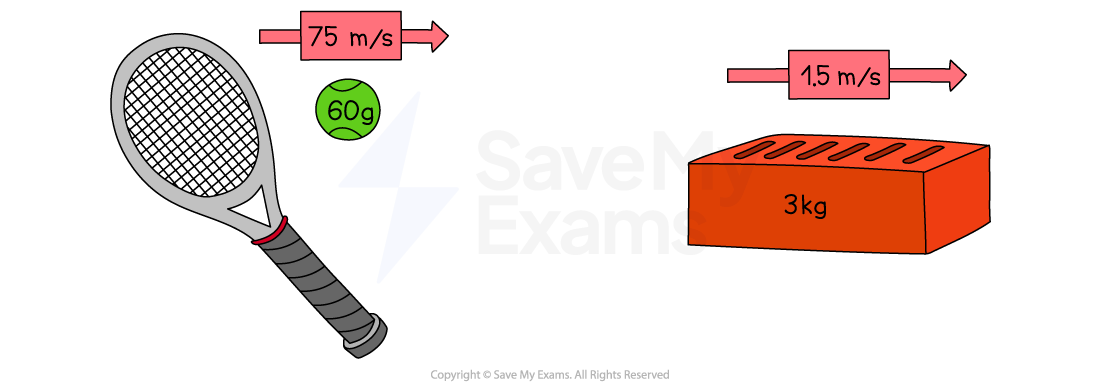
Picture a tennis ball flying at full speed and a heavy brick strolling along — which one is harder to stop? Physics answers with a single quantity that combines mass and velocity. In this lesson you give that quantity a name, a unit and an equation, and learn why its sign tracks direction.
What you know already
Every moving object carries a stored 'quantity of motion' that grows with both its mass and its speed. That single idea explains why a small, fast ball can land as hard as a slow, heavy truck. This note names the quantity, builds its equation, and then follows it unchanged through every collision and explosion.
Key points of understanding
- Momentum belongs to every moving object, and it is worked out by multiplying mass by velocity: p = m × v.
- Momentum is measured in kilogram metres per second (kg m/s), mass in kilograms and velocity in metres per second.
- A stationary object has zero velocity, so it carries no momentum at all.
- Because velocity is a vector, momentum depends on travel direction and can be positive or negative.
- With the usual sign choice, motion to the right counts as positive and motion to the left counts as negative.
- A large momentum makes an object stubborn: hard to slow down or steer onto a new path.
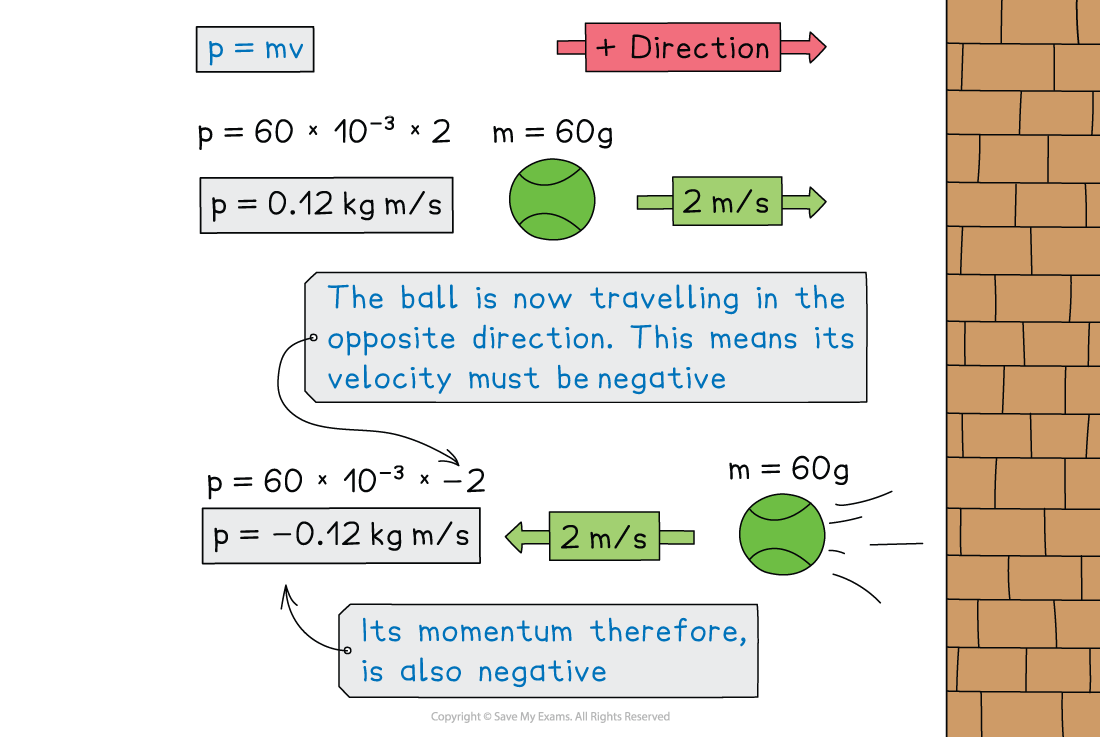
The momentum of the tennis ball is positive as it approaches the wall and negative after the collision as it moves in the opposite direction
Choose a confidence level to continue.
Prefer to read it all at once? Show the full lesson as a page
1.Calculating momentum
Picture a tennis ball flying at full speed and a heavy brick strolling along — which one is harder to stop? Physics answers with a single quantity that combines mass and velocity. In this lesson you give that quantity a name, a unit and an equation, and learn why its sign tracks direction.
The momentum of the tennis ball is positive as it approaches the wall and negative after the collision as it moves in the opposite direction
Key points
- Momentum belongs to every moving object, and it is worked out by multiplying mass by velocity: p = m × v.
Guided content from the SME authoring corpus — note rn_pqp4mfpHzGVtrjTT, pinned at 0cea83a78102 · promoted SyllabAI/syllabai-resources b3caaaa90c5e