Boyle's Law
1 guided lesson · 9 checks · 5. Solids, Liquids and Gases → Ideal Gases
Guided lessons for this note
Which concept don't you understand yet?
We'll explain it simply and check your understanding. Pick any lesson — any order works.
0 of 9 checks correct so far
Lesson 1 of 1
Boyle's law and its use
Halve the volume of a sealed gas at constant temperature and its pressure doubles; double the volume and it halves. The product pV is the invariant — a direct echo of collision frequency set by box size.
What you know already
Boyle's law is the squeeze law: for a fixed sample at constant temperature, pressure times volume never changes, so p1V1 = p2V2. Compress the gas and the pressure climbs in exact inverse proportion — and this note runs the calculation to a two-significant-figure finish.
Key points of understanding
- Boyle's law states p1V1 = p2V2 — for a sealed sample held at one steady temperature, the pressure–volume product never changes.
- Pressure and volume are inversely proportional at constant temperature.
- The temperature must be constant and the amount of gas fixed for the law to hold.
- Rearranged, p2 = p1V1/V2 gives the pressure after a volume change.
- A graph of pressure against volume is a falling curve; pressure against 1/volume is a straight line.
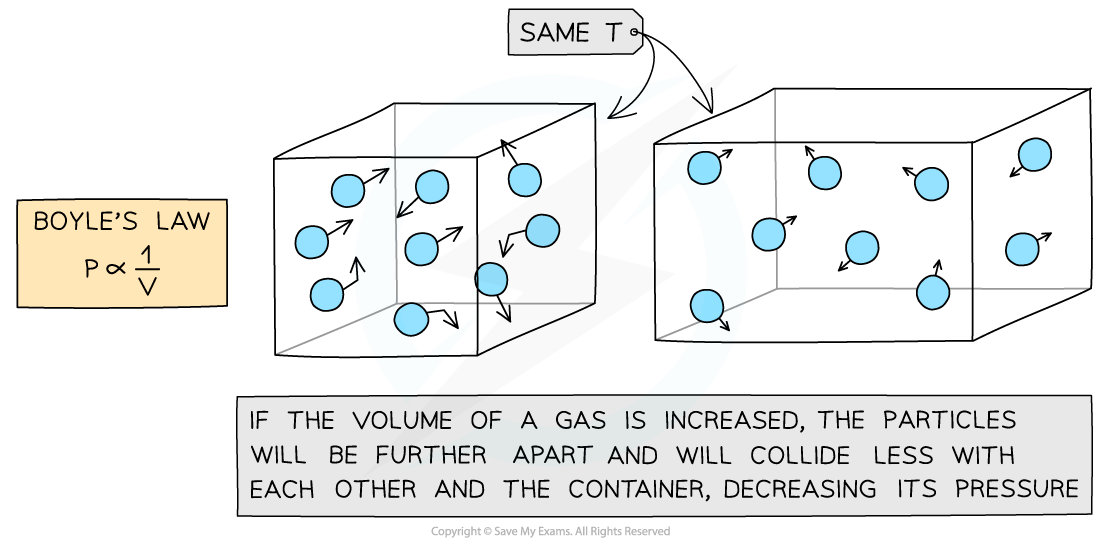
Increasing the volume of a gas decreases its pressure
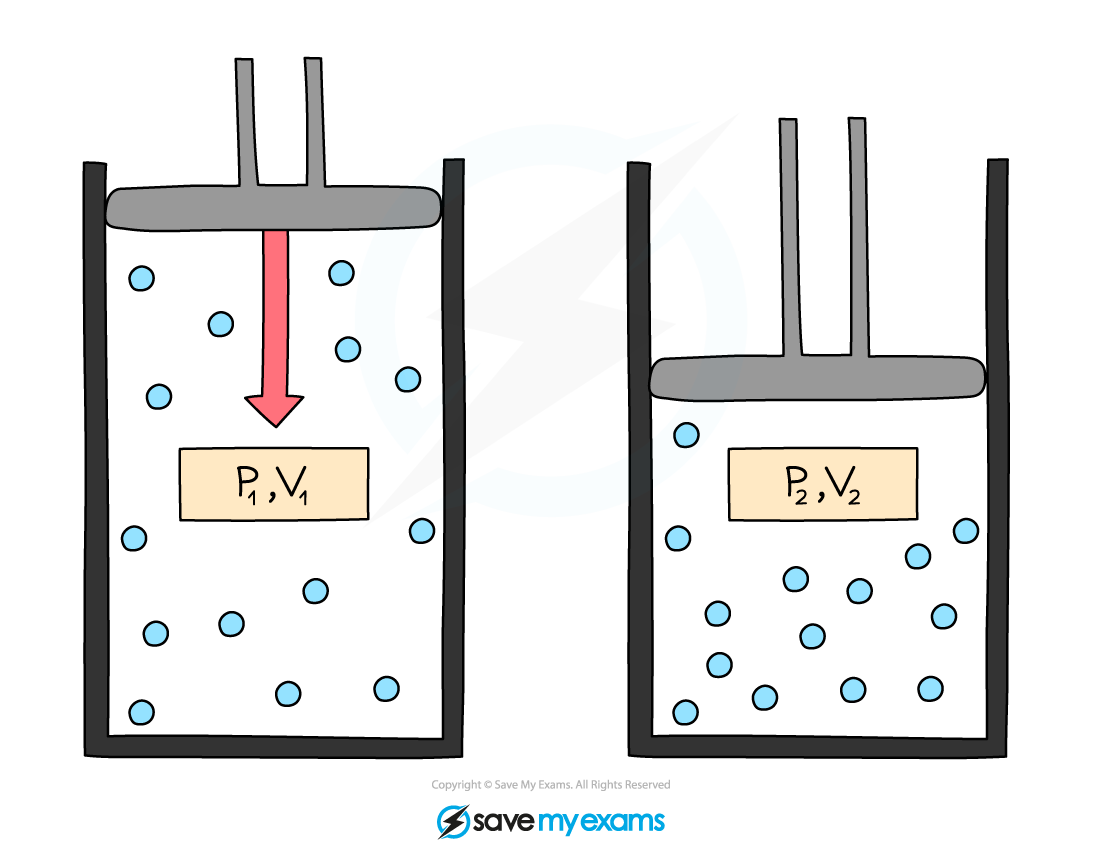
Initial pressure and volume, p1 and V1, and final pressure and volume, p2 and V2. When volume decreases, pressure increases
Choose a confidence level to continue.
Prefer to read it all at once? Show the full lesson as a page
1.Boyle's law and its use
Halve the volume of a sealed gas at constant temperature and its pressure doubles; double the volume and it halves. The product pV is the invariant — a direct echo of collision frequency set by box size.
Increasing the volume of a gas decreases its pressure
Initial pressure and volume, p1 and V1, and final pressure and volume, p2 and V2. When volume decreases, pressure increases
Key points
- Boyle's law states p1V1 = p2V2 — for a sealed sample held at one steady temperature, the pressure–volume product never changes.
Guided content from the SME authoring corpus — note rn_p8XznQx2MXjbvz38, pinned at 8788fc85a2c1 · promoted SyllabAI/syllabai-resources b3caaaa90c5e