Electrical Safety
3 guided lessons · 27 checks · 2. Electricity → Electrical Power & Mains Electricity
Guided lessons for this note
Which concept don't you understand yet?
We'll explain it simply and check your understanding. Pick any lesson — any order works.
0 of 27 checks correct so far
Lesson 1 of 3
Live hazards: damaged insulation, overheating & damp
Mains electricity does not need to be dramatic to be dangerous: even fifty volts can deliver a serious shock. The everyday hazards are few and predictable — broken insulation exposing live conductors, cables overheating under too much current, and moisture giving the current an unexpected path. Each has a matching defence later in this note.
What you know already
Mains electricity is powerful enough to kill, so domestic appliances carry a full set of protections. This note walks through the hazards — exposed conductors, overheating cables and damp — and then the defences: insulated and double-insulated casings, the earth wire, fuses and the resettable circuit breakers that guard modern homes.
Key points of understanding
- Mains electricity can kill: even a 50 V potential difference is a serious hazard.
- Touching exposed conductors through damaged insulation can give a lethal shock.
- Too much current in a thin or tightly coiled cable overheats it and can melt the insulation.
- Damp conditions let moisture conduct, short-circuiting devices or electrocuting users.
- Warning signs mark places where electrocution is a risk.
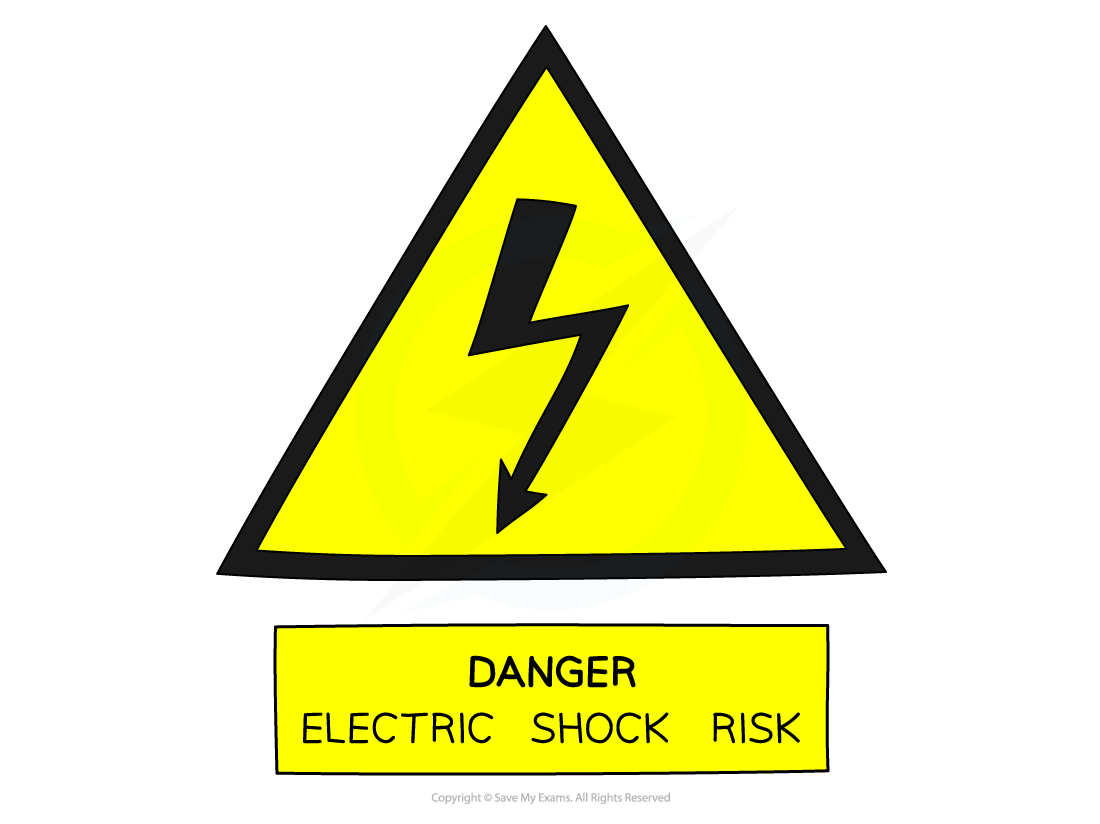
Signs, like the above, warn of the risk of electrocution
Choose a confidence level to continue.
Prefer to read it all at once? Show the full lesson as a page
1.Live hazards: damaged insulation, overheating & damp
Mains electricity does not need to be dramatic to be dangerous: even fifty volts can deliver a serious shock. The everyday hazards are few and predictable — broken insulation exposing live conductors, cables overheating under too much current, and moisture giving the current an unexpected path. Each has a matching defence later in this note.
Signs, like the above, warn of the risk of electrocution
Key points
- Mains electricity can kill: even a 50 V potential difference is a serious hazard.
- Touching exposed conductors through damaged insulation can give a lethal shock.
- Too much current in a thin or tightly coiled cable overheats it and can melt the insulation.
- Damp conditions let moisture conduct, short-circuiting devices or electrocuting users.
- Warning signs mark places where electrocution is a risk.
First pass
Broken cables, overheating and water are the three everyday ways mains electricity hurts people.
Analogy — A garden hose: split casing sprays you (exposed wire), kinking it overheats the pump (coiled cable), and puddles conduct (damp).
Exam pointer — Learn the three hazards by name — damaged insulation, overheating of cables, damp conditions.
Going deeper
Each hazard ends the same way: current reaches a person or a flammable material through a path that was never designed for it.
Analogy — Three loose guards on a machine — any one slipping lets the accident through a different gap.
Exam pointer — Link each hazard to a protection: insulation, correct current rating, and dry placement or RCD-style breakers.
Checks
0 of 9 attempted · 0 correct
2.Double insulation & earthing the metal case
Two different appliances need two different strategies. A plastic-cased device is protected twice over — insulated wires inside a non-metallic case — so it needs no earth connection. A metal-cased device instead relies on its earth wire: a ready-made escape route that turns any fault into a blown fuse rather than a live case.
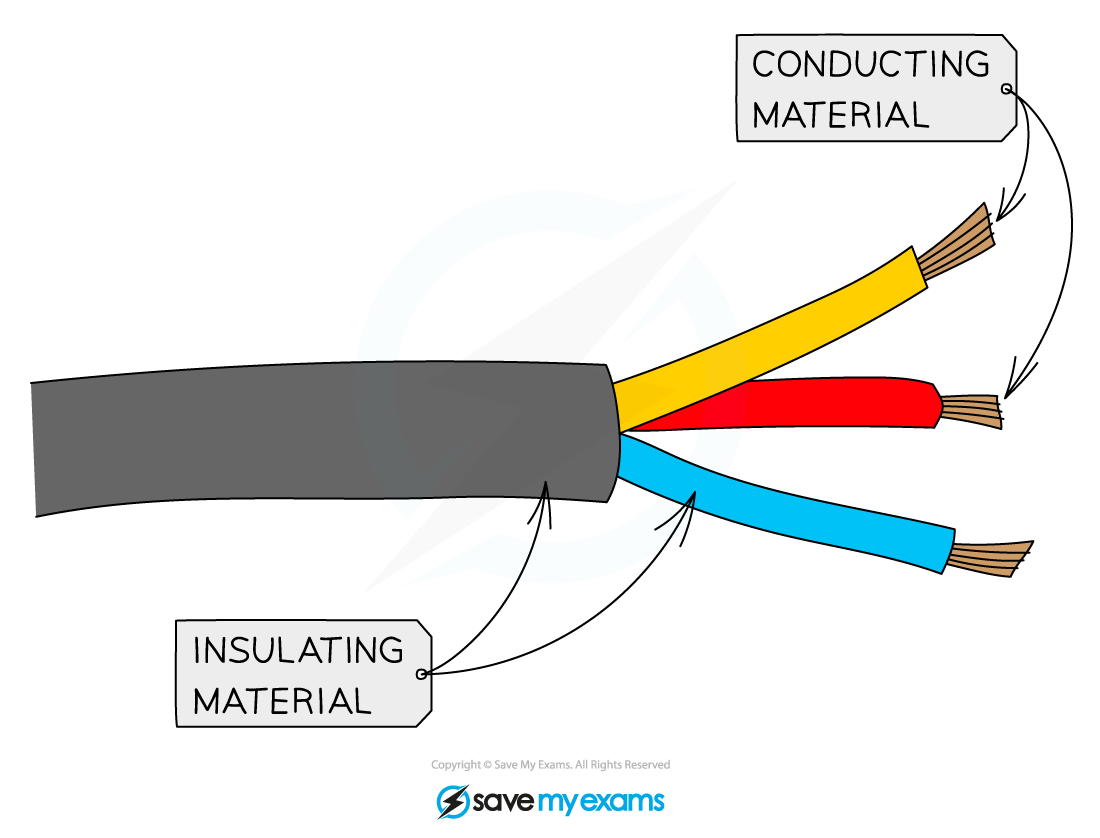
The conducting part of a wire is covered in an insulating material for safety
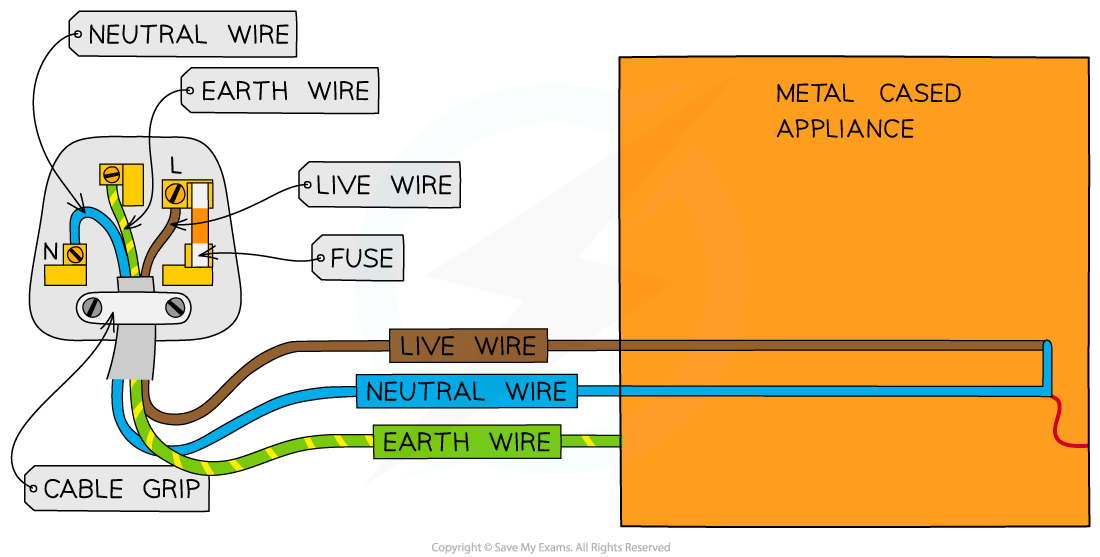
A diagram showing the three wires going to a mains powered appliance: live, neutral and earth
Key points
- Wires carry an insulating jacket, such as rubber, over their metal cores.
- A double insulated appliance has insulated wires plus a non-metallic case.
- Double insulated appliances need no earth wire.
- A metal case touched by a live wire would electrify the case and shock the user.
- The earth wire provides a low-resistance path that carries a fault surge to earth.
- That surge also runs through the live wire and melts the fuse, cutting the supply.
First pass
Plastic cases guard twice; metal cases rely on an earth wire that makes the fuse blow during a fault.
Analogy — Double insulation is a coat over a jumper; earthing is a lightning conductor bolted to the roof.
Exam pointer — Say why plastic cases need no earth — there is no exposed metal to become live.
Going deeper
Earthing converts a latent hazard into a fast circuit failure: the fault current surges down the earth path, and the same surge in the live wire opens the fuse.
Analogy — A fire drill: the alarm (surge) rings through both the escape route (earth) and the control desk (fuse), shutting the building.
Exam pointer — Sequence answers: case becomes live, surge flows to earth, fuse melts, supply cut.
Checks
0 of 9 attempted · 0 correct
3.Fuses & circuit breakers
Both fuses and circuit breakers cut the supply when the current outruns the safe value, but they do it differently: a fuse sacrifices a thin wire once, while a circuit breaker trips an electromagnet switch and can be reset. That speed and reusability is why breakers now guard entire homes.
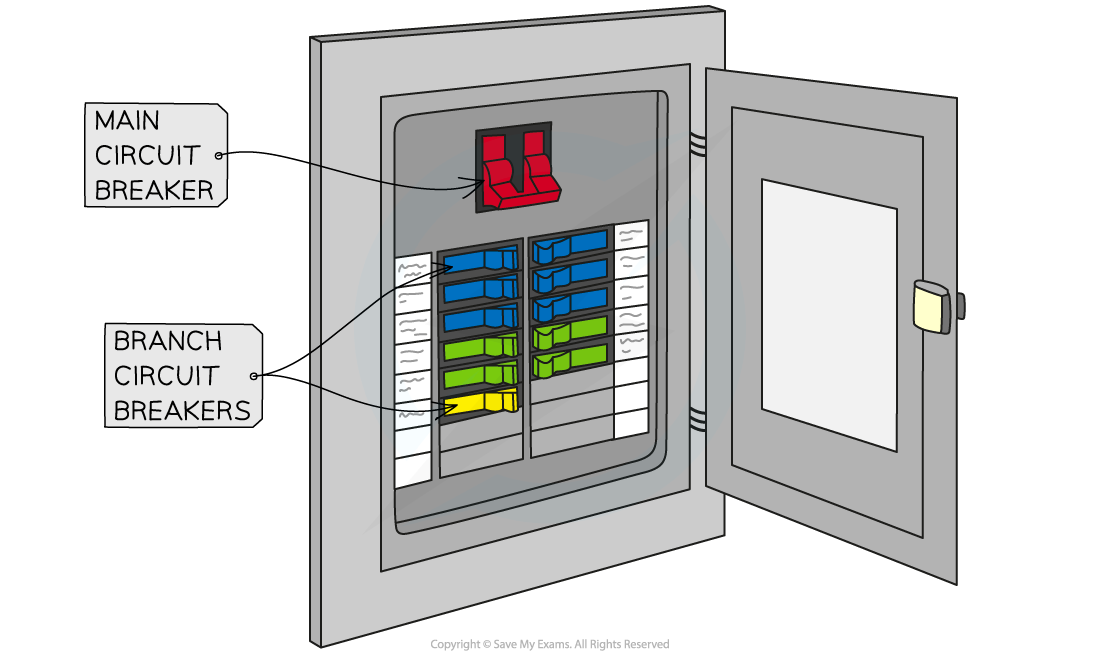
The main circuit breaker can quickly shut off electricity to the whole house. The branch circuit breakers can shut off electricity to specific areas of the house
Key points
- Both fuses and circuit breakers cut the supply when the current grows too large.
- A fuse is a glass cylinder holding a thin wire that melts once.
- A circuit breaker is an automatic electromagnet switch that trips above a set current.
- Breakers reset and act faster, so they protect homes better than fuses.
- The household 'fuse box' actually holds circuit breakers.
First pass
A fuse melts once and is replaced; a breaker trips, resets, and works again.
Analogy — A fuse is a one-time crumple zone; a breaker is a rubber bumper that springs back.
Exam pointer — Comparison questions want both differences: speed and reusability.
Going deeper
The breaker's electromagnet responds to the magnetic pull of a large current in milliseconds, long before heating could melt a fuse wire.
Analogy — A tripwire versus a security guard: the tripwire is spent after one event, the guard simply resets the door.
Exam pointer — Do not confuse the roles: the fuse wire melts, the breaker's contacts separate mechanically.
Checks
0 of 9 attempted · 0 correct
Guided content from the SME authoring corpus — note rn_kxw7Ms4Pr7dQJykY, pinned at 502107a3fcac · promoted SyllabAI/syllabai-resources b3caaaa90c5e