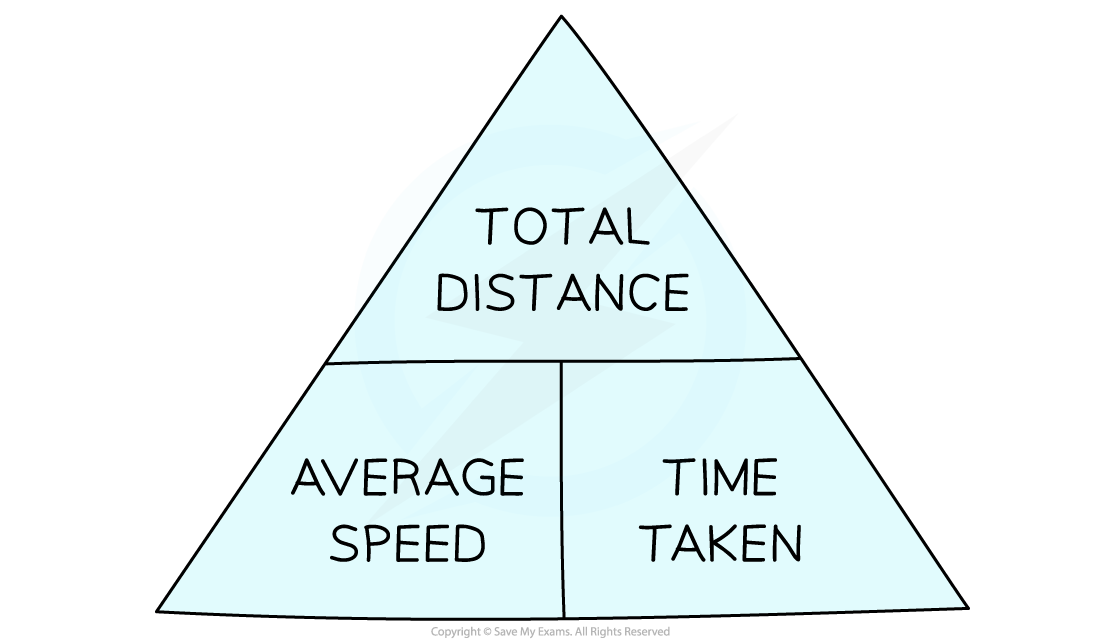
Speed
2 guided lessons · 18 checks · 1. Forces & Motion → Movement & Position
Guided lessons for this note
Which concept don't you understand yet?
We'll explain it simply and check your understanding. Pick any lesson — any order works.
0 of 18 checks correct so far
Lesson 1 of 2
Average speed and the speed equation
A trip rarely keeps one pace from start to finish, so physicists summarise it with a single value: the distance covered in each second of the whole journey. This lesson fixes the relationship among distance moved, time taken and average speed, and shows why that summary counts as a scalar.
What you know already
Every journey has one number that sums it up: the average speed. You already met this relationship for steady motion; here it becomes the working tool for whole trips where the pace rises and falls. This lesson builds the equation, its units, and the triangle trick that rearranges it in seconds.
Key points of understanding
- Average speed is worked out from the whole trip: the full distance moved split by the full time taken.
- Speed is a scalar quantity, so it states a magnitude only and never a direction.
- Instantaneous pace can rise and fall during a journey, which is why the trip-wide average is the useful summary.
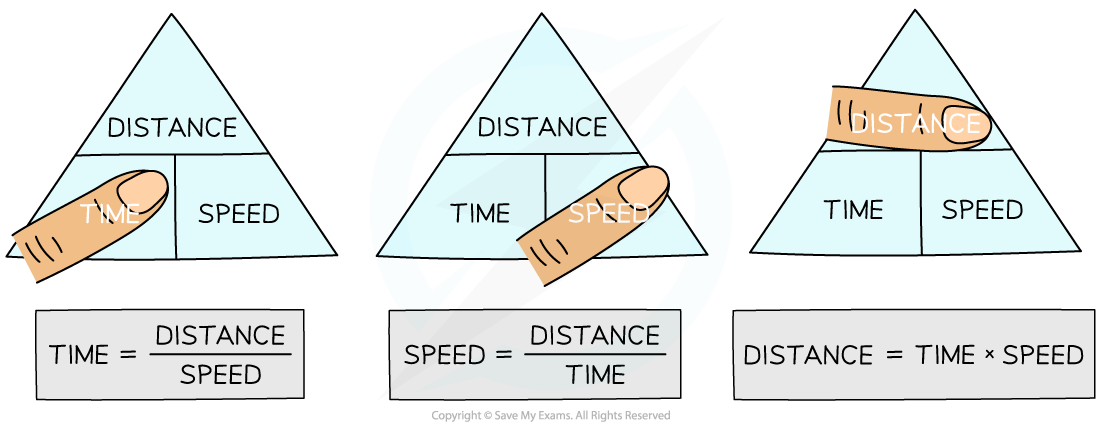
- In standard units the relationship reads distance moved over time taken, giving metres per second (m/s).
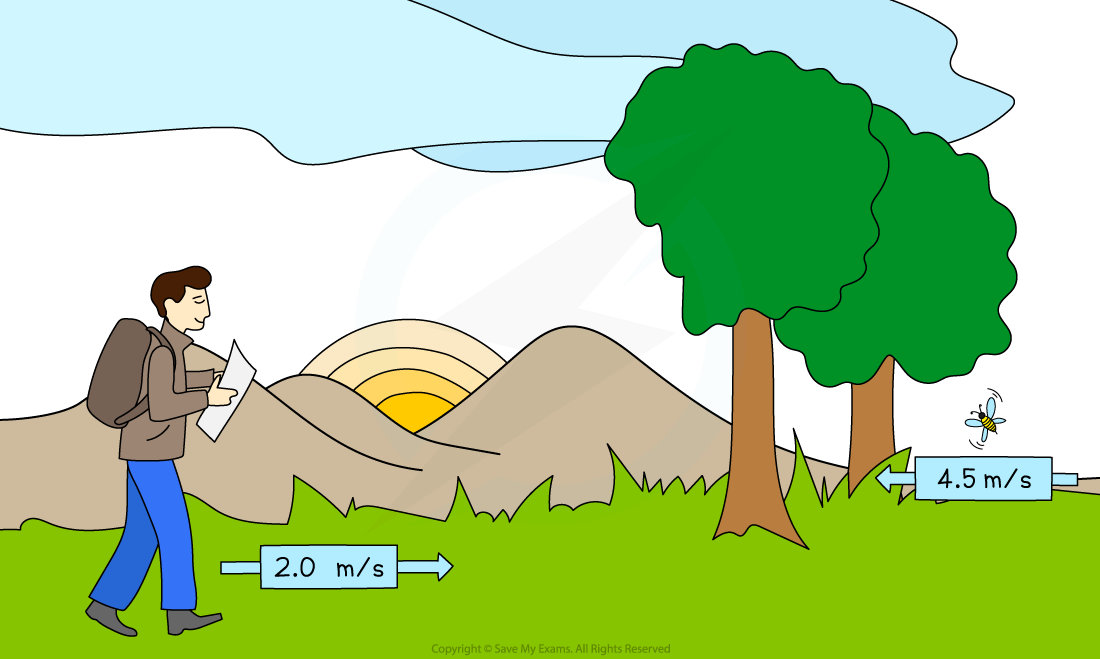
A hiker might have an average speed of 2.0 m/s, whereas a particularly excited bumble bee can have average speeds of up to 4.5 m/s
Choose a confidence level to continue.
Prefer to read it all at once? Show the full lesson as a page
1.Average speed and the speed equation
A trip rarely keeps one pace from start to finish, so physicists summarise it with a single value: the distance covered in each second of the whole journey. This lesson fixes the relationship among distance moved, time taken and average speed, and shows why that summary counts as a scalar.
A hiker might have an average speed of 2.0 m/s, whereas a particularly excited bumble bee can have average speeds of up to 4.5 m/s
Key points
- Average speed is worked out from the whole trip: the full distance moved split by the full time taken.
- Speed is a scalar quantity, so it states a magnitude only and never a direction.
- Instantaneous pace can rise and fall during a journey, which is why the trip-wide average is the useful summary.
Guided content from the SME authoring corpus — note rn_k9wr3prcgSBg5vfw, pinned at aa6485187429 · promoted SyllabAI/syllabai-resources b3caaaa90c5e