The Doppler Effect
1 guided lesson · 9 checks · 3. Waves → Waves & The Electromagnetic Spectrum
Guided lessons for this note
Which concept don't you understand yet?
We'll explain it simply and check your understanding. Pick any lesson — any order works.
0 of 9 checks correct so far
Lesson 1 of 1
The Doppler effect
A stationary siren pushes out wavefronts evenly in every direction, so everyone nearby hears the same pitch. Let the siren drive past and the picture skews: wavefronts pile up ahead of the motion and stretch out behind it. Observers therefore hear a higher pitch as it approaches and a lower pitch once it recedes, which is the Doppler effect.
What you know already
You already know that a wave carries a fixed frequency from its source and that speed depends on the medium. Put a moving source into that picture and the pattern bends: observers ahead and behind disagree about the pitch they hear. This lesson names that disagreement the Doppler effect and explains it with wavefronts.
Key points of understanding
- The Doppler effect is the apparent change in observed wavelength and frequency from a moving source.
- A stationary source emits wavefronts that spread out symmetrically.
- Ahead of a moving source, wavefronts bunch so the wavelength appears shorter and the frequency higher.
- Behind a moving source, wavefronts stretch so the wavelength appears longer and the frequency lower.
- The speed of the emitted waves stays constant; only the observed wavelength and frequency shift.
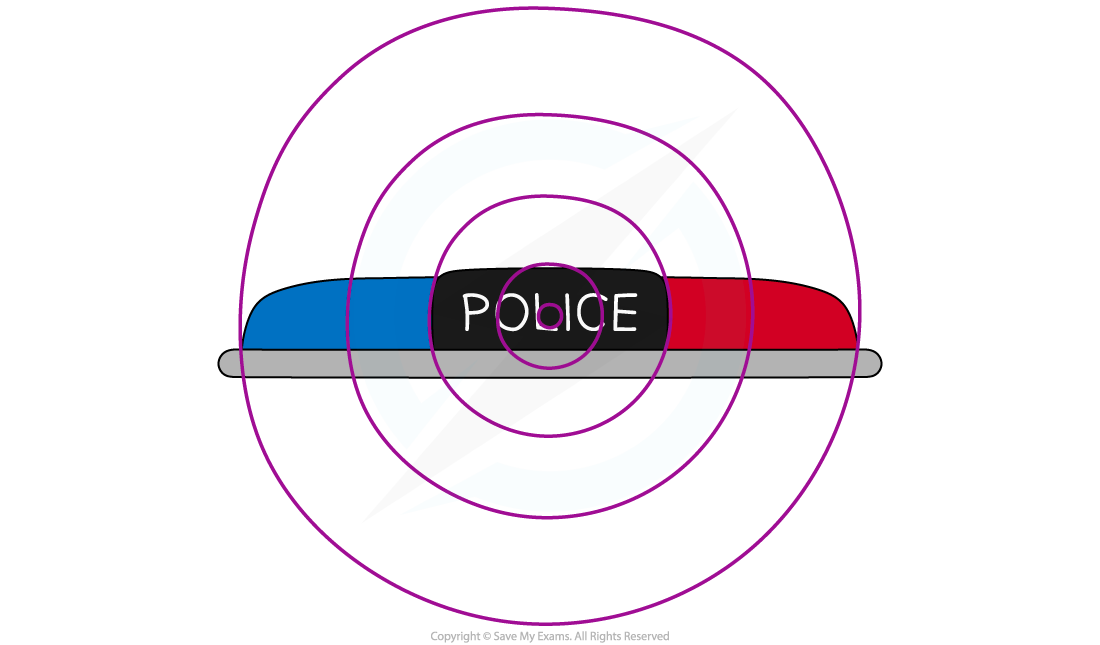
This stationary police car emits sound from the siren and the waves spread out symmetrically
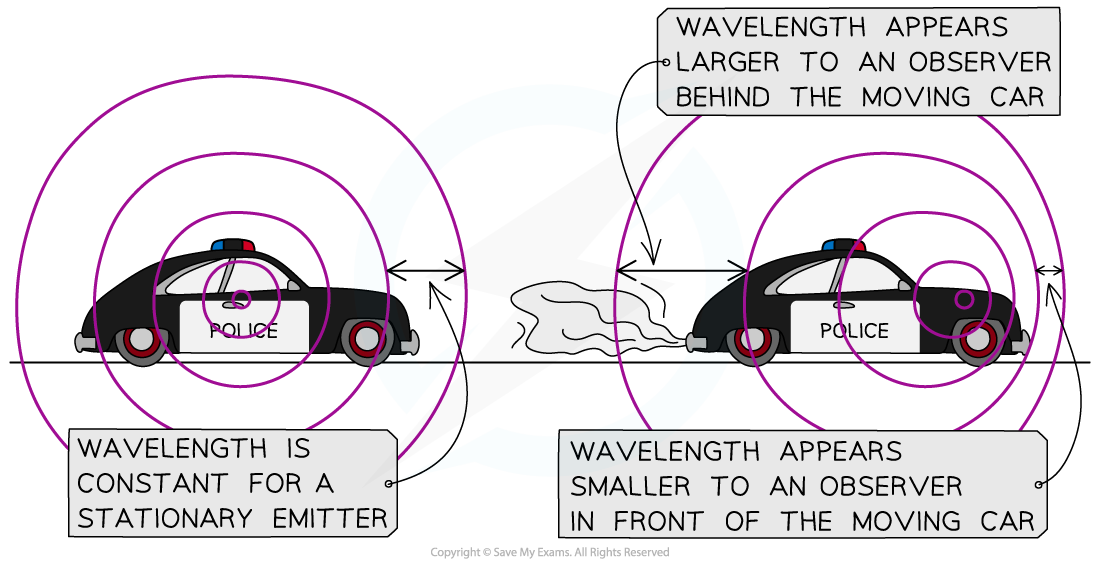
To an observer in front of the moving car, the wavelength appears smaller because they squash together. To an observer behind the moving car, the waves appear to stretch out
Choose a confidence level to continue.
Prefer to read it all at once? Show the full lesson as a page
1.The Doppler effect
A stationary siren pushes out wavefronts evenly in every direction, so everyone nearby hears the same pitch. Let the siren drive past and the picture skews: wavefronts pile up ahead of the motion and stretch out behind it. Observers therefore hear a higher pitch as it approaches and a lower pitch once it recedes, which is the Doppler effect.
This stationary police car emits sound from the siren and the waves spread out symmetrically
To an observer in front of the moving car, the wavelength appears smaller because they squash together. To an observer behind the moving car, the waves appear to stretch out
Key points
Guided content from the SME authoring corpus — note rn_ctTgFb5NSQTSQVSP, pinned at dad406f1ecd8 · promoted SyllabAI/syllabai-resources b3caaaa90c5e