Power
2 guided lessons · 18 checks · 4. Energy Resources and Energy Transfers → Work, Power & Energy Resources
Guided lessons for this note
Which concept don't you understand yet?
We'll explain it simply and check your understanding. Pick any lesson — any order works.
0 of 18 checks correct so far
Lesson 1 of 2
Power as the rate of doing work
Power measures how quickly energy moves, not how much moves in total. Two machines can deliver identical amounts of energy, yet the more powerful one finishes sooner — that speed of delivery is the whole definition.
What you know already
The same job done faster is a more powerful machine. These lessons define power as the rate of energy transfer, walk the ratings scale from torches to power stations, and practise the power equation in both directions.
Key points of understanding
- Power is work done per unit time, and therefore energy transferred per unit time.
- Machines such as car engines transfer energy between stores continuously over time.
- Two vehicles can do the same work; the more powerful one completes it in a shorter time.
- Two motors lifting the same weight the same height differ in power if one lifts faster.
- Power ratings on appliances state the energy transferred each second, from watts to megawatts.
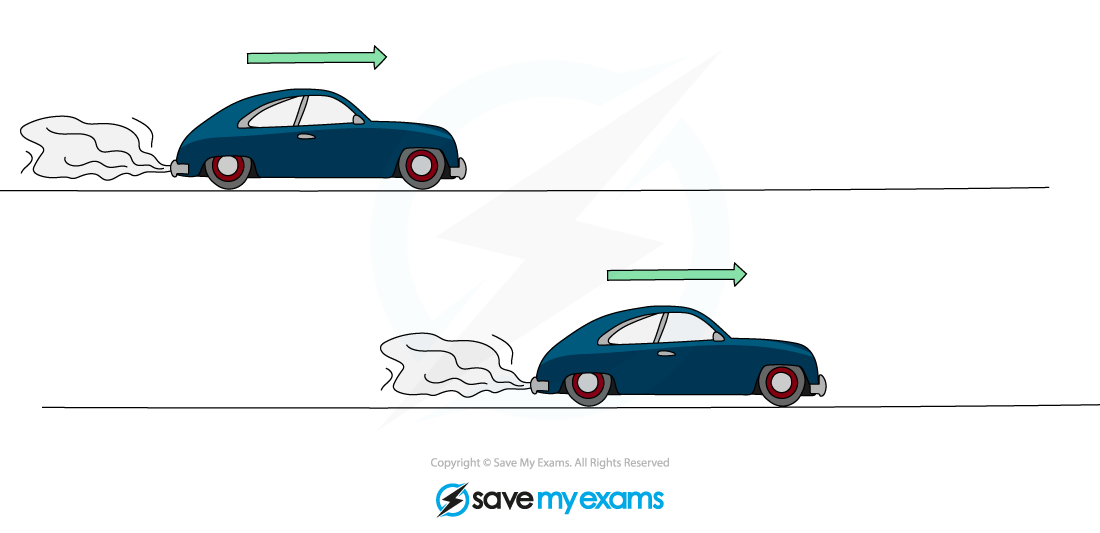
Two cars accelerate to the same final speed, but the one with the most power will reach that speed sooner.
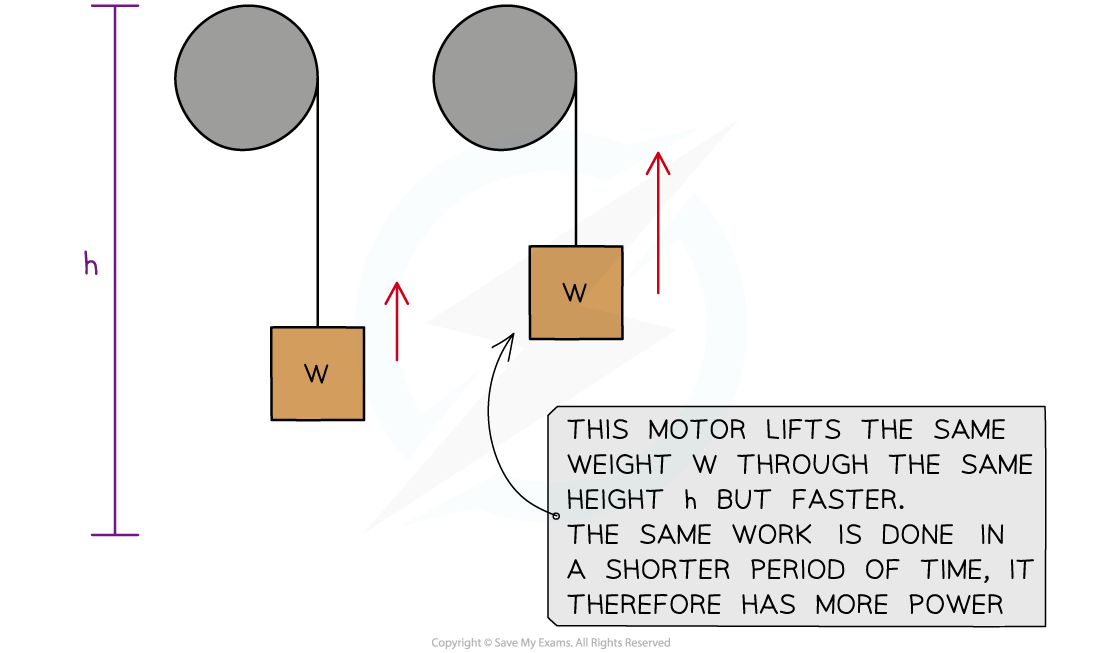
Two motors with different powers
Choose a confidence level to continue.
Prefer to read it all at once? Show the full lesson as a page
1.Power as the rate of doing work
Power measures how quickly energy moves, not how much moves in total. Two machines can deliver identical amounts of energy, yet the more powerful one finishes sooner — that speed of delivery is the whole definition.
Two cars accelerate to the same final speed, but the one with the most power will reach that speed sooner.
Two motors with different powers
Key points
- Power is work done per unit time, and therefore energy transferred per unit time.
- Machines such as car engines transfer energy between stores continuously over time.
- Two vehicles can do the same work; the more powerful one completes it in a shorter time.
- Two motors lifting the same weight the same height differ in power if one lifts faster.
- Power ratings on appliances state the energy transferred each second, from watts to megawatts.
First pass
Power is a pace, not a pile: the same sack of energy delivered in half the time means double the power. A torch trickles joules, an oven pours them, a power station floods them.
Analogy — Two gardeners moving the same pile of bricks: the faster one earns the same wage in half the shift — their hourly rate is their power.
Exam pointer — When comparing machines, hold the energy or work fixed and let the time differ — that is what isolates power in an exam description.
Going deeper
Power is defined as the rate of energy transfer, equivalently the rate of doing work: identical transfers over different durations carry different powers. Ratings express that rate — a 10 kW oven transfers ten thousand joules every second it runs.
Analogy — A tap's flow rate: two tanks can end with the same water, but the wider tap filled in less time — flow rate is to water what power is to energy.
Exam pointer — Quote power in watts and convert kilowatts and megawatts before any equation work — 1 kW = 1000 W, 1 MW = 1 000 000 W.
Checks
0 of 9 attempted · 0 correct
2.Calculating power
The power equation connects three everyday quantities: the work done, the time taken and the rate — power itself. A formula triangle handles every rearrangement, whether a question hides the power, the energy or the time.
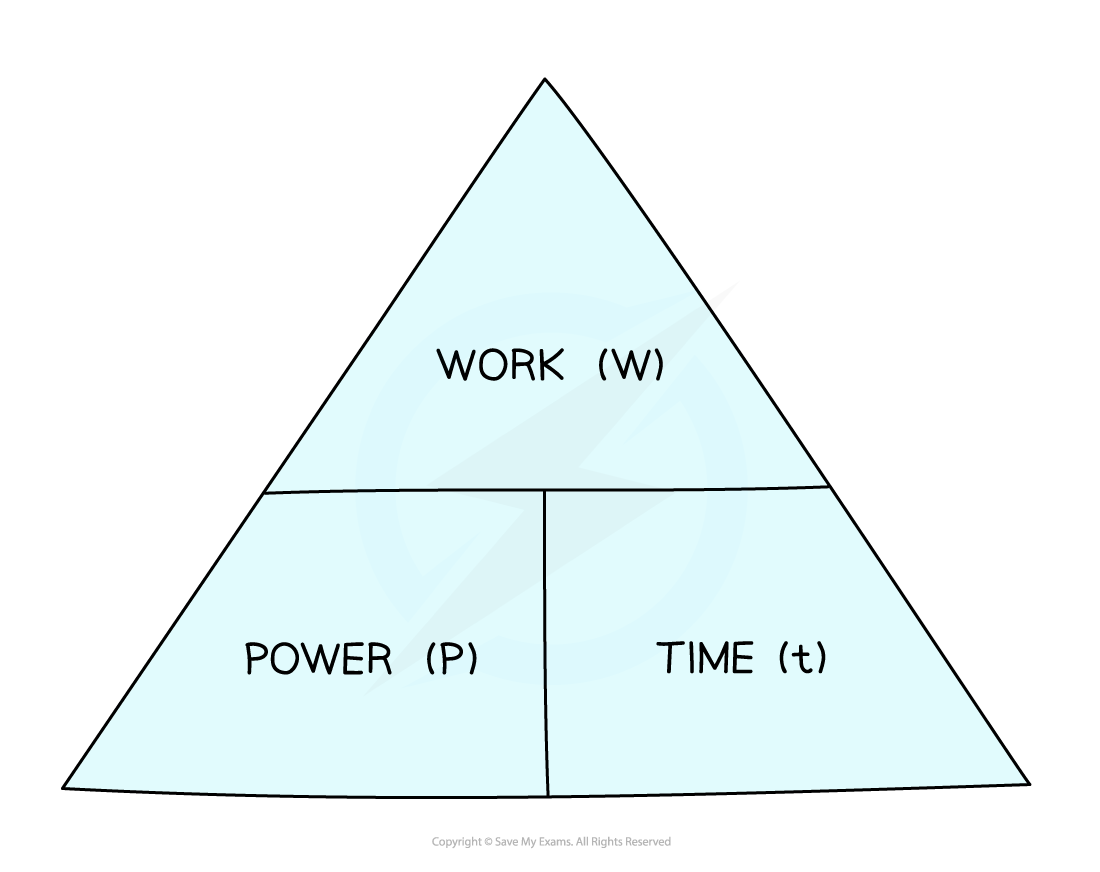
The formula triangle can be used to rearrange the equation
Key points
- P = W ÷ t, with power in watts, work done in joules and time in seconds.
- Rearranged, the work done equals power multiplied by time, and time equals work done divided by power.
- A formula triangle covering P, W or t reproduces each rearrangement of the equation.
- Time must enter the equation in seconds for the power to come out in watts.
First pass
Divide the joules by the seconds and you have the watts. Hide P on the triangle and W over t appears; hide W and P next to t multiplies; hide t and W over P divides.
Analogy — A pay cheque: total earned (joules) divided by hours worked (seconds) gives the hourly rate (watts) — and the triangle rearranges for whichever of the three the question hides.
Exam pointer — Convert minutes to seconds before dividing — the classic slip is using 5 instead of 300 for a five-minute appliance.
Going deeper
The equation P = W/t prices energy transfer per second: W in joules (or newton-metres), t in seconds, P in watts. The triangle encodes W = Pt, P = W/t and t = W/P for the quantity a question withholds.
Analogy — A currency converter with three windows: cover the one you need and the other two show whether to multiply or divide.
Exam pointer — Annotate every value with its unit before substituting — mixed units (minutes, kilojoules) are how power answers go wrong.
Checks
0 of 9 attempted · 0 correct
Guided content from the SME authoring corpus — note rn_bktjjV5hs9qSQQDS, pinned at c40b8b284935 · promoted SyllabAI/syllabai-resources b3caaaa90c5e