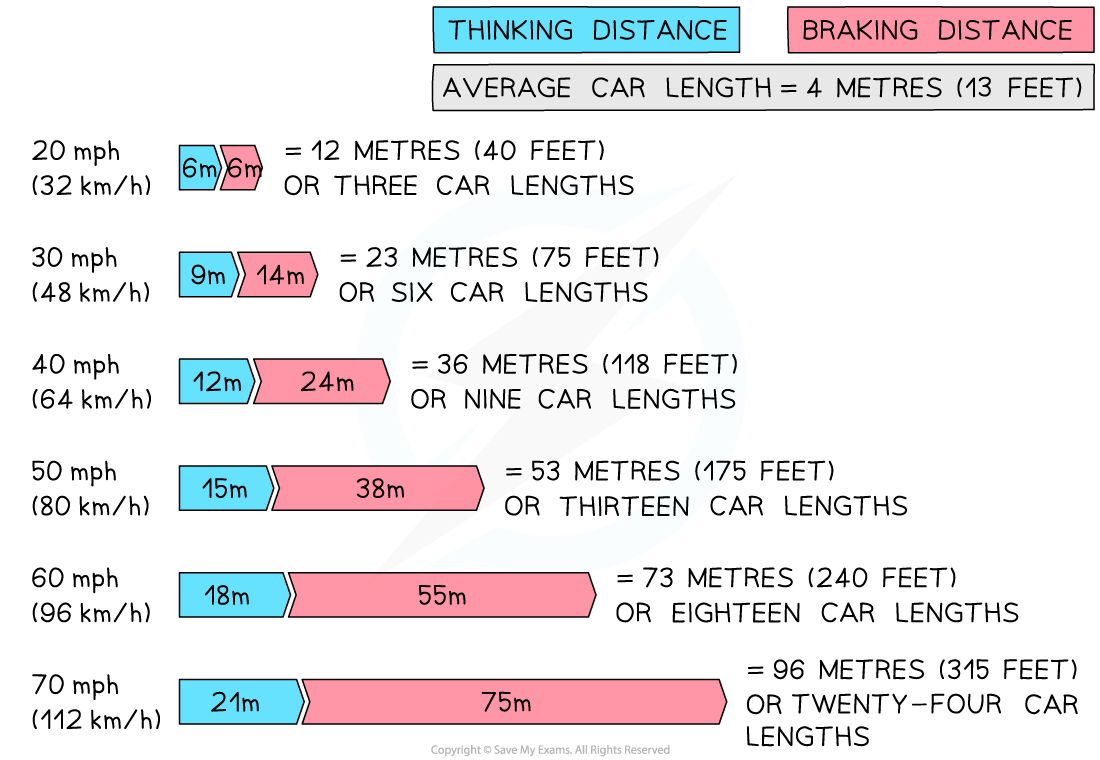
Stopping Distance
2 guided lessons · 18 checks · 1. Forces & Motion → Forces, Movement & Changing Shape
Guided lessons for this note
Which concept don't you understand yet?
We'll explain it simply and check your understanding. Pick any lesson — any order works.
0 of 18 checks correct so far
Lesson 1 of 2
Thinking distance and braking distance
From hazard to halt, the car covers two distances for two reasons. First the driver reacts — the thinking distance; then the brakes bite — the braking distance. The stopping distance is their sum, and the highway data shows how steeply that sum climbs with speed.
What you know already
An emergency stop happens in two acts: the driver's reaction, then the brakes' work. Each act consumes road, and their sum decides whether the vehicle stops in time. This note splits the total into its two distances, then lists the factors that stretch either half.
Key points of understanding
- Stopping distance = thinking distance + braking distance.
- Thinking distance is the distance travelled while the driver reacts to the hazard and prepares to stop.
- The average human reaction time is about 0.25 s, and it lengthens with tiredness, distractions, alcohol or drugs.
- Braking distance is the distance travelled under the braking force.
- For a given braking force, the greater the speed, the greater the stopping distance.
Choose a confidence level to continue.
Prefer to read it all at once? Show the full lesson as a page
1.Thinking distance and braking distance
From hazard to halt, the car covers two distances for two reasons. First the driver reacts — the thinking distance; then the brakes bite — the braking distance. The stopping distance is their sum, and the highway data shows how steeply that sum climbs with speed.
Key points
- Stopping distance = thinking distance + braking distance.
- Thinking distance is the distance travelled while the driver reacts to the hazard and prepares to stop.
- The average human reaction time is about 0.25 s, and it lengthens with tiredness, distractions, alcohol or drugs.
- Braking distance is the distance travelled under the braking force.
- For a given braking force, the greater the speed, the greater the stopping distance.
Guided content from the SME authoring corpus — note rn_ZCGJsYwy6S6FbbbW, pinned at bfae99778094 · promoted SyllabAI/syllabai-resources b3caaaa90c5e