The Pressure Law
1 guided lesson · 9 checks · 5. Solids, Liquids and Gases → Ideal Gases
Guided lessons for this note
Which concept don't you understand yet?
We'll explain it simply and check your understanding. Pick any lesson — any order works.
0 of 9 checks correct so far
Lesson 1 of 1
The pressure law and its use
One law, one condition set, one trap: for a fixed mass at constant volume, pressure is proportional to kelvin temperature, so p1/T1 = p2/T2. The trap is Celsius — converting to kelvin is not optional, it is the law's grammar.
What you know already
For a sealed, rigid container of gas, pressure and kelvin temperature rise and fall together in strict proportion: p1/T1 = p2/T2. This note puts the law to work on a bicycle tyre and a hot cylinder, with the kelvin conversion done before any substitution — the law's one non-negotiable.
Key points of understanding
- The pressure law states p1/T1 = p2/T2 — with the sample sealed and the volume rigid, pressure divided by kelvin temperature stays constant.
- Pressure and kelvin temperature are directly proportional at constant volume.
- Temperatures must be converted to kelvin before any substitution into the law.
- Rearranged, p2 = p1 × T2/T1 gives the new pressure after a temperature change.
- A graph of pressure against kelvin temperature is a straight line through the origin.
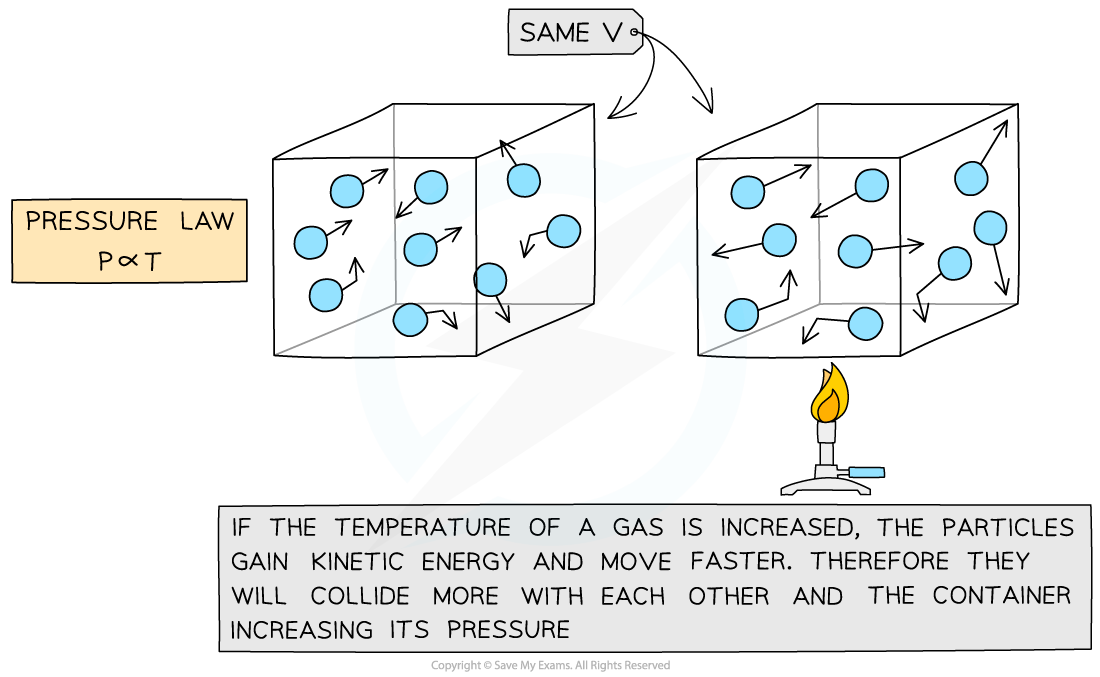
Pressure and temperature are proportional. Doubling temperature also doubles the pressure for a gas in a fixed volume.
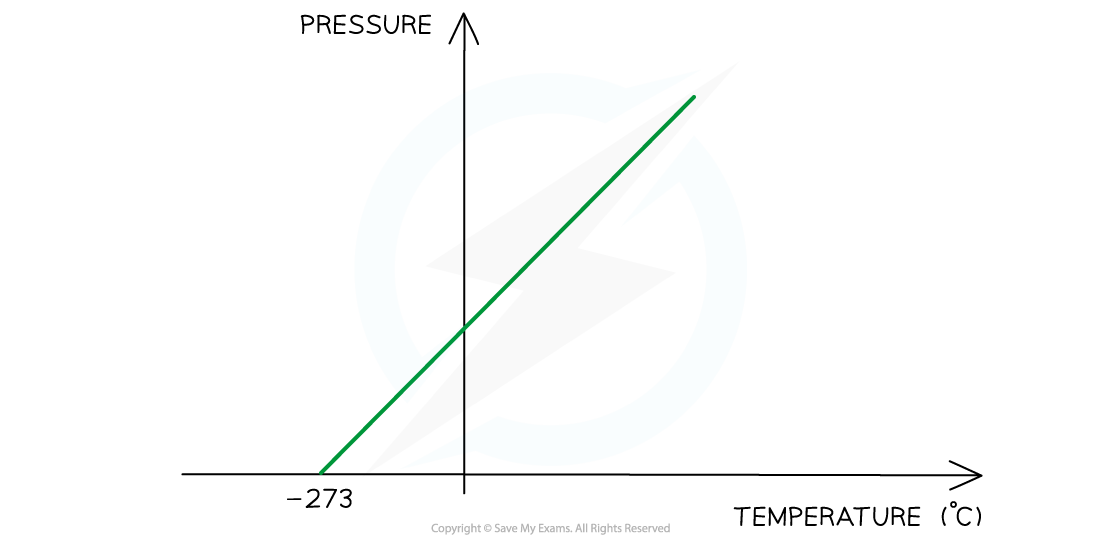
Pressure law graph representing temperature (in °C) directly proportional to the volume
Choose a confidence level to continue.
Prefer to read it all at once? Show the full lesson as a page
1.The pressure law and its use
One law, one condition set, one trap: for a fixed mass at constant volume, pressure is proportional to kelvin temperature, so p1/T1 = p2/T2. The trap is Celsius — converting to kelvin is not optional, it is the law's grammar.
Pressure and temperature are proportional. Doubling temperature also doubles the pressure for a gas in a fixed volume.
Pressure law graph representing temperature (in °C) directly proportional to the volume
Key points
- The pressure law states p1/T1 = p2/T2 — with the sample sealed and the volume rigid, pressure divided by kelvin temperature stays constant.
- Pressure and kelvin temperature are directly proportional at constant volume.
- Temperatures must be converted to kelvin before any substitution into the law.
- Rearranged, p2 = p1 × T2/T1 gives the new pressure after a temperature change.
- A graph of pressure against kelvin temperature is a straight line through the origin.
First pass
In a sealed rigid container, double the kelvin temperature and the pressure doubles; halve it and the pressure halves. Write the law as pressure divided by temperature staying constant and solve for the unknown.
Analogy — A seesaw pinned at one end: load (pressure) and arm length (kelvin temperature) stay in the same ratio no matter where you set them.
Exam pointer — Convert to kelvin first, then substitute — writing 27 °C as 27 K is the classic full-mark-to-zero error on this law.
Going deeper
The law is the quantitative form of the kinetic argument at fixed volume: mean molecular kinetic energy scales with kelvin temperature, so both the impulse per wall impact and the collision frequency scale with T, making pressure proportional to T. The ratio form p1/T1 = p2/T2 is just the proportionality constant cancelling between two states of the same sealed sample.
Analogy — A fixed-fee taxi whose fare per minute never changes: total fare divided by journey time is the same constant on every trip, so any two trips give the ratio equation.
Exam pointer — Quote the proportionality — P ∝ T (kelvin, fixed volume) — in explanations, then deploy the ratio form for calculations; mixing the narrative and the algebra loses structure marks.
Checks
0 of 9 attempted · 0 correct
Guided content from the SME authoring corpus — note rn_VrW4vQKk2VCQ2sQd, pinned at 8788fc85a2c1 · promoted SyllabAI/syllabai-resources b3caaaa90c5e